
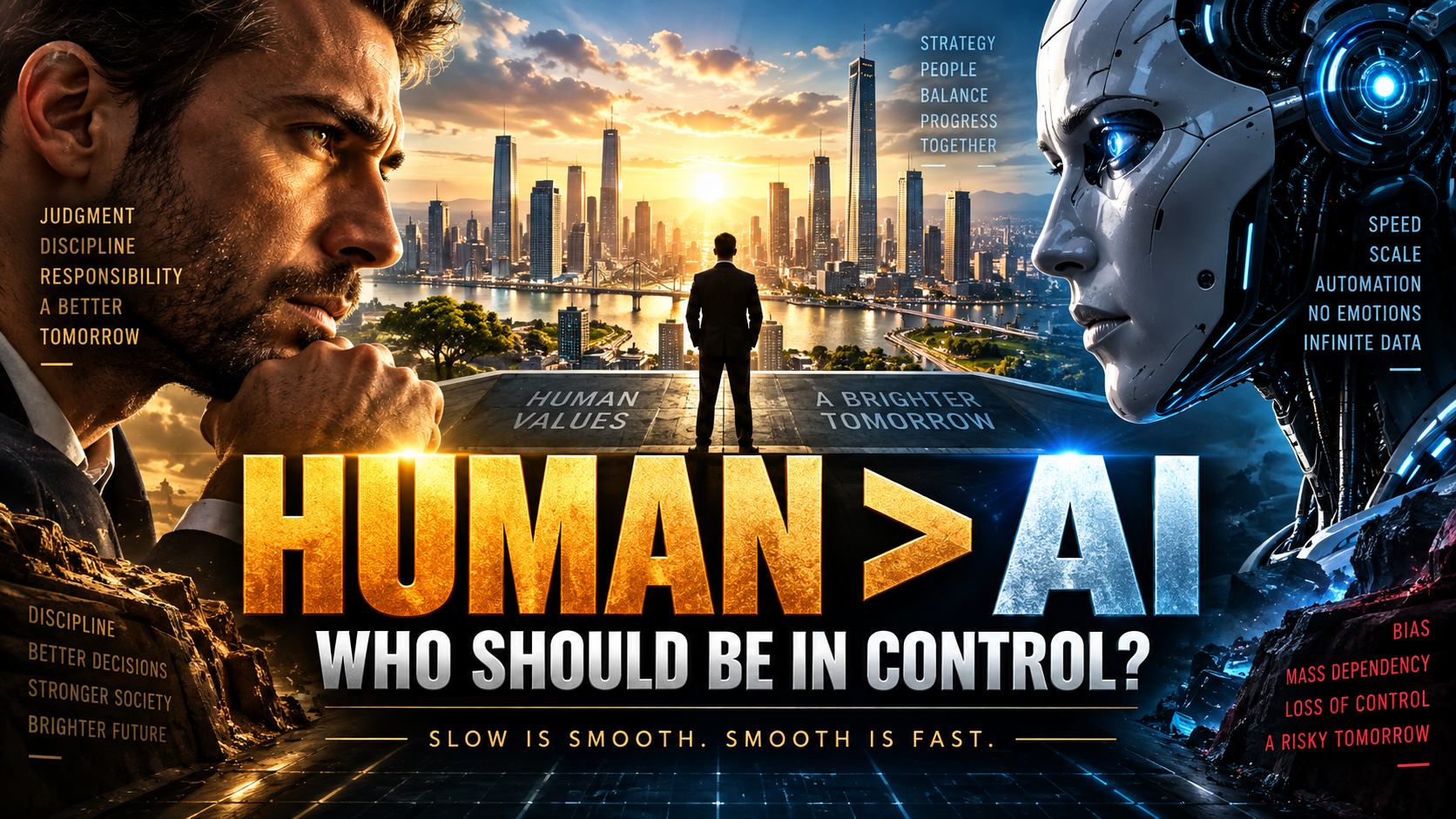
Slow Is Smooth. Smooth Is Fast. And the Future of AI Must Remain Human.
Artificial intelligence may become faster than us at thousands of tasks.
It can search millions of documents, generate software, analyze patterns, summarize research, create images, model scenarios and produce answers in seconds.
But speed is not wisdom.
Calculation is not judgment.
Prediction is not purpose.
And intelligence, however powerful, is not the same thing as responsibility.
That is why I believe something that may sound almost rebellious in an age obsessed with artificial intelligence:
Human is better than AI.
Not because humans can outperform machines at every calculation. We cannot.
Not because AI should be rejected. It should not.
Human beings are better because we are the ones who must decide what all this power is for.
AI can recommend a destination.
Human beings must decide whether that destination is worth reaching.
AI can optimize a system.
Human beings must decide what the system should value.
AI can tell us what is statistically likely.
Human beings still have to decide what is right.
That difference may determine whether the AI revolution becomes one of humanity's greatest advances or one of history's greatest exercises in surrendering responsibility.
The Wrong Question Is "How Much Can AI Do?"
The technology industry is naturally fascinated by capability.
Can AI write this?
Can it automate that?
Can it replace this workflow?
Can it make the decision faster?
Can we remove another person from the process?
Those questions are understandable, but they are incomplete.
The better question is:
What should AI do, and what should remain under meaningful human command?
That distinction is becoming more important as AI capabilities accelerate.
Stanford's 2026 AI Index reports that AI capabilities continue to advance rapidly, with frontier systems reaching or exceeding human baselines on some demanding scientific, mathematical and reasoning benchmarks. At the same time, Stanford found a major confidence gap: 73% of AI experts surveyed expected AI to have a positive impact on how people do their jobs, compared with only 23% of the public.
That gap should not simply be dismissed as people being afraid of technology.
It is a signal.
People are asking a reasonable question:
Who is driving the car?
The answer must remain: we are.
AI Should Be Leverage, Not Dependency
There is strong evidence that AI can make people more productive.
A major study by researchers Erik Brynjolfsson, Danielle Li and Lindsey Raymond examined 5,179 customer-support workers. Access to a generative AI assistant increased productivity by roughly 14% on average, with much larger gains among less-experienced workers.
That is significant.
It demonstrates what AI can do exceptionally well: capture useful patterns, make knowledge easier to access and help people operate closer to the performance of experienced workers.
That is augmentation.
But augmentation and dependency are two entirely different ideas.
A hammer makes a carpenter more capable.
The carpenter should not forget how buildings work.
GPS makes navigation easier.
A pilot still needs to understand where the aircraft is going.
AI can dramatically expand what an individual can accomplish.
But if we reach the point where people cannot think, write, investigate, calculate, create, question or make decisions without consulting an algorithm, we haven't simply gained capability.
We have also surrendered capability.
That is dangerous.
Never Outsource the Mind
Research is beginning to show why.
A 2025 Microsoft Research and Carnegie Mellon University study surveyed 319 knowledge workers and collected 936 real-world examples of generative AI use.
The researchers found that greater confidence in AI was associated with less critical-thinking effort, while greater confidence in one's own ability was associated with more critical engagement. AI changed critical thinking from performing the task itself toward activities such as verifying information, integrating AI responses and supervising the overall task.
That does not mean using AI automatically makes someone a weaker thinker.
It means how we use AI matters.
There is a massive difference between saying:
"Think for me."
and saying:
"Help me think better."
The first creates dependency.
The second creates leverage.
That distinction should become one of the foundational principles of the AI era.
Use AI to challenge your thinking.
Use it to explore alternatives.
Use it to analyze information.
Use it to find weaknesses in an argument.
Use it to simulate scenarios you may have missed.
Use it to accelerate repetitive work.
But do not hand over the steering wheel of your mind.
Automation Bias Is Real
Human beings have another weakness we must acknowledge.
When a sophisticated machine presents something confidently, people can begin trusting the recommendation simply because it came from the machine.
Researchers call this automation bias.
A 2025 review published in AI & Society described automation bias as a serious challenge as AI becomes embedded in high-stakes areas including healthcare, law and public administration.
The danger becomes obvious.
Imagine an AI system making a mistake.
Now imagine nobody questions it because everyone assumes:
"The computer must know."
That is how automation becomes authority.
And AI should never receive authority merely because it possesses computational power.
Its conclusions must remain challengeable.
Its outputs must remain reviewable.
Its systems must remain interruptible.
And somewhere in the chain, a human being must remain accountable.
Slow Is Smooth. Smooth Is Fast.
There is a military maxim worth carrying into the AI age:
Slow is smooth. Smooth is fast.
It sounds contradictory until you understand it.
Moving recklessly creates mistakes.
Mistakes create rework.
Rework wastes time.
Precision initially feels slower because you stop, observe, prepare and execute carefully.
But once the process becomes disciplined, speed comes naturally.
That is exactly how we should approach artificial intelligence.
The race to automate everything immediately may actually slow us down.
Organizations deploy systems they do not fully understand.
Workers trust outputs they have not verified.
Companies discover security problems after deployment.
Leaders chase AI trends without identifying the actual problem being solved.
Schools adopt tools without thinking about what students still need to learn independently.
Everybody is moving.
Not everybody knows where they are going.
That is noise.
Strategy cuts through noise.
The future belongs to organizations that can resist technological panic long enough to ask:
What problem are we solving?
What does success look like?
What should the machine do?
What must the human retain?
What happens when the machine is wrong?
Who can override it?
Who owns the final decision?
Then build.
Then test.
Then move.
That is slow becoming smooth.
And smooth becoming very fast.
Even the Military's AI Strategy Preserves Human Responsibility
There is an interesting lesson here from the institution most associated with the phrase "mission critical."
The U.S. Department of Defense has adopted Responsible AI principles emphasizing that personnel must exercise appropriate judgment and care and remain responsible for the development, deployment and use of AI capabilities. Its principles also emphasize reliability, traceability, governance and the ability to disengage systems displaying unintended behavior.
The Defense Department's AI-readiness guidance goes even further, saying AI technologies should enhance human decision-making and operational efficiency, supporting and amplifying human efforts rather than directing them.
Think about that.
One of the world's most technologically advanced military organizations is not saying:
"Give everything to the algorithm."
It is building AI while simultaneously building governance, accountability and human control.
That principle should travel far beyond defense.
The Human-Control Doctrine
We need a practical operating philosophy for businesses, governments, creators, schools and ordinary people.
Mine would look like this:
1. Humans Define the Mission
Never begin with:
"Where can we use AI?"
Begin with:
"What are we trying to accomplish?"
Technology follows mission.
Mission should never follow technology.
2. AI Handles Scale
Let machines do what machines do brilliantly:
process large datasets, search, compare, categorize, calculate, simulate and automate repetitive work.
Human attention is precious.
Do not waste it on tasks machines can perform reliably.
3. Humans Handle Meaning
Strategy, ethics, context, purpose, compassion, cultural understanding and long-term consequences cannot simply be reduced to a probability score.
Those are command responsibilities.
4. High-Stakes Decisions Get Human Checkpoints
The greater the consequence, the greater the required oversight.
Hiring.
Medicine.
Finance.
Criminal justice.
Infrastructure.
Military systems.
Education.
Critical business decisions.
AI can advise.
A responsible person must still understand what is happening.
5. Every Important AI System Needs a Stop Button
Humans should be able to override, pause, correct or deactivate AI systems when necessary.
The OECD's AI Principles explicitly call for mechanisms enabling harmful systems to be overridden, repaired or decommissioned.
The European Union's AI Act similarly requires effective human oversight for high-risk AI systems, with oversight measures proportionate to the system's autonomy, risk and context.
That is not anti-innovation.
That is engineering.
6. Never Automate Accountability
When something goes wrong, "the AI did it" cannot become society's universal escape hatch.
Someone commissioned the system.
Someone deployed it.
Someone established its permissions.
Someone benefited from its operation.
Responsibility must remain attached to people and institutions.
UNESCO's global AI ethics framework states this plainly: AI systems should not displace ultimate human responsibility and accountability.
7. Protect Human Skill
Use the calculator.
Still understand mathematics.
Use GPS.
Still understand direction.
Use AI writing tools.
Still learn to communicate.
Use AI programming assistants.
Still understand systems.
Use AI research tools.
Still know how to evaluate evidence.
A civilization that has powerful machines and helpless people is not advanced.
It is fragile.
Human Plus AI Must Be Designed, Not Assumed
There is another fascinating finding worth understanding.
A major Nature Human Behaviour meta-analysis examined 106 experimental studies and 370 effect sizes involving humans, AI and human-AI combinations.
The results were surprising.
Human-AI combinations were not automatically better than the strongest human or AI performer. In some tasks, combining them actually reduced performance. Outcomes depended heavily on the task and on whether humans or AI were stronger at that particular activity.
That should destroy one simplistic assumption:
Human + AI does not automatically equal magic.
Good collaboration must be designed.
Division of labor matters.
Interfaces matter.
Training matters.
Verification matters.
Knowing when to trust the machine matters.
Knowing when not to trust it matters even more.
Precision again.
Responsibility Is Not the Enemy of Speed
The National Institute of Standards and Technology's AI Risk Management Framework is built around characteristics including reliability, safety, resilience, accountability, transparency, explainability, privacy and fairness.
Some people hear words like governance, oversight and risk management and imagine bureaucracy standing in the way of innovation.
But good controls can create speed.
A race car needs brakes precisely because it is fast.
Without brakes, you cannot confidently use the engine's full power.
Responsible AI works the same way.
Clear boundaries allow experimentation.
Testing creates confidence.
Audit trails create accountability.
Human override mechanisms reduce catastrophic risk.
Defined missions reduce wasted development.
Responsible design does not merely prevent failure.
It enables organizations to move faster without becoming reckless.
Slow is smooth.
Smooth is fast.
The Bright Future Is Not Humans Serving Machines
The AI revolution presents humanity with an extraordinary opportunity.
We could use these systems to accelerate scientific research.
Improve education.
Help small businesses compete.
Give creators capabilities once reserved for major studios.
Make government services easier to navigate.
Improve accessibility.
Discover medicines.
Build better infrastructure.
Reduce meaningless administrative work.
Help engineers model ideas faster.
Give people access to expertise previously locked behind geography, money or institutions.
That is a future worth building.
But there is another possible future.
One where people gradually stop understanding the systems around them.
Where algorithms become unquestioned authorities.
Where convenience replaces competence.
Where companies automate decisions nobody can explain.
Where human judgment becomes ceremonial.
Where people ask machines what to believe, what to create, what to value and eventually who they should become.
We should reject that future.
Not by rejecting AI.
By mastering it.
The Machine Should Become More Powerful. So Should the Human.
This is ultimately the principle.
Do not make AI smaller so humans can remain important.
Make AI incredibly powerful.
Then make humans better at commanding that power.
Teach AI literacy.
Teach critical thinking.
Teach verification.
Teach strategy.
Teach ethics.
Teach systems thinking.
Teach people how models fail.
Teach people when automation is useful.
Teach them when to shut it off.
The OECD calls for human-centered AI and human oversight. UNESCO emphasizes human dignity and ultimate human responsibility. NIST emphasizes continuous risk management. European law incorporates human oversight into its requirements for high-risk systems. Even military AI doctrine emphasizes judgment, accountability and governability.
Different institutions.
Different countries.
Different missions.
Yet one principle keeps resurfacing:
Human beings must remain responsible.
We Are Not Passengers
AI will become faster.
It will become more capable.
It will surprise us.
It will outperform us at things we once believed required uniquely human intelligence.
That should not frighten us.
But neither should it hypnotize us.
Humanity's advantage has never simply been processing speed.
It is our ability to ask why.
To care about consequences.
To redefine the objective.
To refuse an unacceptable outcome.
To imagine something that does not yet exist.
To forgive.
To sacrifice.
To lead.
To take responsibility.
The future should not be artificial intelligence replacing human intelligence.
It should be human wisdom commanding artificial intelligence with extraordinary precision.
Use the machine.
Study the machine.
Improve the machine.
Build with the machine.
But never surrender yourself to the machine.
Move deliberately.
Verify.
Think.
Then execute.
Slow is smooth. Smooth is fast.
And if we remember who is actually in command, AI will not diminish humanity.
It could become one of the greatest tools humanity has ever built.
Human first. AI empowered. Future focused.
Research and full source links
1. Stanford Institute for Human-Centered AI, 2026 AI Index Report
Current data on AI capabilities, adoption, policy and public attitudes. 2026 AI Index Report, Stanford HAI
2. National Institute of Standards and Technology, AI Risk Management Framework
U.S. framework for trustworthy, safe, accountable and responsible AI development and deployment. NIST AI Risk Management Framework
3. NIST, Artificial Intelligence Risk Management Framework 1.0
The complete framework underlying NIST's approach to trustworthy AI. NIST AI RMF 1.0
4. OECD, Artificial Intelligence Principles
International principles covering human-centered values, oversight, transparency, safety and accountability. OECD AI Principles
5. UNESCO, Recommendation on the Ethics of Artificial Intelligence
Global ethics framework emphasizing human dignity, accountability and human oversight. UNESCO Recommendation on AI Ethics
6. European Union, Artificial Intelligence Act, Regulation (EU) 2024/1689
Article 14 specifically addresses effective human oversight of high-risk AI systems. Official EU Artificial Intelligence Act
7. U.S. Department of Defense, Responsible Artificial Intelligence Strategy and Implementation Pathway
Defense framework connecting AI capability with judgment, accountability, governance and responsible deployment. DoD Responsible AI Strategy and Implementation Pathway
8. U.S. Department of Defense, AI Ethical Principles
Details the principles of responsible, equitable, traceable, reliable and governable AI. Department of Defense AI Ethical Principles
9. U.S. Chief Digital and Artificial Intelligence Office, Pathway to AI Readiness
Explicitly frames AI as technology that should support and amplify human decision-making rather than direct people. CDAO Pathway to AI Readiness
10. Brynjolfsson, Li and Raymond, “Generative AI at Work,” National Bureau of Economic Research
Large workplace study demonstrating measurable productivity benefits from AI assistance. Generative AI at Work, NBER
11. Vaccaro, Almaatouq and Malone, “When combinations of humans and AI are useful,” Nature Human Behaviour
Systematic review and meta-analysis showing that human-AI collaboration must be carefully designed and does not automatically outperform humans or AI working separately. Human-AI Collaboration Meta-Analysis, Nature Human Behaviour
12. Lee et al., “The Impact of Generative AI on Critical Thinking,” Microsoft Research / CHI 2025
Research involving knowledge workers examining how generative AI changes critical-thinking effort and the risks of excessive reliance. Microsoft Research on Generative AI and Critical Thinking
13. Romeo and Conti, “Exploring Automation Bias in Human-AI Collaboration,” AI & Society
Review of automation bias and overreliance on automated recommendations in human-AI decision-making. Automation Bias in Human-AI Collaboration
This one could make a very strong editorial thumbnail too: “HUMAN > AI” with the smaller line “WHO SHOULD BE IN CONTROL?” and a human hand on one side, AI circuitry on the other.