
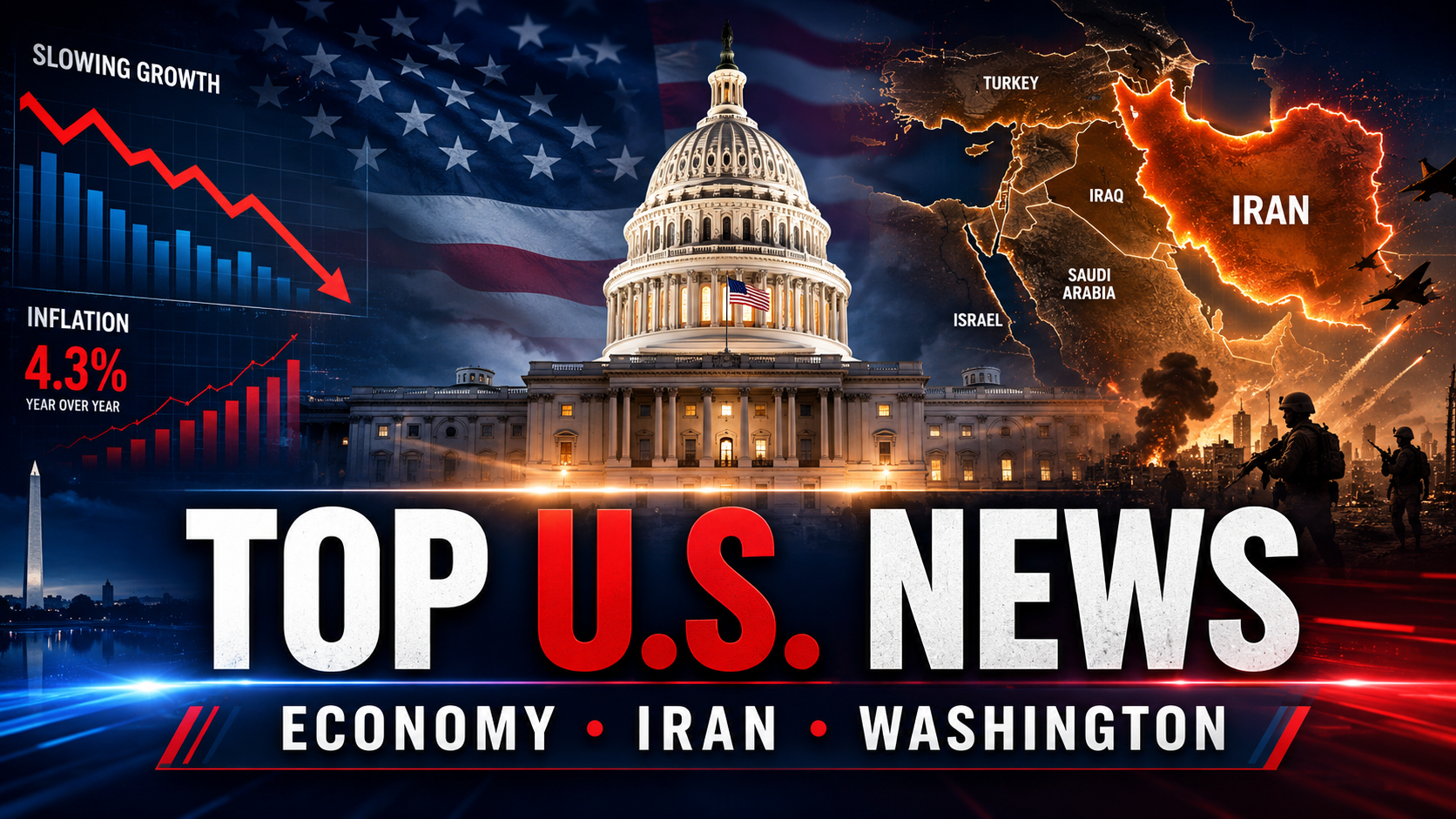
A Nation Under Pressure: U.S. Growth Slows as War and Institutional Battles Intensify
WASHINGTON, July 30, 2026 — The most consequential news in the United States today is not defined by a single breaking event. It is the collision of several pressures: an economy that is still growing but losing momentum, an overseas conflict increasingly affecting Americans at home, political divisions surrounding the nation’s top law-enforcement position, a massive expansion of missile production and a dispute over whether federal regulators are threatening press freedom.
Together, these stories reveal a country whose institutions are being asked to carry more weight at the same time: economic uncertainty, military commitments, public distrust and questions about how government authority should be exercised.
The Economy Is Growing, but the Foundation Is Uneven
The U.S. economy grew at an annual rate of 1.5% during the second quarter, covering April through June. That was slower than the revised 2.1% growth rate recorded during the first quarter, according to the Bureau of Economic Analysis’ advance estimate released Thursday. The estimate remains preliminary and may be revised as additional information becomes available.
The headline number looks weak, but the details are more complicated. Consumer spending increased at a 3.2% annual rate, business investment in equipment rose 15.2%, and private domestic demand grew at a comparatively strong 3.9% pace. Imports, reduced inventories and declining federal spending pulled down the overall GDP figure. Much of the new equipment investment was connected to the continuing construction of artificial-intelligence infrastructure.
That creates an unusual economic picture. Americans and businesses were still spending during the spring, but the country relied heavily on imported equipment, household savings remained limited and inflation continued to run above the Federal Reserve’s goal.
The Federal Reserve’s preferred inflation measure was 3.7% higher in June than one year earlier, while the measure excluding food and energy increased 3.3%. The personal saving rate stood at 2.7%, leaving many households with less room to absorb another surge in fuel, food or borrowing costs.
The Federal Reserve voted Wednesday, July 29, to maintain its benchmark rate between 3.5% and 3.75%. Three officials dissented and favored a quarter-point increase, an unusually visible division that reflects concern about persistent inflation and energy-price shocks associated with the Middle East conflict.
The labor market is providing some stability. New applications for unemployment benefits increased to 197,000 for the week ending July 25, but the total remained historically low. The data suggest layoffs are limited even as hiring and overall economic growth have cooled.
Why It Matters
The economy is not currently showing the broad collapse associated with a recession. Consumer spending, business investment and low layoffs remain important strengths.
The vulnerability is that those strengths may be difficult to sustain if fuel prices rise, savings fall further or interest rates remain elevated. A strong-looking economy can become fragile when households are carrying the load without much financial padding.
U.S. and Iran Exchange New Strikes as the Conflict Spreads
American forces completed a two-hour wave of strikes against Iran beginning Wednesday night and ending early Thursday. U.S. Central Command said dozens of Iranian Revolutionary Guard targets were hit, including command centers, missile and drone facilities, coastal surveillance systems and maritime capabilities.
The United States described the operation as retaliation for Iranian ballistic missiles launched toward American forces in Jordan. The missiles were intercepted, but the exchange ended a brief reduction in hostilities and returned the conflict to a cycle of attack and retaliation.
The consequences are no longer confined to the United States and Iran. Jordan reported intercepting Iranian missiles for a second consecutive day, while a strike in Kuwait killed one person. Recent attacks have also affected Saudi Arabia, Iraq and commercial shipping near Egypt, increasing the risk that the conflict could draw more countries directly into the fighting.
The domestic political foundation for the war is weakening. An AP-NORC survey conducted July 23 through July 27 found that roughly two-thirds of U.S. adults believe the Iran war has not been worth fighting. Only about 28% approved of President Donald Trump’s handling of Iran, while approximately seven in 10 respondents prioritized both lower fuel prices and negotiations toward a permanent ceasefire.
Why It Matters
Military escalation is now directly connected to economic policy. The conflict is influencing oil prices, inflation expectations, federal spending and the ability of the United States to replenish weapons inventories.
It is also creating a widening distance between military operations and public consent. That distance becomes especially significant when a conflict extends beyond its original timeline, involves additional countries and lacks a clearly understood path toward resolution.
Attorney General Nomination Stalls Over Questions of Power and Accountability
A scheduled Senate Judiciary Committee vote on acting Attorney General Todd Blanche’s nomination was postponed Thursday. The committee’s official calendar confirmed that the July 30 executive meeting had been postponed.
Republican Sens. John Cornyn of Texas and Thom Tillis of North Carolina have demanded written assurances concerning an “Anti-Weaponization Fund” and the scope of a settlement arising from President Trump’s lawsuit against the Internal Revenue Service.
Cornyn has sought clarification that protections included in the settlement apply only to existing audits and would not prevent the IRS from reviewing future tax filings. President Trump said he could temporarily withdraw Blanche’s nomination, keep him in the acting position and nominate him again after the two senators leave office.
Why It Matters
This is more than an ordinary confirmation dispute. The attorney general oversees the Justice Department, federal prosecutions and the enforcement of laws that can directly affect the president and members of the administration.
The disagreement therefore raises an enduring democratic question: What safeguards are necessary when the country’s chief law-enforcement officer is closely connected to the president whose administration the department may be required to scrutinize?
A delayed vote does not answer that question. It shows that even members of the president’s own party believe additional guarantees are necessary.
A $58.6 Billion Missile Agreement Reveals the Strain on U.S. Stockpiles
The U.S. Army awarded Lockheed Martin a contract framework worth up to $58.6 billion for Patriot interceptor missiles. The agreement converts a previous one-year, $4.7 billion arrangement into a proposed seven-year procurement plan extending through fiscal year 2032.
The Pentagon is seeking increased production as the United States supplies weapons to allies and uses munitions in its own operations. Lockheed Martin has said it plans to triple production capacity for PAC-3 Missile Segment Enhancement interceptors by the end of 2030 and expand employment at its Camden, Arkansas, facility.
The complete financial terms and delivery schedule are still being negotiated, and Congress must approve funding before all planned investments and purchases can move forward.
Why It Matters
The size of the agreement illustrates how modern conflicts can test industrial capacity as much as battlefield strategy.
Missiles cannot be replenished instantly. Production depends on specialized workers, components, manufacturing facilities and congressional appropriations. The contract may strengthen domestic production and create jobs, but it also demonstrates how prolonged military commitments can force the government into expensive, long-term obligations.
ABC Accuses the FCC of Retaliation Over News Coverage
ABC told the Federal Communications Commission that the regulator’s early review of licenses belonging to eight Disney-owned television stations is an attempt to intimidate the network over coverage disliked by the Trump administration.
The FCC ordered the reviews years before the licenses were otherwise expected to come up for consideration. ABC said the move could create a chilling effect across the media industry. The FCC has said the reviews concern an investigation into whether Disney’s diversity policies violated employment laws, an allegation Disney denies.
The commission could decide what action to take after an August 5 public-comment deadline. More than 150,000 comments had been submitted, according to ABC, with the network reporting that more than 95% supported the stations.
Why It Matters
Broadcast licenses are government-issued because stations use public airwaves. That gives the FCC legitimate regulatory responsibilities, but it also creates the possibility of political pressure when licensing authority intersects with journalism and commentary.
ABC’s retaliation claim has not been adjudicated. Still, the dispute deserves close attention because press freedom is rarely weakened through one dramatic act. More often, it is weakened when media organizations begin calculating whether truthful or critical coverage could bring regulatory punishment.
What to Watch Next
The next major economic test will be whether consumer spending remains strong as higher fuel prices and low household savings meet persistent inflation. Future revisions to the second-quarter GDP estimate could also change the picture.
In the Middle East, the immediate question is whether the latest missile exchange produces another pause or opens additional fronts involving U.S. partners. Diplomatic activity around the Strait of Hormuz will be especially important because disruption there can quickly affect global energy markets.
In Washington, attention will turn to whether Todd Blanche’s nomination is formally withdrawn, renegotiated or brought back for a vote. The FCC’s actions after the August 5 comment deadline could also establish an important precedent for the relationship between federal regulators and news organizations.
Congress will meanwhile have to decide how much of the proposed Patriot missile expansion to finance and whether the military’s growing requirements are compatible with other national priorities.
Refocused Perspective
Today’s news is connected by one central question: How well do American institutions function when pressure arrives from several directions at once?
Economic growth can continue while families feel financially cornered. Military power can expand while public support declines. A president can possess broad authority while senators from his own party demand limits. A regulator can enforce the law while still being required to avoid even the appearance of political retaliation.
The strength of the country will not be measured only by whether it can spend more, strike harder or move faster. It will also be measured by whether leaders explain their decisions, accept meaningful oversight and remain accountable when the stakes become uncomfortable.
That is where public trust is either rebuilt or quietly spent.
Sources and Full Links
U.S. Bureau of Economic Analysis — GDP, Advance Estimate, Second Quarter 2026
https://www.bea.gov/news/2026/gdp-advance-estimate-2nd-quarter-2026
U.S. Bureau of Economic Analysis — Personal Income and Outlays, June 2026
https://www.bea.gov/news/2026/personal-income-and-outlays-june-2026
Federal Reserve — July 29, 2026 FOMC Statement
https://www.federalreserve.gov/newsevents/pressreleases/monetary20260729a.htm
U.S. Department of Labor — Weekly Unemployment Claims Report
https://www.dol.gov/ui/data.pdf
Reuters — U.S. Economic Growth Slows in the Second Quarter
https://www.reuters.com/world/us/us-economic-growth-slows-second-quarter-domestic-demand-robust-2026-07-30/
Reuters — U.S. Military Strikes Iranian Targets
https://www.reuters.com/world/middle-east/us-carries-out-fresh-iran-strikes-centcom-says-2026-07-30/
Associated Press — U.S. and Iran Trade Missile Barrages
https://apnews.com/article/iran-war-us-hormuz-strait-july-30-2026-8dc77ed6a65f389ea4af84635d2473bd
Associated Press — AP-NORC Poll on the Iran War
https://apnews.com/article/trump-approval-iran-war-poll-republicans-election-55e9c80afec521d87f131393a59674c0
U.S. Senate Judiciary Committee — Postponed July 30 Meeting
https://www.judiciary.senate.gov/committee-activity/hearings/executive-business-meeting-07-30-2026
Associated Press — Trump Administration and Todd Blanche Nomination Updates
https://apnews.com/live/trump-iran-news-updates-07-30-2026
Reuters — $58.6 Billion Patriot Missile Agreement
https://www.reuters.com/business/aerospace-defense/army-awards-lockheed-martin-586-billion-largest-ever-pac-3-patriot-missile-deal-2026-07-29/
Reuters — ABC and FCC License Dispute
https://www.reuters.com/world/abc-says-fcc-seeks-intimidate-network-over-coverage-2026-07-30/