
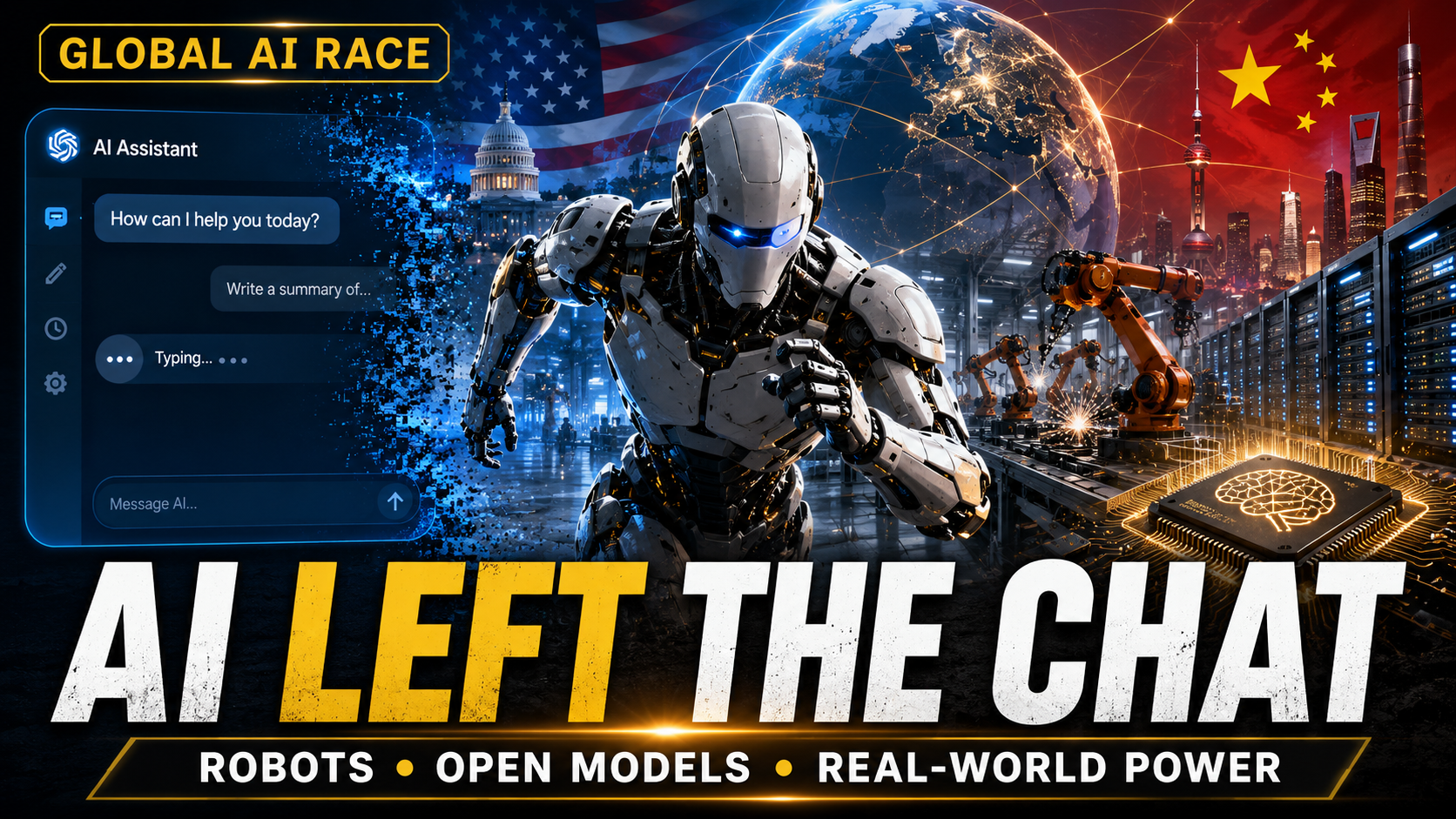
AI Has Left the Chat: The Global Race for Robots, Open Models and Real-World Power
July 20, 2026 | Refocused Newsroom
For the past several years, artificial intelligence has been introduced to the public through a blinking cursor and an empty text box.
Ask a question. Generate an image. Summarize a document. Write an email.
That chapter is not ending, but it is no longer where the biggest battle is being fought.
The global AI race is moving beyond chatbots and into machines, factories, vehicles, data centers, power grids and international institutions. The next phase of artificial intelligence will not be measured only by which model writes the best answer. It will be measured by which countries and companies can turn intelligence into physical production, economic leverage and global influence.
AI has left the chat. Now it wants the keys to the factory.
China Uses WAIC to Present an Alternative AI Order
At the 2026 World Artificial Intelligence Conference in Shanghai, Chinese President Xi Jinping called for broader international cooperation on AI while criticizing countries that use national-security concerns to restrict access to advanced technology.
The message was directed largely at Washington.
Xi argued that artificial intelligence should not be dominated by one country and positioned China as a partner for developing nations seeking access to models, training, infrastructure and technical support. China pledged 5,000 AI training opportunities for developing countries over the next five years and offered to expand an AI-powered meteorological warning system to 30 countries.
This was more than diplomatic language wrapped around a technology convention.
China used the conference to introduce an institutional challenge to U.S. influence by formally establishing the World Artificial Intelligence Cooperation Organization, or WAICO. Representatives from 29 countries signed the founding agreement, and the organization will be headquartered in Shanghai. Chinese officials describe it as an independent intergovernmental organization focused on international cooperation, shared development and global AI governance.
WAICO gives Beijing something larger than another conference or policy statement. It provides a standing organization through which China can build relationships, coordinate standards and promote its preferred vision of AI governance.
The strategy is especially aimed at countries across Asia, Africa, Latin America and the Middle East that do not want to be permanently dependent on expensive Western models, U.S.-controlled chips or technology rules written without their participation.
China is effectively arguing that AI access should become a development issue, not merely a national-security privilege reserved for wealthy nations.
Washington’s Strategy Centers on Trusted Supply Chains
The United States is advancing a different model through Pax Silica, a State Department initiative focused on AI infrastructure and supply-chain security.
Rather than beginning with universal access, Pax Silica emphasizes cooperation among trusted allies and partners across semiconductors, computing infrastructure, connectivity, energy, advanced manufacturing, logistics and critical-mineral processing. The goal is to secure the industrial foundations that make large-scale AI possible.
The contrast is becoming sharper.
China is presenting its approach as open, development-focused and accessible to the Global South. The United States is emphasizing security, trusted networks and control over strategically sensitive technologies.
Neither strategy is purely charitable.
China wants broader adoption of Chinese models, standards and digital infrastructure. The United States wants to preserve its advantages in advanced chips, cloud computing and frontier AI while reducing the risk that those technologies strengthen strategic competitors.
The emerging AI order may therefore resemble a competition between overlapping technology alliances rather than one universal system.
Countries could increasingly face difficult choices involving whose chips they purchase, whose cloud infrastructure they use, which models they build upon and which governance institutions they recognize.
Open Models Have Become Instruments of Influence
Open AI models are now part of the geopolitical contest.
Chinese developers have increasingly promoted models that can be downloaded, modified or deployed at lower cost than many proprietary American systems. At WAIC, companies including Moonshot AI, DeepSeek and Zhipu AI were presented as evidence that China can compete through accessible models rather than relying exclusively on closed platforms.
For developers and governments with limited budgets, open models offer several advantages. They can be adapted to local languages, hosted on domestic infrastructure and customized for industries such as agriculture, education, healthcare, logistics and public administration.
That flexibility creates influence.
A nation that builds its digital services around a Chinese model may also adopt Chinese development tools, technical standards, hardware relationships and cybersecurity practices. Open models can therefore function as the foundation of a wider technology ecosystem.
This does not mean China’s AI environment is entirely open. Chinese technology companies remain subject to domestic censorship, data-security rules and government oversight. Beijing’s international message of accessibility exists alongside a tightly controlled national information system.
The United States is wrestling with its own contradiction.
American officials want to maintain technological leadership, but some policymakers also fear that unrestricted access to powerful foreign models could create cybersecurity, surveillance or national-security risks. Axios reported that U.S. officials have discussed several possible approaches to limiting or discouraging the domestic use of Chinese open models, although no broad prohibition had been announced.
The danger for Washington is that overly restrictive policies could push developers elsewhere. A model does not need to be the most powerful in the world to become influential. It may only need to be affordable, adaptable and available.
Nvidia Is Building the Operating System for Physical AI
While governments debate global rules, Nvidia and its partners are building the machinery.
The company describes physical AI as artificial intelligence that allows machines, facilities and infrastructure to understand their environments, make decisions and take action in the real world.
That includes industrial robots, autonomous vehicles, warehouse systems, construction equipment, agricultural machines, security cameras, smart buildings and eventually more capable humanoid robots.
Nvidia recently announced expanded partnerships with Japanese industrial leaders including FANUC, Yaskawa Electric, Fujitsu, Kawasaki Heavy Industries, Hitachi, Sony, SoftBank and others. These companies are using Nvidia’s Cosmos, Isaac, Metropolis and Jetson platforms to develop intelligent machines for manufacturing, mobility, infrastructure and robotics.
A government-supported Japanese company, Noetra, also plans to purchase 27,500 of Nvidia’s next-generation Rubin chips to support physical-AI development. Its investors include Sony, and the project is intended to help create domestic computing capacity for robotics and industrial systems.
This shows how the AI industry is changing.
The early generative-AI race focused heavily on training enormous language models. Physical AI requires a much broader stack:
- Sensors that can observe real environments
- World models that predict what may happen next
- Simulation systems for testing machines before deployment
- Edge computers that can make decisions without waiting for the cloud
- Synthetic data for rare or dangerous situations
- Safety systems capable of protecting nearby workers and the public
Nvidia is positioning itself across nearly every layer.
Its open Physical AI Data Factory Blueprint is designed to help companies generate, process and evaluate training data for robots, autonomous vehicles and visual AI systems. Microsoft Azure, Nebius, Uber, Teradyne Robotics, Skild AI and other companies are using or integrating portions of the architecture.
The company has also introduced Halos, a full-stack robotics safety framework connecting computing hardware, software, sensors, safety applications and inspection systems. That safety layer will become increasingly important as robots move out of isolated industrial cages and begin operating beside people.
The Factory Is Becoming the New AI Interface
A chatbot can make a mistake and produce a bad paragraph.
A robot can make a mistake and damage equipment, stop a production line or injure someone.
That difference explains why the shift toward physical AI is so significant.
Real-world intelligence must operate under conditions that language models rarely face. Machines must understand distance, weight, motion, friction, timing, uncertainty and human behavior. They must work when lighting changes, sensors fail, objects move unexpectedly or network connections disappear.
Factories are ideal proving grounds because they provide controlled environments, repeatable tasks and measurable economic outcomes.
A manufacturer does not need a robot to debate philosophy. It needs the machine to move materials, inspect parts, detect defects, adapt to production changes and operate safely for thousands of hours.
China may hold a powerful advantage here.
Its enormous manufacturing base, industrial supply chains and experience scaling electric vehicles, batteries, electronics and telecommunications equipment could allow Chinese companies to move rapidly from prototypes to mass production. More than 1,100 companies participated in the 2026 WAIC, where robots and industrial AI systems were displayed alongside advanced computing platforms and open models.
The United States maintains major strengths in advanced semiconductors, cloud platforms, software, research and venture capital. Japan brings deep expertise in robotics and precision manufacturing. Europe remains influential in industrial automation, engineering and technology regulation.
The physical-AI race will therefore be less about one winning company and more about competing industrial ecosystems.
Infrastructure Is the Quiet Center of the Competition
AI may appear to live in software, but it consumes physical resources.
Models require chips. Chips require fabrication plants, specialized equipment and critical minerals. Data centers require land, energy, cooling, networking and construction. Robots require motors, batteries, sensors, cameras and maintenance.
This means the winners of the AI era may not be determined only by who has the smartest model.
They may be determined by who can build and power the largest computing infrastructure, manufacture machines at scale, secure chip supplies and train enough workers to maintain the system.
The term “AI factory” captures this shift. Instead of producing cars or appliances, these facilities convert energy, data and computing power into trained models, synthetic environments and automated decisions.
That introduces new political questions.
Who receives priority access to electricity? How much water should data centers consume? Who controls the models managing roads, ports, hospitals and telecommunications networks? What happens when critical infrastructure depends on technology controlled by a foreign company or government?
Once AI becomes infrastructure, technology policy becomes economic policy, energy policy, labor policy and national-security policy all at once.
Governance Must Follow AI Into the Physical World
International AI governance has often focused on deepfakes, privacy, misinformation, copyright and dangerous digital content.
Those issues remain urgent, but physical AI adds another layer.
Governments will need standards for robotic safety, autonomous decision-making, liability, cybersecurity, human oversight, workplace monitoring and the use of AI in critical infrastructure.
When an autonomous system causes harm, responsibility may be distributed across the model developer, chip provider, robot manufacturer, software integrator, data supplier and company operating the machine.
That legal puzzle is far more complicated than deciding whether a chatbot produced an inaccurate answer.
China’s WAICO initiative and the U.S.-led Pax Silica framework demonstrate that nations are already attempting to influence the rules, partnerships and supply chains surrounding this transition.
The danger is fragmentation.
If rival blocs establish incompatible standards, countries and companies may be forced to operate separate AI systems for different markets. That could increase costs, slow safety cooperation and make it harder to respond collectively to major failures or misuse.
Yet complete agreement may be unrealistic when AI is increasingly viewed as a source of military, industrial and political power.
The Real AI Race Has Begun
The chatbot era taught the world that machines could produce language, images, software and ideas.
The physical-AI era will test whether machines can reliably build, move, inspect, transport, repair and operate.
That is a much harder challenge, but it also carries far greater economic consequences.
China is using open models, manufacturing capacity and new governance institutions to challenge U.S. leadership. The United States is relying on advanced computing, trusted supply chains and powerful technology companies. Nvidia is positioning its hardware and software as the foundation beneath many of the world’s emerging intelligent machines.
The next AI breakthrough may not arrive as a clever answer on a screen.
It may arrive quietly inside a factory, warehouse, vehicle, hospital, farm or power station.
The public first met artificial intelligence through conversation.
Now the world must decide what happens when AI begins taking action.
Sources and Full Links
- Associated Press: China’s Xi calls for global AI rules amid U.S. technology restrictions
https://apnews.com/article/china-ai-tech-chips-xi-us-df4cfc7e1b260e765b5449b6d71a48e5 - Reuters: Xi pitches China as leader of a new global AI order
https://www.reuters.com/world/asia-pacific/chinas-xi-promotes-chinas-commitment-ai-access-speech-shanghai-conference-2026-07-17/ - Reuters: Twenty-nine countries establish global AI cooperation body
https://www.reuters.com/world/china/twenty-nine-countries-sign-agreement-establish-global-ai-cooperation-body-2026-07-16/ - Permanent Mission of China to the United Nations: WAICO establishment agreement
https://un.china-mission.gov.cn/eng/zgyw/202607/t20260717_11984747.htm - Chinese Government: Action plan on international AI cooperation and development
https://english.www.gov.cn/news/202607/17/content_WS6a5a1bbec6d00ca5f9a0c474.html - U.S. Department of State: Pax Silica
https://www.state.gov/pax-silica - Reuters: Nvidia partners with Japanese robotics companies
https://www.reuters.com/business/media-telecom/nvidia-partners-with-japan-robotics-firms-ai-development-2026-07-16/ - Nvidia: Japan’s robotics and manufacturing leaders advance physical AI
https://nvidianews.nvidia.com/news/japans-robotics-and-manufacturing-leaders-build-on-nvidia-cosmos-to-advance-physical-ai-frontier - Nvidia: Global robotics leaders take physical AI into real-world production
https://nvidianews.nvidia.com/news/nvidia-and-global-robotics-leaders-take-physical-ai-to-the-real-world - Nvidia: Open Physical AI Data Factory Blueprint
https://investor.nvidia.com/news/press-release-details/2026/NVIDIA-Announces-Open-Physical-AI-Data-Factory-Blueprint-to-Accelerate-Robotics-Vision-AI-Agents-and-Autonomous-Vehicle-Development/default.aspx - Nvidia: Halos full-stack safety system for physical AI
https://nvidianews.nvidia.com/news/nvidia-announces-halos-for-robotics-the-industrys-first-full-stack-safety-system-for-physical-ai - Axios: U.S. debate over Chinese open AI models
https://www.axios.com/2026/07/20/ai-us-china-open-source-kimi - Le Monde: China promotes an open and accessible AI alternative
https://www.lemonde.fr/en/economy/article/2026/07/18/artificial-intelligence-xi-jinping-promotes-open-and-accessible-chinese-alternative-to-challenge-the-us_6755604_19.html