
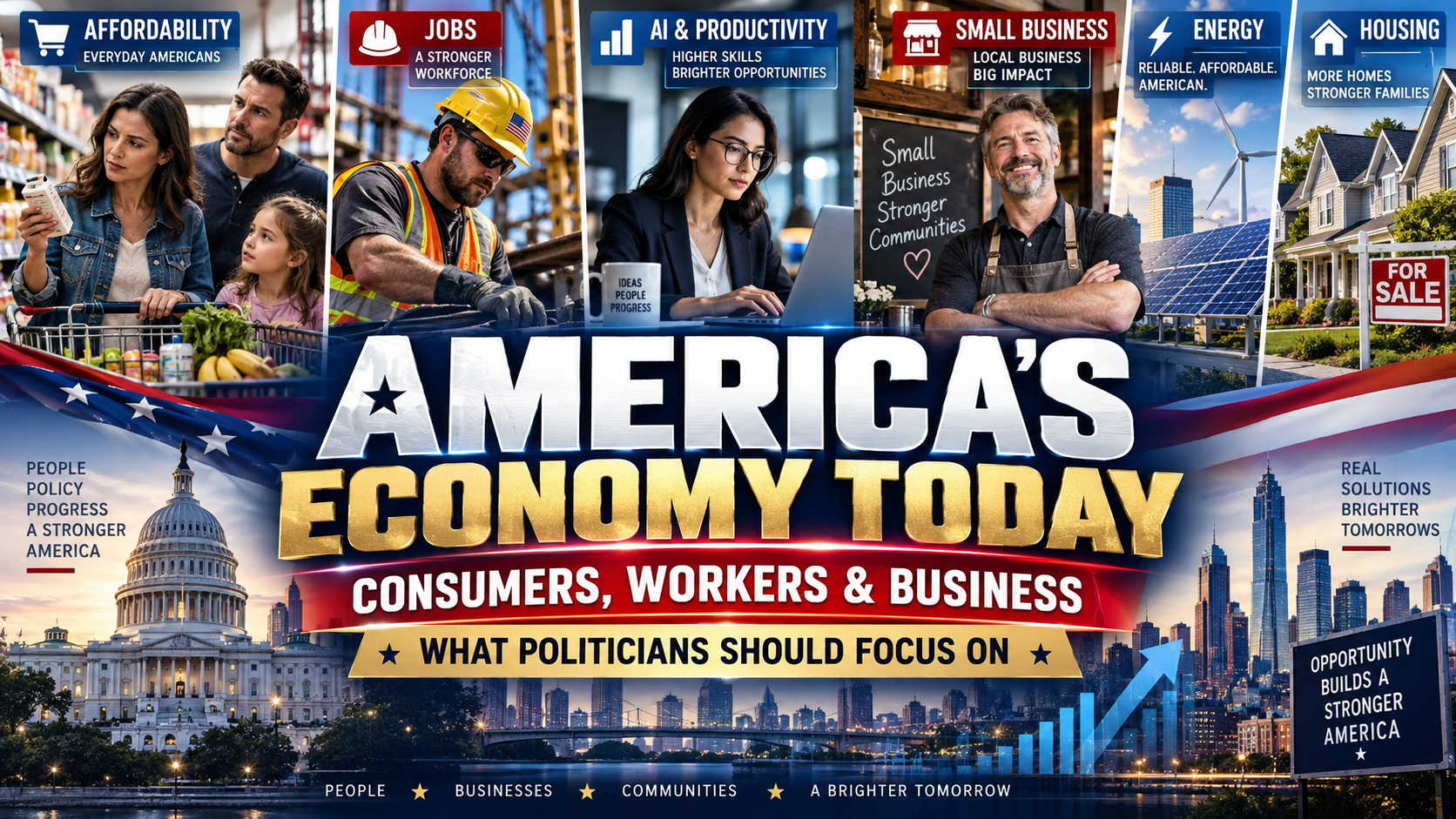
America in 2026: Consumers Are Cautious, Workers Are Holding On, and Businesses Still Want to Build
September 9, 2026
The latest government and Federal Reserve data paints a surprisingly consistent picture of the American economy.
Consumers are still spending, but they are becoming more price-sensitive. Workers are still employed, but fewer appear eager to jump from job to job. Entrepreneurs continue filing hundreds of thousands of business applications. Established businesses are investing, hiring and experimenting with technologies such as AI, but many are increasingly concerned about energy, insurance, healthcare, financing and input costs.
That means the central political question should not simply be, “Is the economy good or bad?”
That question is too blunt.
The better question is:
What is making it harder for Americans to turn work into a better standard of living?
Consumers: Still spending, but increasingly selective
American consumers have not shut their wallets.
Personal consumption expenditures increased 0.2% in July, according to the Bureau of Economic Analysis. But beneath that headline is an important shift: spending on services increased by $86.2 billion, while spending on goods declined by $49.9 billion. After adjusting for inflation, real consumer spending was essentially unchanged.
Retail and food-service sales were $763.6 billion in July, down 0.6% from June but still 5% higher than a year earlier.
So Americans are spending, but the composition matters.
The Federal Reserve's September Beige Book reports that consumer spending increased only slightly overall and that shoppers showed greater price sensitivity, even as higher-income consumers continued making stronger purchases. Auto sales were subdued amid higher financing costs, fuel prices and weaker confidence. Travel demand, however, remained comparatively strong.
That looks less like a collapsed consumer and more like a value-conscious consumer.
People are asking whether the restaurant, automobile, subscription, vacation, house or product is worth the price.
And household finances deserve attention.
The personal saving rate stood at just 3.0% in July.
Credit-card balances reached approximately $1.26 trillion in the second quarter, while auto-loan balances reached about $1.71 trillion. The New York Fed says new delinquencies for credit cards and auto loans remain elevated even though overall delinquency conditions improved slightly.
That tells politicians something important:
Americans are not merely complaining about prices.
Many households are managing the difference between what things cost and what their income can comfortably support.
Inflation has improved, but affordability has not been solved
The latest published Consumer Price Index is for July because the August CPI report is scheduled for Friday, September 11.
July inflation was 3.4% year over year.
Food prices were up 3.0%. Shelter increased again. Energy prices were 14.7% above their year-earlier level, although energy fell during July itself.
There is an important distinction politicians frequently blur:
Lower inflation does not mean lower prices.
If something rises from $100 to $120 and then inflation slows, the price doesn't magically return to $100.
It might simply climb from $120 to $123 more slowly.
That is why voters can hear that inflation is easing while looking at their bank accounts and thinking, Doesn't feel like it.
Both can be true.
Housing remains one of the biggest pressure points
The average 30-year fixed mortgage rate was 6.71% as of September 3.
Meanwhile, new single-family home sales fell to an annualized rate of 607,000 in July, down 10.5% from June, while unsold new-home inventory represented about 9.6 months of supply at the current sales rate.
Housing therefore has a double problem.
Americans need enough homes.
But they also need to be able to finance them.
Simply increasing buyer subsidies without increasing housing supply risks bidding prices higher.
Simply increasing supply without addressing financing costs may leave homes sitting beyond what middle-income families can comfortably afford.
Housing policy has to attack both sides.
Workers: Employed, but less eager to move around
The labor market remains functional.
The U.S. added 162,000 payroll jobs in August, while unemployment remained at 4.1%.
Average hourly earnings increased 3.1% from a year earlier.
But underneath those numbers, workers appear more cautious.
There were 7.3 million job openings in July, while hiring totaled approximately 5.1 million.
About 3.1 million workers quit their jobs, producing a quits rate of 1.9%.
The quits rate matters because voluntarily leaving a job often reflects confidence that another opportunity is available.
The current numbers suggest a labor market that is neither frozen nor running red-hot.
Workers are moving, but there is less of the “I can quit Friday and get something better Monday” mentality that characterized parts of the post-pandemic labor market.
That means politicians should pay attention to job quality and mobility, not only the unemployment rate.
A person can technically be employed and still feel economically trapped.
Skilled workers remain difficult to find
At the same time, businesses still cannot find enough people for certain jobs.
The Federal Reserve says skilled trades and technical workers remain difficult to recruit, particularly in construction and manufacturing.
NFIB's August survey found 35% of small-business owners had job openings they could not fill.
That is a major clue for economic policy.
America does not simply need “more jobs.”
It needs better pipelines connecting people with the jobs employers actually need filled.
Electricians.
Machinists.
Welders.
Nurses and medical technicians.
Construction workers.
Engineers.
Cybersecurity workers.
Advanced manufacturing technicians.
AI-capable workers.
The country may have spent too many years treating workforce policy as something separate from economic policy.
They are the same thing.
Businesses: Still forming, still investing, but uncertainty matters
Americans have not lost their appetite for entrepreneurship.
The Census Bureau recorded 578,926 business applications in July, an 8.1% increase from June.
Based on those applications, the Census Bureau projects roughly 29,959 employer businesses will form within four quarters.
America also has approximately 36.2 million small businesses, according to the Small Business Administration.
Those businesses employ 62.3 million people, about 45.9% of private-sector workers, and generate an estimated 43.5% of U.S. GDP.
So when politicians talk about “business,” they should resist picturing only giant corporations.
A huge portion of American business is the roofer, restaurant owner, podcast studio, contractor, trucking company, neighborhood retailer, barber, software startup, manufacturer and family business.
Small businesses are hopeful, but uneasy
NFIB's Small Business Optimism Index stood at 98.7 in August, slightly above its 52-year average of 98.0.
But its Uncertainty Index remained high at 89, compared with a historical average of 68.
Owners cited weaker sales, supply-chain disruptions and inflation pressures.
That is a fascinating combination:
optimism plus uncertainty.
Business owners still believe they can make something happen.
They are just less certain about the ground underneath them.
Businesses are also becoming more productive
There is some encouraging news here.
U.S. nonfarm business productivity increased 2.2% from the second quarter of 2025 to the second quarter of 2026.
Manufacturing productivity also rose during the most recent quarter.
That matters enormously.
Productivity is one of the closest things economics has to a long-term cheat code.
If workers can produce more value per hour, companies can potentially pay more without increasing prices at the same rate.
Technology, automation and AI could accelerate that.
But only if America uses them to expand human productivity rather than merely pursuing short-term head-count reduction.
So what should politicians actually focus on?
If politicians want policies that connect with what Americans are actually experiencing, I would put eight areas at the center:
- Attack affordability through supply, not just subsidies. Build more housing, expand energy production and infrastructure, improve transportation capacity and reduce unnecessary bottlenecks. Giving people more money to compete for the same limited supply can simply raise prices.
- Make housing construction a national economic priority. Federal, state and local governments should examine zoning, permitting delays, infrastructure capacity, starter-home construction, manufactured housing and financing. Housing is no longer just a housing issue. It affects workforce mobility, marriage, family formation, entrepreneurship and retirement.
- Build a serious skilled-workforce pipeline. Expand apprenticeships, community-college partnerships, technical education and employer-led credentialing. Where appropriate, lawmakers can also debate targeted legal immigration pathways for occupations facing persistent shortages. The objective should be simple: if America needs workers, create legitimate pathways for people to become those workers.
- Give small businesses predictability. Tax rules, trade rules, regulation and permitting should not swing so violently that businesses cannot confidently invest. The Federal Reserve is already hearing concerns about energy costs, tariffs, transportation costs, healthcare and insurance. Policy stability itself has economic value.
- Make productivity the center of AI policy. The question should not merely be how many jobs AI can automate. Government should encourage AI adoption that increases output, creates new companies and raises worker capability while funding retraining for occupations undergoing major disruption. America wins if AI makes a $50,000 worker capable of generating $80,000 or $100,000 worth of economic value, not merely if a company figures out how to eliminate the position.
- Protect households from debt spirals without shutting down useful credit. Credit cards and auto loans are essential tools for millions of households, but elevated delinquency deserves attention. Policymakers should prioritize transparent lending terms, financial literacy, competition among lenders and early intervention rather than allowing consumers to tumble quietly from manageable debt into default.
- Treat energy security as cost-of-living policy. Businesses in the Fed's latest survey reported higher energy and transportation expenses feeding into prices. America needs reliable energy, sufficient generation, grid modernization, pipelines and transmission, domestic production where economical, nuclear capacity, renewables and storage. Energy policy should be judged partly by whether households and businesses can obtain dependable power at competitive prices.
- Measure success by household progress, not one headline statistic. GDP grew at a 1.5% annualized rate during the second quarter, and consumer spending helped drive the expansion. But policymakers should also track real wages, household saving, housing affordability, debt delinquency, business formation, productivity and labor-force mobility. One statistic cannot describe 340 million economic lives.
The political opportunity
Both major political camps can find pieces of their philosophy in this data.
People worried about inflation have evidence.
People concerned about wages and household debt have evidence.
Those advocating business growth have evidence.
Those concerned about workforce development have evidence.
Those arguing America needs more housing have a mountain of evidence.
Those interested in AI and advanced manufacturing have reasons for optimism.
The danger is turning these interconnected problems into ideological islands.
Housing affects employment.
Energy affects inflation.
Childcare affects labor-force participation.
Education affects productivity.
Immigration affects labor supply.
Healthcare and insurance affect business costs.
Interest rates affect housing and investment.
AI affects productivity and jobs.
It is one machine.
Politicians who understand that machine will be more useful than politicians who simply become better at describing who voters should blame.
What Americans appear to be saying
The economic behavior of Americans currently looks something like this:
Consumers: “I will spend, but convince me it's worth the price.”
Workers: “I want stability, better pay and a path forward.”
Entrepreneurs: “I still want to build something.”
Small businesses: “Give me customers, workers and enough predictability to plan.”
Families: “Make the basic architecture of life affordable again.”
That last sentence may be the biggest one.
Housing.
Food.
Transportation.
Healthcare.
Energy.
Education.
Childcare.
Savings.
Those are not abstract economic indicators.
They are the operating system of an ordinary American life.
The politicians who focus relentlessly on making that operating system work better may discover that they do not need to manufacture quite so much noise.
Results are loud enough.
Key sources
Bureau of Economic Analysis: Personal Income and Outlays, July 2026
Bureau of Labor Statistics: August 2026 Employment Situation
Bureau of Labor Statistics: July 2026 JOLTS Report
Bureau of Labor Statistics: July 2026 Consumer Price Index
Federal Reserve: August 2026 Beige Book National Summary
Federal Reserve Bank of New York: Q2 2026 Household Debt and Credit
Federal Reserve: July 2026 Consumer Credit
U.S. Census Bureau: July 2026 Retail Sales
U.S. Census Bureau: July 2026 Business Formation Statistics
U.S. Census Bureau: July 2026 New Home Sales
Freddie Mac: Current U.S. Mortgage Rates
NFIB: August 2026 Small Business Optimism Survey
NFIB: August 2026 Small Business Jobs Report
SBA Office of Advocacy: 2026 Small Business Facts