
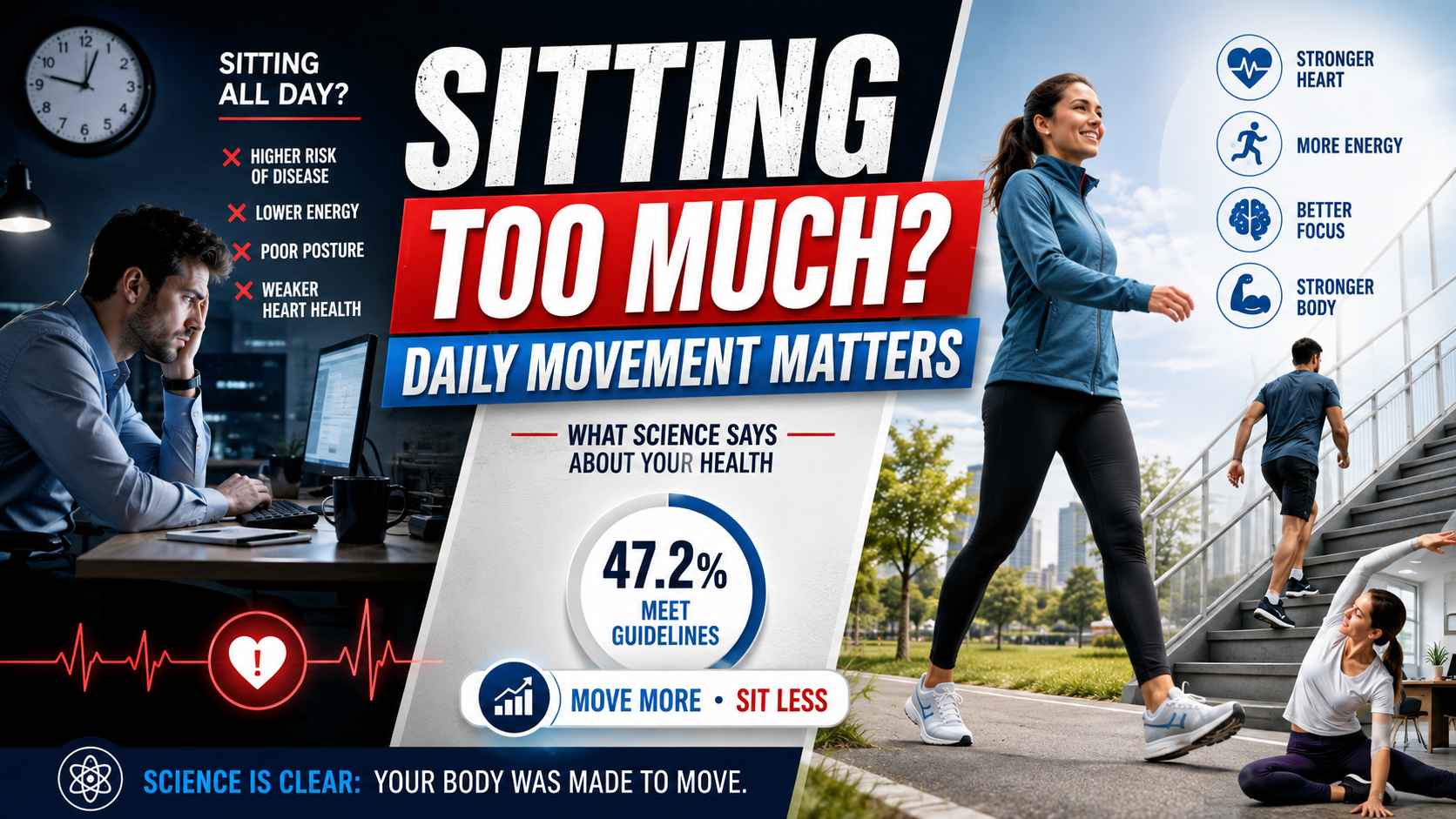
Are We Sitting Too Much? What Science Says About Daily Movement
For millions of people, a normal day looks something like this:
Sit in the car.
Sit at work.
Sit during lunch.
Drive home.
Then sit on the couch.
None of those activities seems particularly dangerous by itself. But researchers have increasingly studied what happens when large amounts of sitting become the default setting for our day.
The evidence doesn't mean your office chair is secretly plotting against you. 😄
It does suggest that moving more and sitting less matters for long-term health.
More Than Half of U.S. Adults Don't Meet Aerobic Exercise Guidelines
According to a CDC report released in April 2026 using data from the 2024 National Health Interview Survey, only 47.2% of U.S. adults age 18 and older met federal guidelines for aerobic physical activity during their leisure time.
The percentage also declined with age.
About 54% of adults ages 18 to 34 met the aerobic guidelines, compared with just 38.4% of adults age 65 and older.
Separate CDC tracking estimated that 26.2% of U.S. adults were physically inactive in 2024.
That doesn't mean 26% of Americans never move. In this dataset, "inactive" refers to people reporting no moderate- or vigorous-intensity leisure-time activity beyond normal daily living.
Sitting and Physical Inactivity Aren't Exactly the Same Thing
This distinction matters.
Someone can exercise for 30 minutes in the morning and still spend most of the remaining day sitting.
Likewise, someone who never goes to a gym may accumulate movement throughout the day through walking, household activities, work or transportation.
Public-health researchers use the term sedentary behavior for low-energy activities performed while sitting, reclining or lying down while awake.
Examples include office work, driving and watching television.
The concern is not simply that people aren't exercising.
It's that many of us may be spending enormous portions of our waking lives barely moving.
A Study of Nearly Half a Million Workers Found an Interesting Pattern
A 2024 study published in JAMA Network Open followed 481,688 adults for an average of nearly 13 years.
Researchers compared people who mostly sat at work with those who mostly did not.
After adjusting for factors including age, sex, smoking, alcohol use, education and body mass index, people who mostly sat at work had a 16% higher risk of death from any cause and a 34% higher risk of cardiovascular death compared with people who mostly did not sit at work.
That's an association, not proof that sitting directly caused those deaths.
But another part of the study was especially interesting.
People who alternated between sitting and not sitting at work did not show the same increased all-cause mortality risk compared with the mostly nonsitting group.
Researchers also found that increasing leisure-time activity by around 15 to 30 minutes per day, depending on a person's existing activity level, was associated with reductions in the elevated risk among people who mostly sat at work.
In other words:
The solution may not be “never sit.” It may be “don't stay still all day.”
So How Much Exercise Do Adults Actually Need?
Current U.S. physical activity guidelines recommend that adults get at least:
150 to 300 minutes of moderate-intensity aerobic activity each week
or
75 to 150 minutes of vigorous activity
or an equivalent combination of both.
Adults should also perform muscle-strengthening activities involving the major muscle groups on at least two days per week.
A simple way to reach the minimum aerobic recommendation is about 30 minutes of moderate activity five days per week.
And you don't have to do all 30 minutes at once.
The federal guidelines no longer require physical activity to occur in sessions lasting at least 10 minutes. Smaller amounts throughout the day can still contribute to better health.
That is a major point.
A walk around the building counts.
Taking the stairs counts.
Walking during a phone call counts.
A short movement break counts.
You don't need to transform every Tuesday afternoon into the Olympics.
Is There a Maximum Number of Hours You Should Sit?
Interestingly, science doesn't currently give us one perfect number.
The Physical Activity Guidelines for Americans recommend that adults “move more and sit less,” but federal health officials say the evidence does not yet support a specific maximum number of sedentary hours per day or a precise schedule for how often sitting should be interrupted.
The World Health Organization takes a similar approach.
It recommends limiting sedentary time and replacing some of it with physical activity at any intensity, including light movement.
So be cautious when you see claims such as:
“Never sit longer than exactly 42 minutes.”
Science isn't quite that tidy.
Why Does Movement Matter So Much?
Physical activity affects much more than body weight.
Federal guidelines report evidence that regular activity can reduce the risk of heart disease, stroke, high blood pressure, type 2 diabetes, depression and several cancers.
Physical activity is also associated with improved sleep, cognition, physical function and quality of life.
Some benefits can even happen relatively quickly.
A single episode of physical activity can reduce anxiety and blood pressure while improving insulin sensitivity and sleep quality.
That changes the way we should think about exercise.
Movement isn't only something you do because you're trying to lose weight.
It's something your body is built to do.
What Can You Do If You Work at a Desk?
You don't necessarily need to quit your job, purchase a treadmill desk and start answering emails while power-walking at 4 mph. 😂
Start smaller.
Stand up periodically during the day.
Walk while taking certain phone calls.
Take a short walk after lunch.
Use stairs when practical.
Park slightly farther from an entrance.
Break longer periods of sitting with light movement.
Schedule exercise the way you would schedule another important appointment.
And if 150 minutes per week currently feels unrealistic, start with less.
Federal guidance emphasizes that some physical activity is better than none and that even small amounts can provide health benefits.
The Bigger Lesson
The conversation around exercise is slowly changing.
For years, fitness culture often made movement feel like something that required a gym membership, special clothes, an intense workout and an hour of free time.
Science paints a broader picture.
Movement throughout the day matters.
You can exercise and still sit too much.
You can also become healthier without suddenly becoming a marathon runner.
The goal isn't to become afraid of sitting.
It's to recognize how easy modern life has made it to stop moving.
Sometimes one of the simplest health questions you can ask yourself is:
“How long have I been sitting here?”
And every once in a while, the answer might be your cue to get up and move.
Sources
CDC National Center for Health Statistics — Aerobic Physical Activity Among Adults Age 18 and Older: United States, 2024
https://www.cdc.gov/nchs/products/databriefs/db555.htm
CDC — Active People, Healthy Nation: Data and Progress
https://www.cdc.gov/active-people-healthy-nation/php/data-research/index.html
CDC — Adult Activity: An Overview
https://www.cdc.gov/physical-activity-basics/guidelines/adults.html
U.S. Department of Health and Human Services — Physical Activity Guidelines: Top 10 Things to Know
U.S. Department of Health and Human Services — Physical Activity Guidelines Questions & Answers
JAMA Network Open — Occupational Sitting Time, Leisure Physical Activity, and All-Cause and Cardiovascular Disease Mortality
https://jamanetwork.com/journals/jamanetworkopen/fullarticle/2814094
PubMed — Occupational Sitting Time, Leisure Physical Activity, and All-Cause and Cardiovascular Disease Mortality
https://pubmed.ncbi.nlm.nih.gov/38241049/
World Health Organization — Physical Activity Fact Sheet
https://www.who.int/news-room/fact-sheets/detail/physical-activity
World Health Organization — Guidelines on Physical Activity and Sedentary Behaviour