
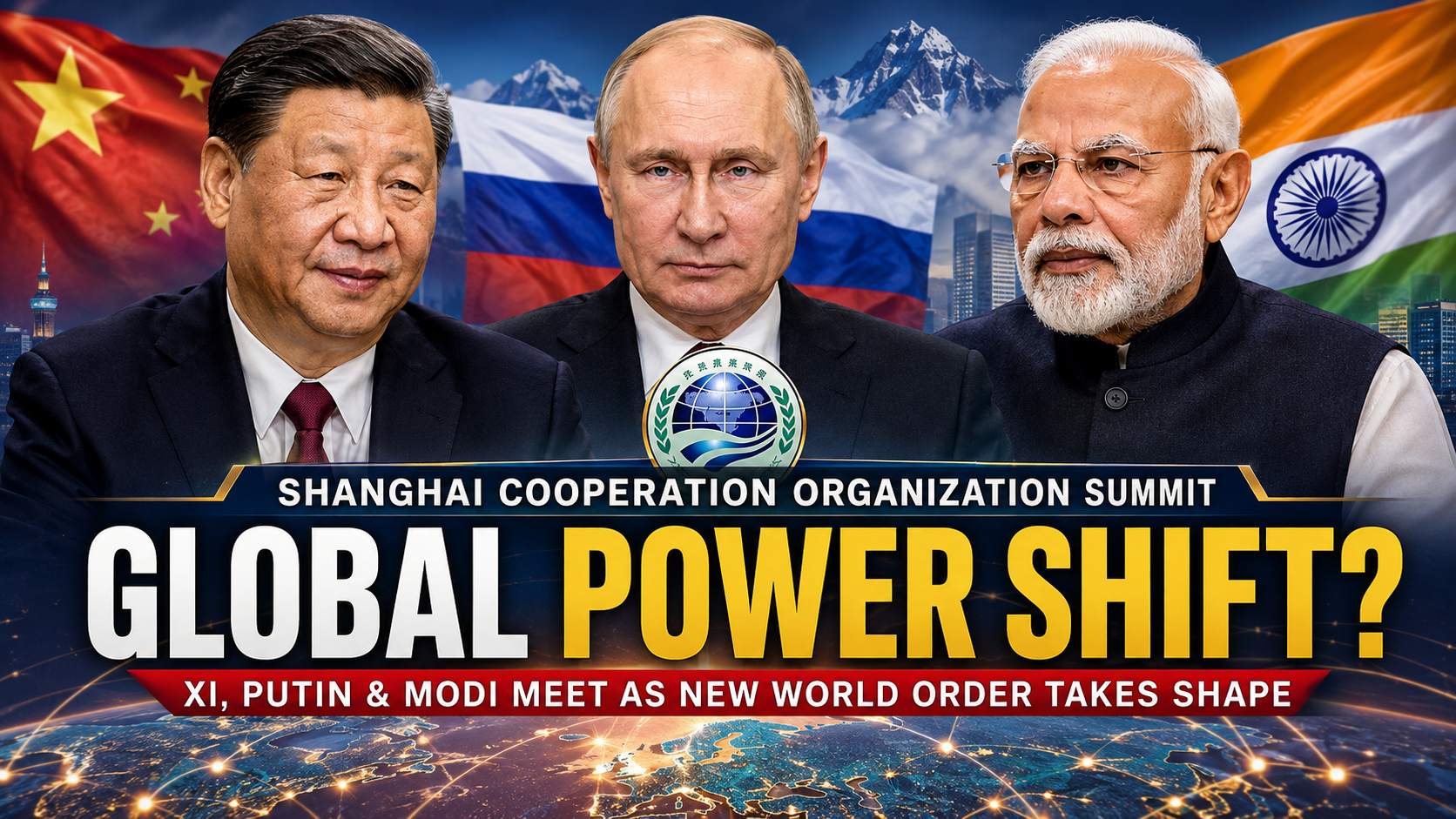
China, Russia and India Gather at Major Summit as Global Power Lines Continue to Shift
BISHKEK, Kyrgyzstan, Aug. 31, 2026 - Some of the world's most influential leaders have converged on Kyrgyzstan for a major Shanghai Cooperation Organization summit at a moment when wars, tariffs, sanctions and competition between major powers are reshaping the international system.
Chinese President Xi Jinping, Russian President Vladimir Putin and Indian Prime Minister Narendra Modi are among the leaders gathered in Bishkek for the two-day SCO summit, alongside leaders from Iran, Pakistan, Belarus, Kazakhstan, Uzbekistan and other countries.
The gathering is drawing particular attention because China and Russia increasingly present organizations such as the SCO as part of a more multipolar international system, one in which Washington and Western-led institutions exercise less dominant influence.
But the reality inside the organization is more complicated.
India, China and Russia cooperate through the SCO while maintaining significantly different interests, alliances and foreign-policy priorities. That makes this summit important not simply as a display of unity, but as a window into how countries are navigating an increasingly fragmented global order.
What is the Shanghai Cooperation Organization?
The Shanghai Cooperation Organization began in 2001 as a regional grouping focused largely on security, border stability and counterterrorism.
It has since grown into a much larger Eurasian organization.
The SCO now has 10 full member states:
China, Russia, India, Pakistan, Kazakhstan, Kyrgyzstan, Tajikistan, Uzbekistan, Iran and Belarus.
Together, the organization's members cover a huge portion of Eurasia and represent a significant share of the world's population.
The bloc has also expanded beyond its original security mission into discussions involving trade, transportation, energy, economic cooperation, diplomacy and global governance.
This year's summit marks the organization's 25th anniversary.
The meetings are taking place in Bishkek on Aug. 31 and Sept. 1, with the formal Council of Heads of State gathering and an expanded SCO Plus meeting among the scheduled events.
China pushes its vision of a multipolar world
For China, the SCO represents more than a regional security conference.
Beijing increasingly uses the organization to demonstrate that major international cooperation can take place outside institutions traditionally led or heavily influenced by the United States and Europe.
During a meeting with Putin on the sidelines of the summit, Xi said China wanted to work with Russia and other countries to strengthen the SCO and promote reform of global governance.
Xi specifically referred to advancing what Beijing describes as an “equal and orderly multipolar world.”
That language reflects a long-running Chinese argument that global decision-making should be distributed among multiple centers of power rather than dominated by one country or alliance system.
China also has major economic interests in Central Asia.
The region sits at the intersection of Chinese trade routes, energy infrastructure and Beijing's broader Belt and Road ambitions. Deepening relationships with Kazakhstan, Uzbekistan, Kyrgyzstan and other Central Asian states therefore offers China both economic opportunity and strategic influence.
Putin uses the summit to demonstrate Russia is not isolated
For Vladimir Putin, the Bishkek gathering carries a different kind of importance.
Russia is now more than four years into its full-scale invasion of Ukraine and continues to face extensive Western sanctions and diplomatic pressure.
The presence of major powers including China and India allows Moscow to demonstrate that, despite its deteriorated relationship with the United States and much of Europe, it continues to maintain significant political and economic relationships elsewhere.
Putin met Xi on Monday and emphasized the strength of Russian-Chinese relations.
Xi likewise said the foundation of the relationship would continue to strengthen despite growing uncertainty in international affairs.
Russia is also expected to use the summit to strengthen ties with Iran, another SCO member facing direct confrontation with the United States and Israel.
Iranian President Masoud Pezeshkian is attending the summit, adding another geopolitical layer to a gathering already shaped by the wars in Ukraine and the Middle East.
India complicates the idea of an anti-U.S. bloc
India may be the most interesting player at the table.
New Delhi maintains a long-standing strategic relationship with Russia and continues to buy large quantities of Russian energy.
At the same time, India has developed extensive economic and security relationships with the United States and participates with the U.S., Japan and Australia in the Quad.
India also has its own complicated relationship with China.
The two nuclear-armed countries share a disputed Himalayan border where a deadly clash in 2020 triggered years of heightened tension.
Only days before the SCO summit, senior Chinese and Indian officials held fresh border talks and agreed to continue working toward what they described as a fair and mutually acceptable settlement.
That context matters because India's attendance at the SCO should not automatically be interpreted as New Delhi joining a China-Russia geopolitical axis.
India has traditionally pursued what it calls strategic autonomy, maintaining relationships with competing global powers rather than formally choosing one geopolitical camp.
The SCO gives New Delhi another table at which it can protect its interests in Central Asia, engage China and Pakistan, maintain ties with Russia and influence discussions about terrorism, trade and regional connectivity.
Modi directly challenges Putin over Ukraine
One of Monday's most significant moments came during Modi's meeting with Putin.
Rather than simply presenting a picture of Russia-India solidarity, Modi publicly pressed Putin on the continuing war in Ukraine.
The Indian prime minister said the fighting needed to end and reiterated India's support for peace efforts.
According to Reuters, Modi told Putin that the international community needed to move away from prolonged warfare and toward an end to hostilities, describing peace as important for humanity as a whole.
That is an important distinction.
India has avoided joining Western sanctions against Russia and continues to maintain major commercial ties with Moscow, but New Delhi has also repeatedly called for dialogue and a negotiated resolution to the Ukraine conflict.
The position demonstrates precisely why the SCO is difficult to describe as a unified geopolitical alliance.
Its largest members may share a desire for greater influence outside Western institutions, but they do not necessarily agree on major international conflicts.
Iran brings the Middle East crisis directly into the room
Iran's participation makes the 2026 summit particularly consequential.
The country is involved in an ongoing conflict with the United States and Israel, while instability around the Strait of Hormuz has disrupted energy markets and global shipping.
Iran joined the SCO as a full member in 2023, giving Tehran an institutional forum in which it can deepen relationships with China, Russia, India and Central Asian governments.
For Moscow and Beijing, Iran's participation reinforces the SCO's role as a platform that includes countries facing varying degrees of Western sanctions or political confrontation.
For India, however, Iran is also an important commercial and strategic partner because of energy security and transportation links connecting India with Central Asia.
That again creates overlapping interests rather than a simple unified bloc.
U.S. influence is the elephant in the conference hall
The United States is not an SCO member, but American power is part of the backdrop to nearly every major conversation taking place in Bishkek.
AP described the organization as increasingly being positioned as a counterweight to U.S. global influence.
China has openly called for a more multipolar system.
Russia wants stronger partnerships outside the Western sanctions architecture.
Iran wants greater political and economic room to maneuver while under U.S. pressure.
India wants the freedom to cooperate with Washington without allowing its U.S. relationship to dictate every other foreign partnership.
Those interests overlap, but they are not identical.
That distinction could determine how influential the SCO ultimately becomes.
The SCO is powerful, but it has internal divisions
The gathering certainly produces powerful imagery.
Xi, Putin, Modi and other leaders appearing together sends a message that significant diplomatic activity is happening outside Western-led forums.
But political symbolism is easier than political unity.
India and China still have an unresolved border dispute.
India and Pakistan remain strategic rivals.
China and Russia have a close partnership, but Central Asia has historically been part of Moscow's sphere of influence while Beijing's economic presence in the region continues to grow.
India has challenged Russia over Ukraine.
Different SCO members also maintain dramatically different relationships with the United States.
Analysts therefore caution against treating the SCO as an equivalent to NATO or as a tightly integrated anti-Western military alliance.
One expert quoted by Al Jazeera described it instead as a forum where governments with different interests can demonstrate that they possess diplomatic alternatives and greater room for maneuver.
That may actually be the organization's most important function.
Why Central Asia matters
The summit also highlights the increasing geopolitical importance of Central Asia itself.
Kyrgyzstan, Kazakhstan, Uzbekistan, Tajikistan and neighboring states sit geographically between Russia, China, South Asia, the Middle East and Europe.
The region contains major energy and mineral resources and is increasingly important for international transportation corridors.
For decades, Russia held enormous political and economic influence throughout former Soviet Central Asia.
China has since become a major investor and trading partner.
India, Turkey, Europe and the United States are also seeking stronger relationships in the region.
Hosting Xi, Putin, Modi, Iran's Pezeshkian and numerous other leaders places Kyrgyzstan at the center of that competition for at least two days.
Bilateral diplomacy may matter more than the final group photo
Some of the summit's most consequential developments may happen outside the formal meeting.
Putin has already met separately with Xi and Modi.
Modi met Kyrgyz President Sadyr Zhaparov, with the two leaders discussing expanded economic and commercial cooperation and reaffirming their strategic partnership.
Additional meetings involving Iran, Turkey and other attending governments could produce agreements or diplomatic signals separate from whatever language eventually appears in the summit declaration.
That is often how meetings such as the SCO generate real-world consequences.
The giant group photograph attracts attention.
The private rooms around it can produce the policy.
What happens next
The summit continues into Sept. 1, when leaders are expected to hold the main formal SCO sessions and consider a Bishkek Declaration along with other documents and decisions prepared during Kyrgyzstan's chairmanship.
Key issues expected to remain in focus include:
regional security and terrorism, the Russia-Ukraine war, the war involving Iran, Afghanistan, economic cooperation, energy, transportation corridors, trade and the future direction of the SCO itself.
The exact language of the final declaration will matter.
It could reveal how much consensus exists among countries whose leaders may agree that the world is changing but disagree substantially about what the new order should look like.
The bigger picture
The Bishkek summit does not mean China, Russia and India have suddenly created a unified alliance against the United States.
The reality is more interesting.
Countries that disagree with one another are increasingly building multiple diplomatic relationships at the same time.
India works with the United States through the Quad while meeting Russia and China through the SCO.
China maintains enormous commercial relationships with Western economies while promoting institutions that reduce dependence on Western leadership.
Russia uses the organization to maintain international partnerships while facing isolation from much of Europe.
Central Asian countries cooperate with all of them while attempting to protect their own independence and economic interests.
That is what makes the SCO summit significant.
It provides a snapshot of a world that is becoming less neatly divided into traditional political camps.
The emerging international system may not simply be East versus West.
Instead, countries increasingly appear willing to sit at several tables at once, choosing cooperation issue by issue and relationship by relationship.
And this week, one of the most important of those tables is in Bishkek.
This is a developing story. The SCO's principal sessions continue Sept. 1, and additional declarations, bilateral agreements and diplomatic statements may follow.
Sources
Associated Press - China, Russia and India among leaders gathering at the SCO summit
Read the full AP report
Reuters - Modi tells Putin the war in Ukraine must end
Read the full Reuters report
Reuters - Xi says China-Russia relationship will grow stronger
Read the full Reuters report
Reuters - China and India hold fresh border talks before summit
Read the full Reuters report
Shanghai Cooperation Organization - Official SCO information
Visit the official SCO website
Shanghai Cooperation Organization - Secretary-General arrives for 2026 Bishkek summit events
Read the official SCO summit update
Prime Minister of India - Modi meets Kyrgyz President Sadyr Zhaparov
Read India's official statement
Kremlin - Putin's 2026 SCO summit visit
Read the Kremlin announcement
Kremlin - Putin-Xi bilateral meeting in Bishkek
Read the official meeting transcript
Xinhua - Xi's comments on China-Russia relations and multipolar global governance
Read the Xinhua report
Al Jazeera - Explainer on the summit agenda and geopolitical significance
Read the full summit explainer