
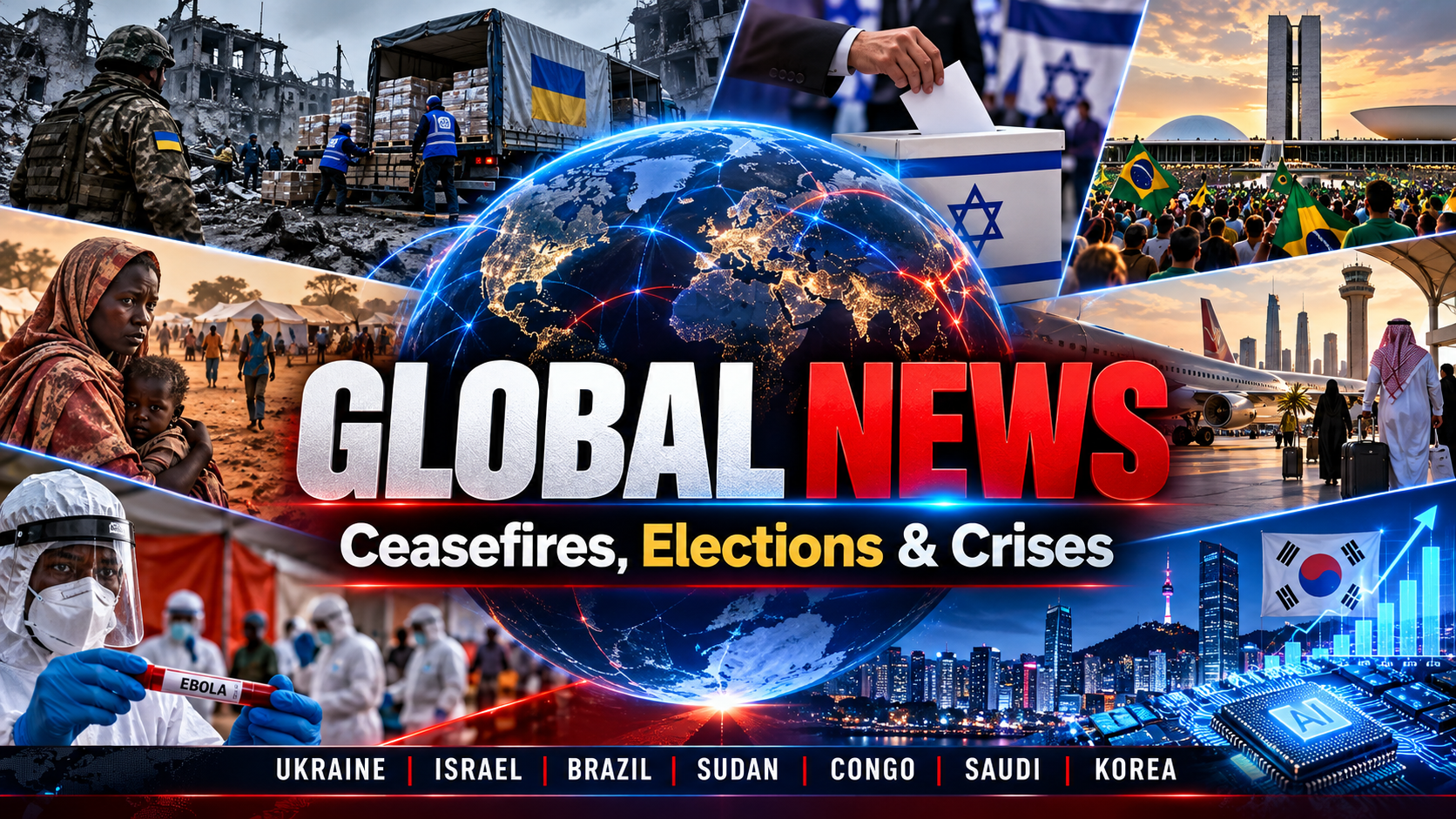
Global News: Ukraine Ceasefire Begins, Israel Votes, Brazil Faces Election Dispute, and Africa Confronts Humanitarian Crises
GLOBAL NEWS DESK | Tuesday, October 27, 2026
World leaders are navigating a series of major developments this week as a temporary ceasefire takes effect in Ukraine, Israelis head to the polls in a consequential national election, and Brazil faces political tensions following President Luiz Inácio Lula da Silva's reelection.
Meanwhile, a student-led political movement has reshaped Serbia's leadership, international governments are warning of possible famine in Sudan, and health authorities are confronting an expanding Ebola outbreak in Central Africa.
Economic developments in Asia and renewed security concerns in the Middle East are adding to an already complicated global picture.
1. Russia and Ukraine Begin Localized Ceasefire to Allow Humanitarian Aid
UKRAINE: A temporary ceasefire between Russian and Ukrainian forces began Tuesday in the Russian-occupied town of Oleshky, offering a potential humanitarian lifeline to civilians who have endured years of war.
The agreement, brokered through diplomatic efforts involving U.S. First Lady Melania Trump and Pope Leo XIV, is intended to allow food, clean water, medical supplies, and other essential assistance into the devastated community.
The ceasefire began at approximately 3 a.m. local time Tuesday and is expected to remain in place until November 1.
Oleshky, located in Ukraine's southern Kherson region, has been under Russian occupation since the early stages of the full-scale invasion in February 2022.
Before the war, approximately 24,000 people lived in the town. Only a few thousand are believed to remain, many of them elderly or dealing with serious medical conditions.
Residents have reported dangerous shortages of medicine, food, electricity, and drinking water.
Despite the humanitarian breakthrough, the agreement does not extend across Ukraine.
Russian missile and drone attacks continued elsewhere, including strikes on Kyiv that killed at least one person and damaged critical infrastructure.
The limited ceasefire comes ahead of additional U.S.-Russia-Ukraine diplomatic discussions expected in Abu Dhabi in early November.
Whether the localized agreement creates opportunities for broader negotiations remains uncertain.
2. Israel Votes in High-Stakes Election That Could Determine Netanyahu's Political Future
JERUSALEM, ISRAEL: Israeli voters headed to polling stations Tuesday in the country's first national election since the October 7, 2023, Hamas-led attacks.
Prime Minister Benjamin Netanyahu faces one of the most consequential political challenges of his career as the election becomes a referendum on his leadership, national security policies, and handling of prolonged regional conflicts.
Former Israeli military chief Gadi Eisenkot has emerged as a major challenger.
More than seven million Israelis are eligible to vote.
The election arrives amid continuing public concerns about security, the Gaza war, relations with neighboring countries, and divisions within Israeli society.
For Netanyahu's supporters, the election represents an opportunity to preserve experienced leadership during an uncertain security environment.
Critics argue that Israel needs a new political direction following years of conflict and domestic disagreement.
The final outcome could influence Israel's military strategy, relations with the United States, negotiations involving Palestinians, and broader diplomatic efforts throughout the Middle East.
The election's results may also determine whether Netanyahu can assemble another governing coalition.
3. Brazil's Lula Wins Fourth Presidential Term as Election Dispute Intensifies
BRASILIA, BRAZIL: Brazilian President Luiz Inácio Lula da Silva secured a historic fourth nonconsecutive presidential term following Sunday's runoff election.
Lula defeated right-wing Senator Flávio Bolsonaro, son of former President Jair Bolsonaro, by more than four million votes.
However, the aftermath has created new political tensions.
Flávio Bolsonaro initially refused to concede, announcing plans to challenge the result after Brazil's Supreme Court authorized a two-hour extension of voting.
On Monday, Bolsonaro's Liberal Party formally recognized the election results while continuing to question aspects of the process.
U.S. President Donald Trump also criticized the election, suggesting without presenting evidence that the outcome appeared questionable.
Brazilian officials rejected those allegations and defended the country's electoral system.
The election places Lula at the center of another important period for Latin America's largest economy.
His next administration will face pressure to address public debt, economic growth, political divisions, and relationships with international trading partners.
The outcome also carries significance for regional diplomacy as governments throughout South America respond to shifting political alliances.
4. Serbia Enters New Political Era After Student-Led Movement Defeats Longtime Leadership
BELGRADE, SERBIA: Serbia is experiencing a major political transformation following the election victory of a student-backed movement that defeated longtime leader Aleksandar Vučić.
The historic result followed approximately two years of anti-government demonstrations fueled by public anger over corruption and accountability.
The movement gained momentum after a railway station canopy collapsed in Novi Sad in 2024, killing 16 people.
Students became central figures in protests demanding government responsibility and institutional reform.
Following Sunday's election, Vučić acknowledged defeat, triggering celebrations across Serbia.
However, the victory has also created questions about the country's next government.
The student movement supported a diverse group of candidates, including teachers, legal professionals, doctors, and other members of civil society.
Many have little or no experience in national government.
Their immediate challenges include building a stable administration, combating corruption, addressing economic issues, and managing Serbia's relationships with Russia, China, and the European Union.
The transition represents a potentially historic moment for democratic accountability in the Western Balkans.
5. International Community Warns of Growing Famine Risk in Sudan
SUDAN: The United States and dozens of international partners are warning that Sudan faces an increasingly severe humanitarian emergency as civil war continues to devastate communities.
A joint international statement called for expanded humanitarian access and additional financial assistance to prevent worsening hunger.
Sudan's civil war began in April 2023 following a power struggle between the Sudanese Armed Forces and the paramilitary Rapid Support Forces.
The conflict has displaced more than 14 million people and disrupted agriculture, commerce, transportation, and humanitarian relief operations.
United Nations-backed assessments have identified millions of people facing severe food insecurity.
Approximately 5.1 million people were reported to be experiencing severe hunger in a June assessment.
International governments are urging both warring parties to remove restrictions on humanitarian operations and protect civilian infrastructure and aid workers.
The growing emergency illustrates how prolonged conflict can create humanitarian consequences extending well beyond the battlefield.
Without improved access to food, medical care, and essential services, international officials warn that conditions could deteriorate further.
6. Congo Ebola Outbreak Surpasses 10,000 Cases as Regional Health Concerns Grow
DEMOCRATIC REPUBLIC OF CONGO: Health officials are raising concerns about the continued spread of Ebola after confirmed cases in the Democratic Republic of Congo surpassed 10,000.
Government figures released Tuesday identified 10,060 confirmed infections and 4,887 deaths.
The outbreak, announced in May, involves the Bundibugyo species of Ebola and has become the largest recorded epidemic in Congo's history.
Cases have also been reported in other African countries, increasing concern about regional transmission.
Kenya has reported infections, while health officials in Nigeria are investigating a case involving a woman who was subsequently transported to Switzerland for treatment.
International health organizations are working with regional authorities to strengthen disease surveillance, identify transmission routes, and reduce the risk of additional outbreaks.
The epidemic is placing further pressure on health systems already facing infrastructure shortages and other public health challenges.
The growing death toll has renewed calls for international cooperation, medical resources, and improved access to affected communities.
7. Houthi Attacks Disrupt Saudi Air Travel and Raise Regional Security Concerns
RIYADH, SAUDI ARABIA: Missile and drone attacks launched by Yemen's Iran-aligned Houthi movement have caused major disruptions to air travel in Saudi Arabia.
Aviation data reviewed by Reuters showed that approximately 86% of scheduled flights at Riyadh's King Khalid International Airport were canceled between October 8 and October 25.
That represents more than 4,000 canceled flights.
The airport has experienced repeated security threats and attacks, forcing authorities and airlines to alter flight operations.
Saudi officials partially reopened airport terminals on Sunday, but continued security concerns have complicated efforts to restore normal service.
The disruption highlights the wider economic consequences of conflict in the Middle East.
Air transportation, international business travel, tourism, logistics, and commercial activity can all suffer when regional security deteriorates.
The situation remains particularly important because Saudi Arabia is a major international aviation and energy hub.
8. South Korea's Economy Grows Faster Than Expected as AI Chip Demand Surges
SEOUL, SOUTH KOREA: South Korea's economy delivered stronger-than-expected growth during the third quarter as global demand for artificial intelligence technology supported semiconductor exports and business investment.
Preliminary central bank data showed the economy expanded 1.0% compared with the previous quarter, outperforming economists' expectations of 0.7%.
Officials estimated that semiconductor activity accounted for approximately half of the country's economic growth.
The increased demand for advanced chips reflects continuing global investment in AI infrastructure and computing technology.
However, the economic picture remains mixed.
Private consumption declined during the quarter, indicating that the technology-driven expansion has not translated into equally strong household spending.
The latest figures demonstrate the growing influence of artificial intelligence on international trade and economic competitiveness.
South Korea remains a major supplier of semiconductor technology essential to global computing, electronics, and AI development.
Global Outlook: A World Balancing Conflict, Political Change, and Economic Opportunity
The international developments of October 27 illustrate the different challenges facing governments and communities worldwide.
Ukraine's limited ceasefire offers an opportunity for humanitarian relief, but wider fighting continues.
Elections in Israel and Brazil are testing political leadership and public trust, while Serbia faces the difficult transition from political protest to governing.
Across Africa, hunger and disease remain urgent concerns demanding sustained international attention.
Meanwhile, developments in the Middle East and Asia show how security risks and technological innovation can affect economies far beyond national borders.
The central question moving forward is whether diplomatic cooperation, responsible leadership, and international assistance can keep pace with the world's rapidly changing political, humanitarian, and economic challenges.
SOURCES AND FULL LINKS
1. Reuters | US-Brokered Ceasefire Starts in Ukrainian Town Facing Starvation (October 27, 2026)
2. Associated Press | Israelis Vote in Pivotal Election (October 27, 2026)
https://apnews.com/article/israel-election-netanyahu-eisenkot-3b5a0fd078208155337ee9a0b9fbfde2
3. Reuters | Brazil Election Dispute After Lula Victory (October 26, 2026)
4. Reuters | Serbia's Student Movement Topples Longtime Leadership (October 26, 2026)
5. Reuters | Countries Warn of Sudan Famine Risk (October 27, 2026)
6. Reuters | Congo Ebola Cases Surpass 10,000 (October 27, 2026)
7. Reuters | Houthi Attacks Ground Flights Across Saudi Arabia (October 26, 2026)
8. Reuters | South Korea Economic Growth Beats Forecasts (October 27, 2026)