
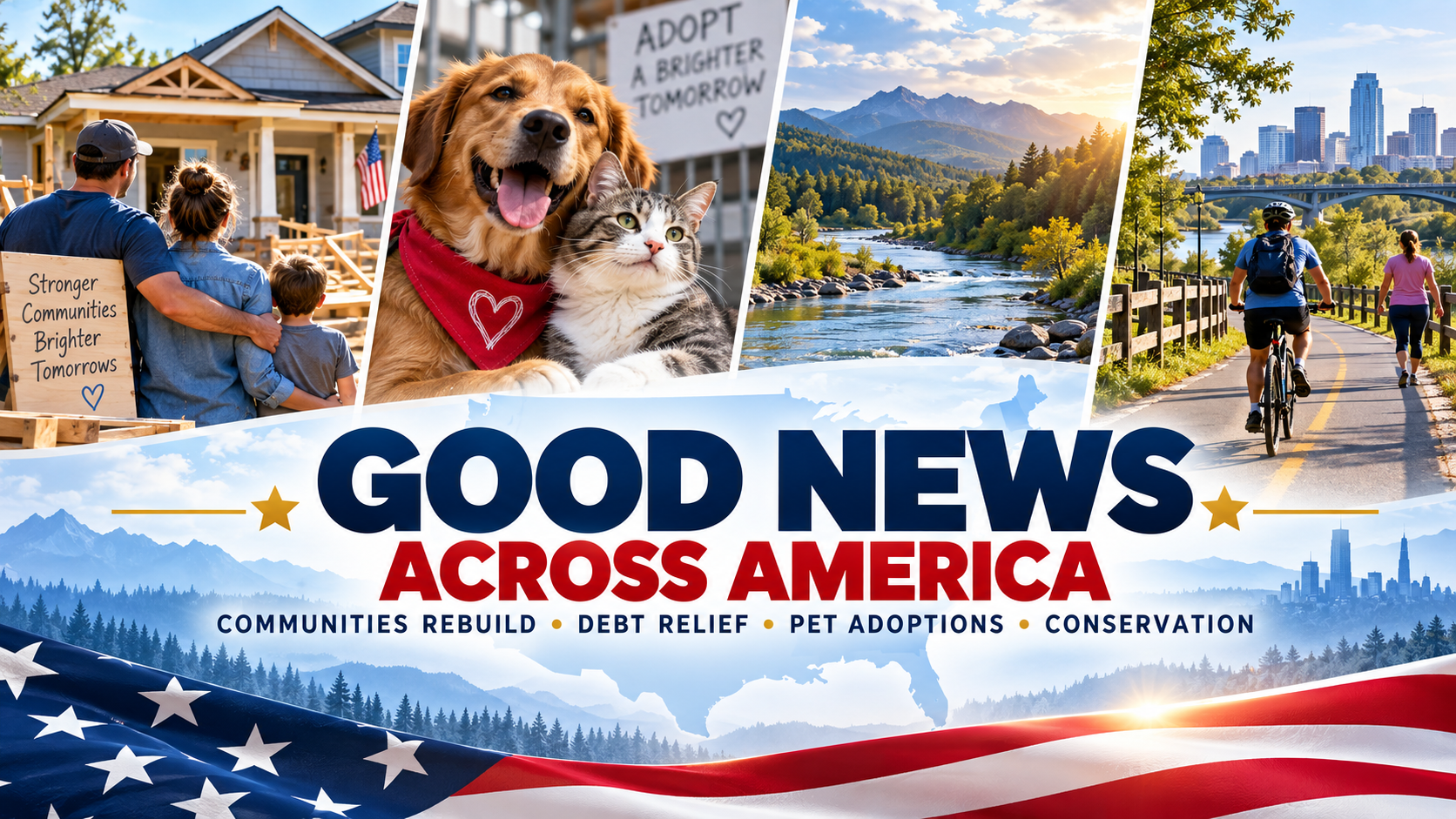
Good News Across America: Communities Rebuild, Medical Debt Disappears and Thousands of Pets Find Homes
September 25, 2026 | U.S. Good News
By I Am Refocused Radio News Desk
Across the United States, some of this week's most encouraging stories are not necessarily the loudest ones.
A Tennessee family displaced by Hurricane Helene has finally returned home. Kentucky is moving to erase hundreds of millions of dollars in medical debt. More than 135,000 shelter animals have found homes through a nationwide adoption campaign. A major philanthropic commitment aims to make veterinary care more accessible, while new investment is being directed toward conserving one of the West's most important water sources.
From Minnesota to the Colorado River Basin, here are several stories showing communities, organizations and individuals solving problems rather than simply describing them.
Tennessee Family Returns Home Nearly Two Years After Hurricane Helene
For one eastern Tennessee family, recovery from Hurricane Helene has finally reached a milestone that once seemed distant: coming home.
The American Red Cross reported September 24 that Noah and his family have moved into a newly rebuilt home after their previous house along the Pigeon River in Cocke County was destroyed during Helene.
Their recovery became a community effort.
The Red Cross provided direct financial assistance and grants to local recovery partners. The United Methodist Committee on Relief helped with disaster case management and building materials, while the Salvation Army supplied furniture and Catholic Charities helped with additional household essentials.
The house was ultimately rebuilt on land that has been in the family for generations.
The story illustrates something often lost after disaster headlines fade: recovery can take years, and rebuilding frequently depends on cooperation among local residents, nonprofits, charities and public institutions.
Kentucky Moves to Eliminate $250 Million in Medical Debt
More than 130,000 Kentuckians are expected to receive relief from approximately $250 million in medical debt through a new statewide program.
Kentucky Gov. Andy Beshear signed an executive order September 15 directing $2.5 million to Undue Medical Debt, a nonprofit that purchases qualifying medical debt and cancels it.
For eligible residents, the process does not require an application or payment.
Kentucky says an initial round will eliminate roughly $100 million in debt for 46,000 people, with notices being sent directly to those whose qualifying debts have been canceled.
Medical debt can affect much more than a hospital bill. It can influence household budgets and access to credit while creating financial pressure long after treatment ends.
The program is an unusually large example of governments and nonprofit organizations using the secondary medical-debt market to provide direct financial relief.
More Than 135,000 Shelter Pets Find Homes
Thousands of dogs, cats and other animals have new homes following one of the country's largest coordinated pet-adoption campaigns.
NBCUniversal Local says its 2026 Clear The Shelters campaign helped more than 135,000 animals find homes while raising nearly $500,000 for participating shelters.
More than 100 NBC and Telemundo stations partnered with over 1,200 shelters in 47 states, Washington, D.C., Puerto Rico and Guam.
The adoption campaign ran throughout August, while fundraising continued from July 15 through September 15.
Since Clear The Shelters began in 2015, organizers say the initiative has contributed to nearly 1.5 million pet adoptions and generated more than $6 million for shelters.
Those numbers matter at a time when many animal shelters continue operating near or above capacity.
Behind the national totals are thousands of very small stories: an empty kennel, a new leash, a first night on somebody's couch.
$250 Million Commitment Aims to Expand Affordable Veterinary Care
Finding pets homes is one challenge. Helping families afford their care is another.
The Dave & Cheryl Duffield Foundation has announced a $250 million, five-year commitment to expand access to nonprofit and lower-cost veterinary services across the United States.
The initiative, called Big Bet for Pets, will support nonprofit veterinary providers, rural communities, research and programs designed to reduce barriers to care.
The foundation says one part of the program will provide 250 nonprofit or low-cost veterinary clinics with $10,000 grants during 2026. Other grants are designed to help established providers expand their services, including adding clinics, mobile units, staff, equipment and technology.
At least $25 million of the broader commitment is planned for veterinary-care research, program evaluation and efforts to identify strategies that can be replicated nationally.
The Chronicle of Philanthropy reports that the foundation estimates as many as 50 million dogs and cats in the United States may face gaps in access to veterinary care because of cost and other barriers.
New Colorado River Coalition Directs Millions Toward Water Conservation
The Colorado River supplies water to communities, farms and ecosystems across much of the American West, making efforts to conserve it consequential far beyond any single state.
Amazon announced a $20 million investment in Colorado River conservation projects as part of the newly formed Colorado River Basin Collaborative. The broader coalition has set a two-year goal of mobilizing $100 million for water-conservation work.
Projects are expected to include agricultural efficiency improvements and water-loss reduction efforts in Arizona and California.
The Colorado River serves roughly 40 million people and millions of acres of farmland across seven U.S. states and Mexico.
The investment does not solve the river's larger water-supply challenges. Reporting by The Verge notes that Amazon itself continues to face scrutiny over the water demands associated with its data centers and the completeness of its water-use disclosures.
That context matters.
The encouraging development is not that one corporate investment has "saved" the Colorado River. It is that additional private funding is being directed toward measurable conservation projects while the larger debate over sustainable water use continues.
Minnesota Completes 165-Mile Trail After Three Decades
Some projects require patience measured not in months, but generations.
After more than 30 years of planning, fundraising and construction, Minnesota's Mesabi Trail is now complete.
The paved route stretches approximately 165 miles from Grand Rapids to Ely, crossing forests, wetlands, historic mining areas and 28 communities along northern Minnesota's Iron Range.
The final 6.5-mile section between Embarrass and Tower was completed this year.
Minnesota Public Radio reports that approximately 285,000 people used the trail in 2025, and officials expect usage to increase following completion of the continuous route.
The trail is more than a recreational amenity.
Long-distance trails can connect small towns, encourage outdoor activity, generate tourism spending and repurpose landscapes once dominated by industrial activity.
Thirty years after construction began, cyclists can now travel the entire corridor without encountering the gaps that defined the project for decades.
A 13-Year-Old Heads Toward Graduate School
One of the week's most remarkable education stories comes from New York.
Joe Petraro-Hyppolite, a 13-year-old Long Island student, has been accepted into a master's program at New York University after completing an unusually accelerated academic path.
His story includes more than academic achievement.
Joe previously underwent treatment for leukemia and has spoken publicly about experiencing severe bullying and living with Tourette syndrome and dyslexia. He later advanced rapidly through school and completed college coursework while still in his early teens.
He has also been involved in charitable work, including an anti-bullying campaign and community service projects.
The significance of the story is not that every young person should race through school.
It is that a student whose abilities and challenges were not always understood found an educational environment that allowed him to develop them.
Progress Doesn't Always Arrive With a Breaking-News Banner
There is a temptation to treat "good news" as an escape from serious journalism.
It should not be.
The strongest positive stories still involve real problems: hurricanes destroy homes, medical debt burdens families, shelters become overcrowded, veterinary care can be unaffordable, water supplies are under pressure and major infrastructure projects can take decades to finish.
What makes these stories encouraging is not the absence of difficulty.
It is the presence of response.
A family came home.
Debt is being erased.
Animals left shelters with families.
Veterinary clinics are receiving new resources.
Money is moving toward water conservation.
A trail that took three decades to build finally connects end to end.
None of those developments fixes everything.
But each represents measurable movement in a better direction, and that is worth reporting too.
Sources
American Red Cross — Happy Tears: A Tennessee Family Returns Home after Helene
https://www.redcross.org/local/tennessee/about-us/news-and-events/news/happy-tears--a-tennessee-family-returns-home-after-helene.html
Team Kentucky — Executive Actions: Medical Debt Relief
https://medicaldebtrelief.ky.gov/executive-actions/
Office of Kentucky Gov. Andy Beshear — Gov. Beshear To Relieve $250 Million in Medical Debt for More Than 130,000 Kentuckians
https://content.govdelivery.com/accounts/KYGOV/bulletins/42ad0e3
Team Kentucky Medical Debt Relief — Program Overview
https://medicaldebtrelief.ky.gov/
NBCUniversal — 2026 Clear The Shelters Results in More Than 135,000 Pet Adoptions
https://www.nbcuniversal.com/article/nbcu-locals-2026-clear-shelters-presented-hills-pet-nutrition-results-more-135000-pet-adoptions-and
Dave & Cheryl Duffield Foundation — Big Bet for Pets
https://www.duffieldfoundation.org/bigbetforpets
Chronicle of Philanthropy — Duffield Foundation's $250 Million Helps Families Access Veterinary Care
https://www.philanthropy.com/news/duffield-foundations-250-million-helps-struggling-families-access-veterinary-care/
Amazon — Colorado River Basin Collaborative Conservation Investment
https://www.publicnow.com/view/F3585865C41F440CB797762BC34AA705B35D5D4F
KJZZ — Amazon Will Spend Millions to Help Save Colorado River Water
https://www.kjzz.org/business/2026-09-21/amazon-will-spend-millions-to-help-save-colorado-river-water
The Verge — Amazon Wants to Help the Colorado River, but Questions Remain About Its Water Use
https://www.theverge.com/tech/998539/amazon-data-center-water-conservation-colorado-river
Minnesota Public Radio — After 30 Years, Minnesota's Longest Paved Bike Path Is Finally Finished
https://www.mprnews.org/story/2026/09/15/mesabi-trail-minnesotas-longest-paved-bike-path-completed
KAXE — Mesabi Trail Completed After 30 Years
https://www.kaxe.org/local-news/2026-09-08/mesabi-trail-completed-after-30-years
People — 13-Year-Old Set to Start Graduate School After Overcoming Cancer and Bullying
https://people.com/new-york-teen-tests-genius-level-iq-set-for-masters-program-at-13-12128501