
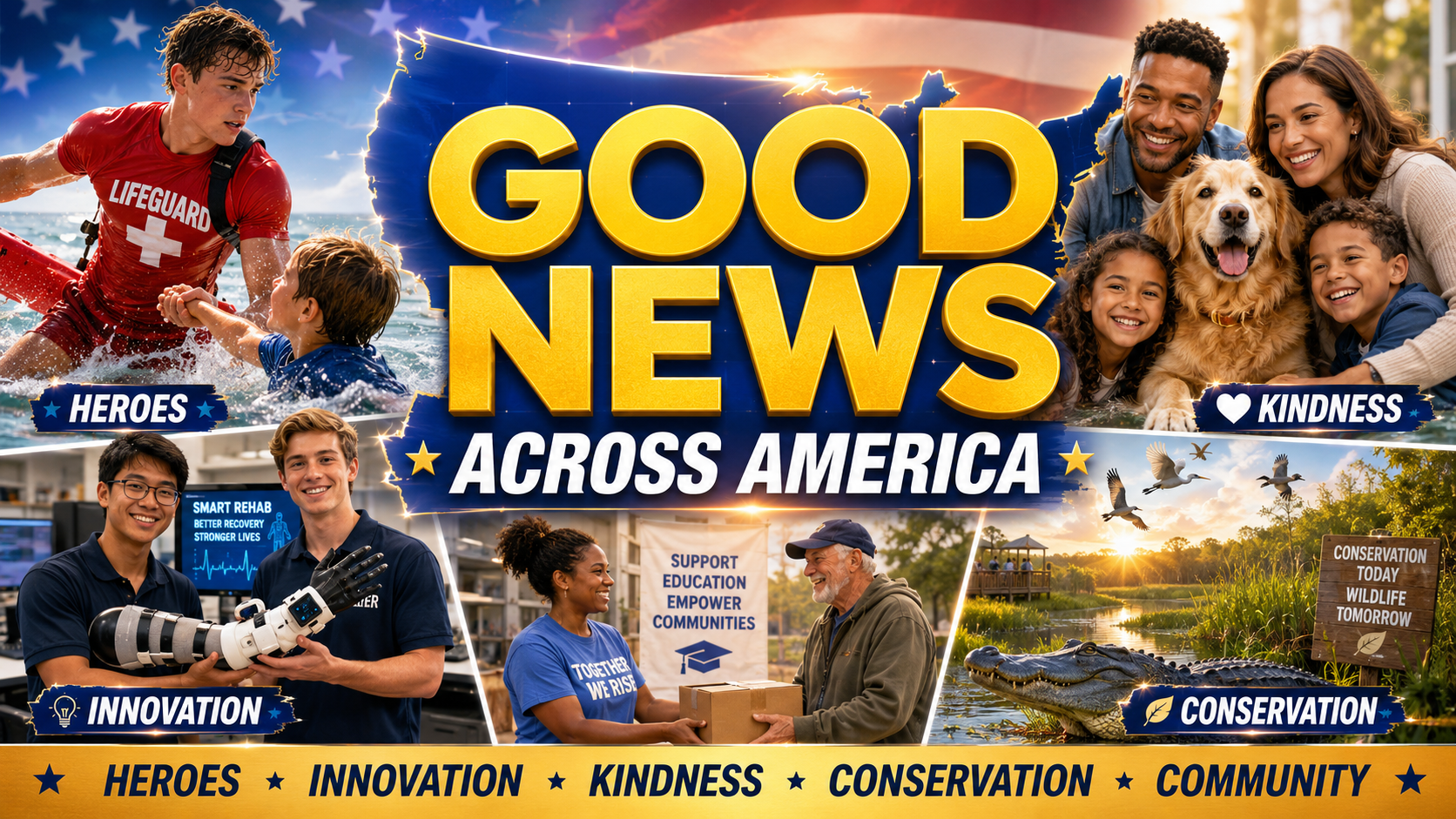
Good News Across America: Young Heroes, Big Giving and Communities Rising
Wednesday, August 5, 2026
The national news cycle can feel like a machine built to grind every difficult moment into dust. Yet across the United States, another story is unfolding quietly beneath the louder headlines.
A teenage lifeguard refused to release a child caught in violent surf. College students designed technology that could help stroke survivors regain movement. A stranger handed his vehicle to a stranded band, trusting people he had never met with the keys.
Elsewhere, one of America’s greatest wetlands gained international recognition, communities celebrated progress after years of drought, and major philanthropic campaigns committed hundreds of millions of dollars to education, nonprofits and public service.
These stories do not erase the country’s challenges. They remind us that challenge is not the only thing growing.
Sixteen-Year-Old Lifeguard Saves Child From Powerful California Surf
A rookie lifeguard in Santa Cruz, California, is being praised after rescuing a 10-year-old boy who was swept into the ocean by a powerful sneaker wave at Seabright Beach.
Ryder Williams, 16, rushed into the surf and held tightly to the child as repeated waves crashed over them. Other adults attempted to help but were knocked down by the force of the water.
Williams stayed with the boy until another lifeguard arrived and helped bring him safely to shore. No serious injuries were reported.
The teenager later described the rescue simply as his job, giving credit to lifeguards who perform similar acts every day. His humility may be the quietest part of the story, but it is also the loudest lesson: courage often arrives before anyone has time to prepare a speech.
Texas Students Develop Wearable Device for Stroke Recovery
Two University of Texas at Arlington students have won a national invention award for creating a lightweight robotic wrist device designed to help stroke survivors regain movement.
Electrical engineering student Suyog Neupane and computer science student Kritazya Upreti earned first place in the university division of the 2026 National Academy of Inventors GenSpiration Prize Competition.
Their soft exoskeleton uses air pressure rather than heavy motors and can assist two types of wrist movement through one compact actuator. The technology is intended to support repetitive rehabilitation exercises while becoming less intrusive as a patient regains strength.
The students say the project was motivated by the everyday challenges stroke survivors can face with tasks such as writing, eating or turning a doorknob.
This is what innovation looks like when intelligence and compassion share the same laboratory.
Nationwide Shelter Campaign Begins With a Mission to Find Homes for Pets
The annual Clear the Shelters campaign is underway throughout August, connecting animal shelters and rescue organizations with potential adopters across the country.
Since its launch in 2015, the campaign has helped more than 1.3 million pets find homes and has raised more than $5.6 million for shelters and rescues.
During the 2025 campaign alone, more than 160,000 animals were adopted. More than 1,700 participating organizations represented 49 states, the District of Columbia, Puerto Rico and Guam.
The 2026 initiative runs through August 31, while fundraising continues through September 15. Participants can search for adoptable pets, contribute to specific shelters or support the campaign’s general fund.
For an animal waiting behind a shelter door, a family’s decision to adopt is not a small event. It is the whole sky opening.
Okefenokee National Wildlife Refuge Earns World Heritage Recognition
The Okefenokee National Wildlife Refuge, located across southeastern Georgia and northeastern Florida, has been added to UNESCO’s World Heritage List.
The refuge protects the world’s largest lowland freshwater peatland in the subtropical zone and one of the most intact ecosystems in the North American Coastal Plain biodiversity hotspot.
UNESCO says the site supports at least 856 plant species, 48 mammal species, 238 bird species, 39 fish species and 90 reptile and amphibian species.
Its wetlands also store carbon, preserve a record of environmental history and provide critical habitat for migratory birds, American alligators and threatened wildlife.
The designation recognizes more than scenery. It celebrates generations of conservation work that protected a living ecosystem rather than allowing it to become a memory printed inside a textbook.
Wisconsin Stranger Lends His Vehicle to Stranded Touring Band
A Detroit-based rock band was facing the collapse of its tour when its van broke down on a rural Wisconsin highway.
The members of Autumn Kings had about 10 hours to travel roughly 500 miles for their next performance in Grand Rapids, Michigan, but mechanics said the van would need approximately two days of repairs.
Then a stranger named Ernie stopped to help.
Rather than offering only a ride or a phone number, the 60-year-old Wisconsin resident handed the musicians the keys to his Ford Explorer and allowed them to use it for several days. The band drove more than 1,000 miles before returning the vehicle.
When asked why he trusted three strangers with his truck, Ernie said he simply wanted to help people stranded on the road.
No grand strategy. No committee meeting. Just a man, a set of keys and kindness operating without a background check.
Corpus Christi Eases Water Restrictions After Rain and Conservation
Corpus Christi, Texas, has eased its water restrictions after nearly two years of severe drought conditions and strict conservation measures.
The city transitioned from Stage 3 to Stage 2 restrictions on August 4 after rainfall improved levels in Lake Corpus Christi and Choke Canyon Reservoir.
Officials also credited residents with significantly reducing water use. Average monthly household consumption reportedly declined from approximately 6,000 gallons to 4,000 gallons during the conservation period.
The city is not declaring the water challenge permanently solved. Leaders continue pursuing long-term strategies involving desalination, groundwater, wastewater reuse and infrastructure investment.
Still, the improvement demonstrates what can happen when weather finally cooperates with years of shared discipline. A community cannot command the clouds, but it can decide what to do with every drop that arrives.
Foundation Commits at Least $500 Million to Community Organizations
The Seattle-based Marguerite Casey Foundation plans to distribute at least $500 million over the next decade, raising its annual giving baseline to $50 million.
The foundation supports community organizations working on issues including housing, employment, responsive government and local journalism.
The new annual commitment is approximately 50 percent higher than the foundation’s average giving during the previous decade. Its leaders hope the increased spending will encourage other philanthropic organizations to provide more support during a period of growing pressure on nonprofits.
The announcement is important because community groups are often asked to solve enormous problems with tiny budgets and heroic levels of exhaustion.
Funding cannot manufacture trust. But when placed in the hands of organizations that already possess community trust, it can provide the oxygen needed to turn local knowledge into lasting action.
$25 Million Matching Gift Supports 9/11 Education for New Generations
The National September 11 Memorial and Museum has launched a $75 million fundraising campaign aimed partly at educating young Americans who were born after the attacks.
Former New York City Mayor Mike Bloomberg has pledged to match the next $25 million donated through Bloomberg Philanthropies. Organizers say an initial $25 million has already been secured.
The campaign will help create educational materials, support teacher training and continue free museum access for students, first responders and veterans.
Museum leaders estimate that roughly 100 million Americans were born after September 11, 2001. The project seeks to teach both the basic facts of the attacks and the stories of service, sacrifice and cooperation that followed.
Remembering tragedy responsibly means refusing to let pain have the final word. The history must include the darkness, but it should also preserve the people who carried food, powered emergency lights and served strangers when the city needed them most.
A Colorado Child’s Musical Gift Flourishes After a Stranger Donates a Piano
A Colorado boy whose remarkable musical ability was discovered unexpectedly is now performing and recording after a stranger invested in his talent.
Jude Kofie, who is autistic, began playing an unused keyboard at age nine despite having no formal training. A local piano tuner named Bill Magnuson later heard Jude perform and purchased a grand piano for him, reportedly spending about $15,000 from a family inheritance.
The gift also included professional lessons and lifetime tuning services.
Now 14, Jude has performed publicly and released an album. What began with a forgotten keyboard became a reminder that talent is everywhere, even when opportunity is not.
Sometimes potential does not need to be created. It needs someone willing to hear it through the basement walls.
What These Stories Have in Common
A lifeguard used his training. Students used their education. Residents conserved water. Researchers built a rehabilitation device. Donors opened their wallets. One stranger simply opened his vehicle.
None of them waited to solve every problem in America before addressing the problem directly in front of them.
That may be the common thread running through the country’s best news: meaningful change rarely begins at maximum volume. It begins with someone noticing, caring and moving.
Refocused Perspective
Good news is not the denial of difficult reality. It is evidence that difficult reality is still being challenged.
Hope is not passive optimism floating above the ground. It is a lifeguard tightening his grip, a student refining a prototype, a family opening its home to an animal, or a stranger placing trust into another person’s hands.
The country may not agree on everything. But every day, people continue agreeing through their actions that a life can be saved, a community can recover and tomorrow is still worth building.
That deserves a headline too.
Sources and Full Links
- Good News Network: Sixteen-year-old lifeguard leads California ocean rescue
https://www.goodnewsnetwork.org/16-yo-rookie-lifeguard-leads-heroic-ocean-rescue-with-viral-video-of-harrowing-effort/ - University of Texas at Arlington: Students win national invention award
https://www.uta.edu/news/news-releases/2026/07/23/uta-students-win-national-award - NBCUniversal: Clear the Shelters returns for its 12th year
https://www.nbcuniversal.com/article/nbcu-locals-clear-shelters-presented-hills-pet-nutrition-returns-12th-annual-pet-adoption-donation - UNESCO: Okefenokee National Wildlife Refuge
https://whc.unesco.org/en/list/1751/ - UNESCO: United States World Heritage properties
https://whc.unesco.org/en/statesparties/us - Good News Network: Stranger lends truck to touring band
https://www.goodnewsnetwork.org/midwest-stranger-lends-his-truck-to-band-with-broken-down-van/ - MySA: Corpus Christi eases water restrictions
https://www.mysanantonio.com/news/local/article/corpus-christi-lifts-water-restrictions-22372255.php - Associated Press: Marguerite Casey Foundation pledges $500 million
https://apnews.com/article/marguerite-casey-foundation-endowment-trump-nonprofits-305497c5a1a280e03cecfda439cd5a9a - Associated Press: $25 million matching gift supports 9/11 education
https://apnews.com/article/september-11-memorial-mike-bloomberg-72aea9254c308958a4cb408232ff74cf - Good News Network: Stranger gives talented Colorado child a piano
https://www.goodnewsnetwork.org/after-stranger-gives-boy-a-piano-a-mozart-level-is-revealed-in-spite-of-autism/