
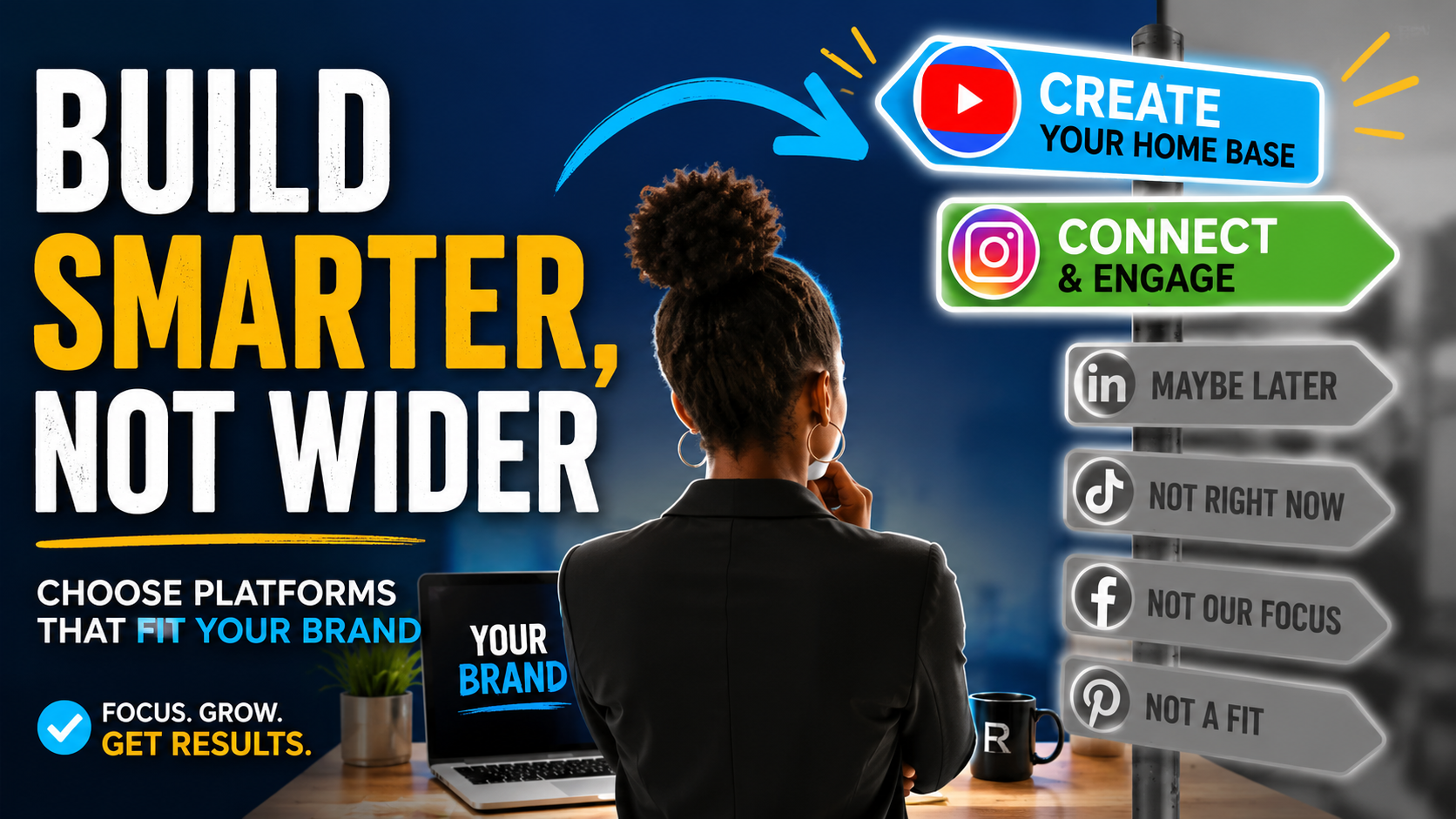
Grow Your Brand Online Without Spreading Yourself Thin
How to Choose Social Platforms That Actually Fit Your Brand
Trying to maintain a presence on every social platform can make a brand look active while quietly draining the person running it.
The solution is not to abandon social media. It is to build a smaller, more deliberate platform system based on your audience, strengths, goals and available time.
Most independent creators, small businesses, nonprofits and personal brands should begin with one primary platform and one supporting platform. The primary platform holds your strongest content. The supporting platform helps people discover, discuss or share it.
Everything else can wait.
The Direct Answer
Choose the social platforms where these three things overlap:
- Your intended audience already spends time there.
- The platform supports the kind of content you can consistently produce.
- The platform can move people toward a meaningful next step.
That next step might be:
- Watching a complete interview
- Visiting your website
- Joining an email list
- Booking a consultation
- Attending an event
- Buying a product
- Streaming a song
- Donating to a cause
- Contacting your organization
A platform should have a specific job. If you cannot explain why your brand is using a platform, maintaining it will probably become busywork.
A practical structure is:
- Primary platform: Your main content and community home
- Supporting platform: Discovery, short-form content or professional conversation
- Owned destination: Your website, email list, store or contact system
Your social accounts are rented rooms. Your website and email list are property you control.
Why This Matters
Social platforms reward different behaviors, audiences and formats. A strategy that works for a restaurant may not fit a consultant. A musician’s strongest platform mix may be ineffective for a nonprofit or local contractor.
The largest platform is not automatically the best platform for your brand.
Pew Research Center reported in its 2025 survey that YouTube and Facebook remained the most widely used social platforms among American adults, while Instagram, TikTok, LinkedIn and other platforms reached different portions of the public. Broad popularity can indicate opportunity, but it does not prove that a platform contains the right audience for a specific business or creator.
Spreading yourself too thin usually creates four problems:
- Content quality declines.
- The brand begins sounding different on every platform.
- Comments and messages go unanswered.
- The owner cannot determine which activity is producing results.
A focused social strategy gives your content time to improve. It also makes your results easier to measure.
The goal is not to appear everywhere. The goal is to become recognizable somewhere.
Step-by-Step Guide
Step 1: Decide What Social Media Must Accomplish
Do not begin with, “Which platform should I join?”
Begin with, “What should happen because I am using social media?”
Choose one primary objective for the next 90 days.
Examples include:
- Increase podcast or video viewers
- Generate qualified business inquiries
- Sell event registrations
- Grow an email list
- Build professional credibility
- Attract media opportunities
- Introduce a new product
- Create stronger community relationships
A local fitness trainer might choose consultation requests as the objective. An independent musician might focus on increasing repeat listeners and email subscribers. A nonprofit might want more volunteer applications.
These objectives require different content and different calls to action.
How to know this step is complete
You should be able to finish this sentence:
During the next 90 days, our social content will help [specific audience] take [specific action].
Step 2: Identify the Audience You Need, Not Just the Audience You Have
Write down:
- Who you want to reach
- What problem they are trying to solve
- What they care about
- What questions they repeatedly ask
- What type of content earns their attention
- What action they are realistically prepared to take
Avoid descriptions such as “everyone,” “business owners” or “people who love music.”
A more useful audience description would be:
Independent business owners in San Antonio who need affordable ways to improve visibility but do not have an in-house marketing team.
That description immediately points toward practical educational content, local references and platforms that support professional or community discovery.
Step 3: Give Each Platform a Job
Choose platforms according to what they do for the brand.
YouTube
YouTube is a strong primary platform for:
- Interviews
- Tutorials
- Product demonstrations
- Educational series
- Music videos
- Documentaries
- Commentary
- Searchable long-form content
YouTube Analytics provides information about viewers, engagement, returning audiences and other content an audience watches. YouTube recommends using those audience insights to shape content strategy rather than relying only on assumptions.
Best fit: Brands that can teach, demonstrate, interview, entertain or tell complete stories.
Poor fit: A team that does not have enough production time and has no realistic plan for video.
Instagram can work well for:
- Visual storytelling
- Personal brands
- Behind-the-scenes material
- Products and services with strong visual appeal
- Short video
- Event promotion
- Community interaction through comments and messages
Instagram Insights can help professional accounts understand their followers and content performance. Meta also provides performance information through Meta Business Suite.
Best fit: Brands with strong visuals, recognizable people, products, transformations, experiences or short educational content.
Poor fit: Organizations that post attractive graphics but provide no useful message or next step.
LinkedIn can be effective for:
- Business-to-business services
- Professional credibility
- Leadership ideas
- Industry commentary
- Recruiting
- Partnerships
- Consulting
- Media and speaking opportunities
LinkedIn provides analytics for individual posts and company pages, including performance across multiple content formats and audience information when enough data is available.
Best fit: Professionals and organizations whose growth depends on expertise, trust, referrals or business relationships.
Poor fit: A brand that posts corporate announcements without offering any insight, story or useful information.
Facebook remains useful for:
- Local businesses
- Community organizations
- Events
- Neighborhood audiences
- Groups
- Existing customer relationships
- Reaching adult consumers across a broad age range
Meta Business Suite provides performance information for Facebook posts, videos, reels, stories and advertising.
Best fit: Local, community-oriented and service-based organizations.
Poor fit: Brands that automatically repost everything without participating in community conversations.
TikTok
TikTok may fit brands that can produce:
- Short explanations
- Strong opening hooks
- Personality-led content
- Demonstrations
- Cultural commentary
- Fast visual storytelling
- Frequent creative experiments
TikTok’s Creative Center is a public resource containing trends, examples, creative guidance and tools. Trends can reveal how people communicate on the platform, but brands should adapt those patterns rather than imitate them without context.
Best fit: Brands willing to communicate quickly, test ideas and place real people or strong storytelling at the center.
Poor fit: Organizations that chase every trend, even when the trend conflicts with their identity.
Other Platforms
Pinterest can support evergreen visual discovery for food, design, fashion, education, events and home-related content.
Threads or X may support timely commentary, reporting, networking or direct conversation.
Podcast platforms can deepen relationships through long-form audio, although discovery may need to come from YouTube, search, newsletters, guest appearances or short-form clips.
Do not activate another platform merely because it exists. Give it a measurable purpose first.
Step 4: Match the Platform to Your Natural Strengths
Consider how you communicate most effectively.
- Strong speaker: Video, livestreams or podcasts
- Strong writer: LinkedIn, newsletters, articles or text-based platforms
- Strong visual creator: Instagram, Pinterest or video
- Strong teacher: YouTube, LinkedIn or educational short-form video
- Strong community builder: Facebook Groups, Instagram or live content
- Strong entertainer: YouTube, TikTok or Instagram Reels
- Strong interviewer: YouTube, podcasts and short interview clips
Do not build your entire strategy around a format you hate producing.
You can improve your skills, but a sustainable strategy should use at least one ability you already possess.
Step 5: Choose One Primary and One Supporting Platform
Your primary platform receives most of your creative attention.
Your supporting platform receives adapted material that leads people toward your primary platform, website or offer.
Examples:
Podcast Brand
- Primary: YouTube
- Supporting: Instagram
- Owned destination: Website and email list
The complete interview lives on YouTube. Instagram receives short clips, quotes and behind-the-scenes moments. The website holds the episode article, guest information and subscription opportunities.
Local Professional Service
- Primary: LinkedIn
- Supporting: Facebook
- Owned destination: Website inquiry page
LinkedIn carries educational posts and professional insights. Facebook supports local awareness, reviews and community information.
Independent Musician
- Primary: YouTube
- Supporting: TikTok or Instagram
- Owned destination: Artist website or email list
The music video, visualizer or live performance becomes the anchor. Short-form platforms receive performance clips, production stories and lyrical moments.
Nonprofit Organization
- Primary: Facebook or Instagram
- Supporting: LinkedIn
- Owned destination: Donation or volunteer page
Community stories appear on Facebook or Instagram. LinkedIn highlights partnerships, outcomes and organizational leadership.
Step 6: Define Three or Four Brand Content Pillars
Content pillars are the recurring subjects your brand has permission to discuss.
A useful pillar should connect:
- Audience needs
- Brand knowledge
- Organizational goals
- Repeatable content ideas
A small-business consultant might use:
- Business planning
- Marketing
- Financial preparation
- Local business resources
A podcast brand might use:
- Guest wisdom
- Behind-the-scenes production
- Host commentary
- Community impact
A musician might use:
- Finished music
- Creative process
- Personal meaning behind songs
- Live performances or audience reactions
A pillar is not merely a format. “Video” is a format. “How independent creators build sustainable careers” is a pillar.
Step 7: Build One Content Engine
Instead of creating unrelated posts for five platforms, start with one meaningful piece of content.
One podcast interview could become:
- One complete YouTube episode
- Three short video clips
- One written article
- One LinkedIn lesson
- One quote graphic
- One email
- Several short questions for audience discussion
One business workshop could become:
- A recorded presentation
- A checklist
- A frequently asked questions post
- A client email
- Three short educational videos
- A downloadable guide
Repurposing does not mean publishing the identical file with the identical caption everywhere. Adapt the opening, length, caption and call to action to fit the platform.
The message stays consistent. The packaging changes.
Step 8: Set a Sustainable Time Budget
Treat time as a real business cost.
A manageable starting schedule for one person might include:
- One anchor piece each week
- Two or three adapted supporting posts
- Fifteen minutes of audience interaction on publishing days
- Thirty minutes each week to review results
- One monthly planning session
A focused one-person operation may need approximately three to six hours each week. Video-heavy production may require more. These are planning estimates, not platform requirements.
Choose a schedule you can maintain for three months without sacrificing your main work.
Posting seven times during one energetic week and disappearing for a month is not a strategy. It is a content thunderstorm.
Step 9: Measure Outcomes That Matter
Follower count can provide context, but it should not be the only measure of progress.
Track four categories.
Attention
- Reach
- Impressions
- Video views
- Watch time
- Profile visits
Trust
- Saves
- Shares
- Meaningful comments
- Direct messages
- Returning viewers
- Repeat engagement
Action
- Website visits
- Email signups
- Inquiries
- Appointments
- Registrations
- Donations
- Sales
Efficiency
- Hours spent
- Cost per lead
- Posts produced from each anchor asset
- Results generated by each platform
- Percentage of content that can be reused
Use each platform’s built-in analytics before paying for advanced reporting software. Meta even provides an A/B testing feature that can compare multiple versions of certain posts or reels.
Step 10: Conduct a 90-Day Platform Review
After 90 days, place each platform into one of three categories:
Continue
The platform is producing relevant attention, stronger relationships or measurable action.
Adjust
The audience appears correct, but the content, frequency or call to action needs improvement.
Pause
The platform consumes significant time without producing meaningful results.
Pausing a platform is not failure. It is resource management.
Keep the account name, update the profile information and direct visitors toward your active platform. You do not need to demolish the building. Just turn off the lights for a while.
Advice for Beginners
Begin with the smallest system that can produce useful information.
- Select one primary platform.
- Commit to one content pillar first.
- Create one strong piece each week.
- Use built-in analytics.
- Respond to genuine comments and questions.
- Record what people repeatedly ask.
- Improve the content before increasing the volume.
Do not purchase several subscriptions, cameras, scheduling systems or advertising packages before proving that you can consistently communicate a useful message.
A smartphone, clear audio, steady lighting and a helpful idea can carry the first phase.
Advice for More Experienced Brands
Experienced teams should move beyond posting frequency and study the complete audience journey.
Consider:
- Which content attracts new people
- Which content builds credibility
- Which content produces inquiries or purchases
- Which platforms assist conversions without receiving final credit
- Which topics bring people back
- Which collaborations introduce qualified audiences
- Where production can be standardized
- Which activities should be delegated
Build platform-specific experiments around one variable at a time, such as:
- Opening hook
- Thumbnail
- Video length
- Topic
- Call to action
- Posting time
- Speaker
- Content format
Do not change everything simultaneously. You will create movement without learning what caused it.
Common Mistakes
Joining a Platform Because It Is Popular
A large audience is not the same as a relevant audience.
Better approach: Confirm that your intended customers, listeners or supporters use the platform and engage with your kind of content.
Copying the Same Post Everywhere
Identical posts often ignore differences in platform culture, layout and user behavior.
Better approach: Preserve the core idea while changing the opening, format and next step.
Measuring Only Followers
A large following can still produce few website visits, inquiries or repeat viewers.
Better approach: Track attention, trust, action and efficiency.
Creating Content Without a Destination
A person may enjoy the post but have nowhere to learn more.
Better approach: Connect each account to a relevant website page, email signup, product, episode or contact option.
Posting More Than You Can Sustain
An unrealistic schedule produces rushed content and burnout.
Better approach: Select a weekly workload that can survive busy seasons.
Chasing Trends That Do Not Match the Brand
A trend can produce temporary attention while confusing the audience about what the brand represents.
Better approach: Use trends only when they can carry a message your brand would already communicate.
Ignoring Comments and Messages
Social media is not only a publishing system. It is also a relationship channel.
Better approach: Reserve time for thoughtful responses and identify recurring questions that can become future content.
Hiding Paid Relationships
Creators and organizations must clearly disclose material relationships when promoting products or services. The Federal Trade Commission provides guidance on when and how disclosures should appear.
Better approach: Make disclosures clear, visible and difficult to misunderstand.
Paying for Tools Before Building a Process
Software cannot repair unclear positioning or weak content.
Better approach: Begin with built-in publishing and analytics tools. Add paid software only when it solves a documented problem.
Practical Checklist
Before committing to a social platform, confirm that:
- We know the audience we are trying to reach.
- We have chosen one primary 90-day objective.
- The platform supports our strongest content format.
- The audience uses the platform for relevant information.
- We have defined three or four content pillars.
- We know what action followers should take next.
- We can maintain the publishing schedule.
- We have assigned responsibility for comments and messages.
- Our website or landing page is ready.
- We are tracking more than follower count.
- We have scheduled a 90-day review.
- We know which platform will be paused if the workload becomes unsustainable.
Helpful Resources
San Antonio and Texas
UT San Antonio Small Business Development Center
The UT San Antonio SBDC provides business advising, training and referrals for entrepreneurs and small-business owners. Its advising can help businesses examine marketing strategy alongside broader operational and financial decisions.
Official website:
https://sasbdc.org/
U.S. Small Business Administration San Antonio District Office
The San Antonio District Office connects businesses across South Central Texas with counseling, funding programs, contracting support and partner organizations. The district serves 55 counties.
Official website:
https://www.sba.gov/district/san-antonio
SCORE Central Texas
SCORE offers confidential business mentoring and educational resources. Texas mentors can be filtered by experience in branding, digital marketing, public relations, social media and strategy.
Official website:
https://www.score.org/tx/central-texas/
Platform and National Resources
YouTube Analytics
Use YouTube Studio to review audience behavior, engagement, content performance and returning viewers.
https://support.google.com/youtube/answer/9002587
Instagram Insights
Use Instagram Insights to learn more about followers and content performance.
https://www.facebook.com/business/help/441651653251838
Meta Business Suite
Manage Facebook and Instagram publishing, messages and performance information.
https://www.facebook.com/business/help/205614130852988
LinkedIn Analytics
Review individual post and Page performance.
https://www.linkedin.com/help/linkedin/answer/a712399
TikTok Creative Center
Explore public creative tools, platform guidance, trends and examples.
https://ads.tiktok.com/help/article/creative-center
FTC Social Media Disclosure Guidance
Review federal guidance concerning endorsements, brand relationships and social media disclosures.
https://www.ftc.gov/business-guidance/resources/disclosures-101-social-media-influencers
Frequently Asked Questions
How many social platforms should a small brand use?
One primary platform and one supporting platform are enough for many small organizations. Add another platform only when the existing system is sustainable and the new platform has a defined purpose.
Should I reserve my brand name on other platforms?
Yes. Claiming the name can protect brand consistency. You do not have to publish actively on every reserved account. Keep the profile accurate and direct visitors toward your active channels.
How often should I post?
Post as often as you can maintain useful quality and genuine interaction. A smaller reliable schedule is usually more valuable than an aggressive schedule that collapses.
How long should I test a platform?
A 90-day test gives a brand enough time to publish consistently, review patterns and make adjustments. Do not judge the entire platform from two posts, but do not continue indefinitely without evidence.
Do I need paid scheduling software?
Not necessarily. Meta, YouTube and other platforms offer native publishing and analytics tools. Paid software becomes useful when it saves documented time, improves collaboration or combines information your team actually uses.
Should every social post promote something?
No. Some posts should educate, inform, entertain or begin a conversation. However, the overall platform should still support a larger brand objective.
What should I do when a platform stops producing results?
Check whether the audience, content quality, format or call to action has changed. Test specific adjustments. Pause the platform when the time investment no longer supports the brand’s goals.
Is it better to have a small engaged audience or a large general audience?
A smaller relevant audience can produce stronger conversations, referrals, sales and repeat engagement. Audience quality and relationship depth matter more than an impressive number with no meaningful response.
Refocused Perspective
Focus does not make a brand smaller. It gives the brand enough concentrated energy to become clear.
You do not need to win every platform. You need to build trust with the right people, deliver something useful and create a path for the relationship to continue.
Choose the platform where your voice is strongest. Build a repeatable system around it. Let evidence, not pressure, determine where you expand next.
Your next step: Write down your primary audience, your 90-day objective and the one platform most capable of connecting the two. Give that platform your best work before giving five platforms your leftovers.
SEO Deliverables
SEO Title:
How to Choose Social Platforms That Fit Your Brand
Meta Description:
Learn how to choose social platforms that match your audience, content strengths and goals without wasting time or stretching your brand too thin.
Suggested URL Slug:/choose-social-platforms-for-your-brand/
Primary Search Phrase:
how to choose social platforms for your brand
Related Search Phrases:
- best social media platform for my business
- focused social media strategy
- how many social platforms should a business use
- social media strategy for small brands
- how to avoid social media burnout
- choosing social media channels
- brand content strategy
- social media plan for creators
Internal-Link Suggestions for IAmRefocusedRadio.com:
- A guide to getting media coverage for a small business
- A guide to preparing for a podcast interview
- An article about telling stronger brand and community stories
Featured-Image Concept:
A professional creator or small-business owner standing at a central content workstation while several social-platform pathways appear around them. Only two pathways are illuminated, representing intentional focus, while the others remain muted. Include clean blue lighting, strong visual hierarchy and minimal text.
Accessible Image Alt Text:
Creator choosing two focused social media paths instead of trying to manage every available platform.
Social-Media Caption:
Posting everywhere is not the same as building a brand. This guide explains how to choose the platforms that match your audience, strengths and goals, then create a focused system you can actually maintain.
Sources and Further Reading
Pew Research Center
“Americans’ Social Media Use 2025”
Published November 20, 2025
https://www.pewresearch.org/internet/2025/11/20/americans-social-media-use-2025/
Accessed July 27, 2026
YouTube Help
“Understand Your YouTube Audience”
https://support.google.com/youtube/answer/9314416
Accessed July 27, 2026
YouTube Help
“Tips to Learn What Content to Create”
https://support.google.com/youtube/answer/13616340
Accessed July 27, 2026
Meta Business Help Center
“About Instagram Insights”
https://www.facebook.com/business/help/441651653251838
Accessed July 27, 2026
Meta Business Help Center
“How Meta Business Suite Works”
https://www.facebook.com/business/help/205614130852988
Accessed July 27, 2026
LinkedIn Help
“Analytics for LinkedIn Members”
https://www.linkedin.com/help/linkedin/answer/a712399
Accessed July 27, 2026
TikTok for Business Help Center
“About Creative Center”
https://ads.tiktok.com/help/article/creative-center
Accessed July 27, 2026
Federal Trade Commission
“Disclosures 101 for Social Media Influencers”
Published November 1, 2019
https://www.ftc.gov/business-guidance/resources/disclosures-101-social-media-influencers
Accessed July 27, 2026
UT San Antonio Small Business Development Center
https://sasbdc.org/
Accessed July 27, 2026
U.S. Small Business Administration
“San Antonio District”
https://www.sba.gov/district/san-antonio
Accessed July 27, 2026
SCORE Central Texas
https://www.score.org/tx/central-texas/
Accessed July 27, 2026