
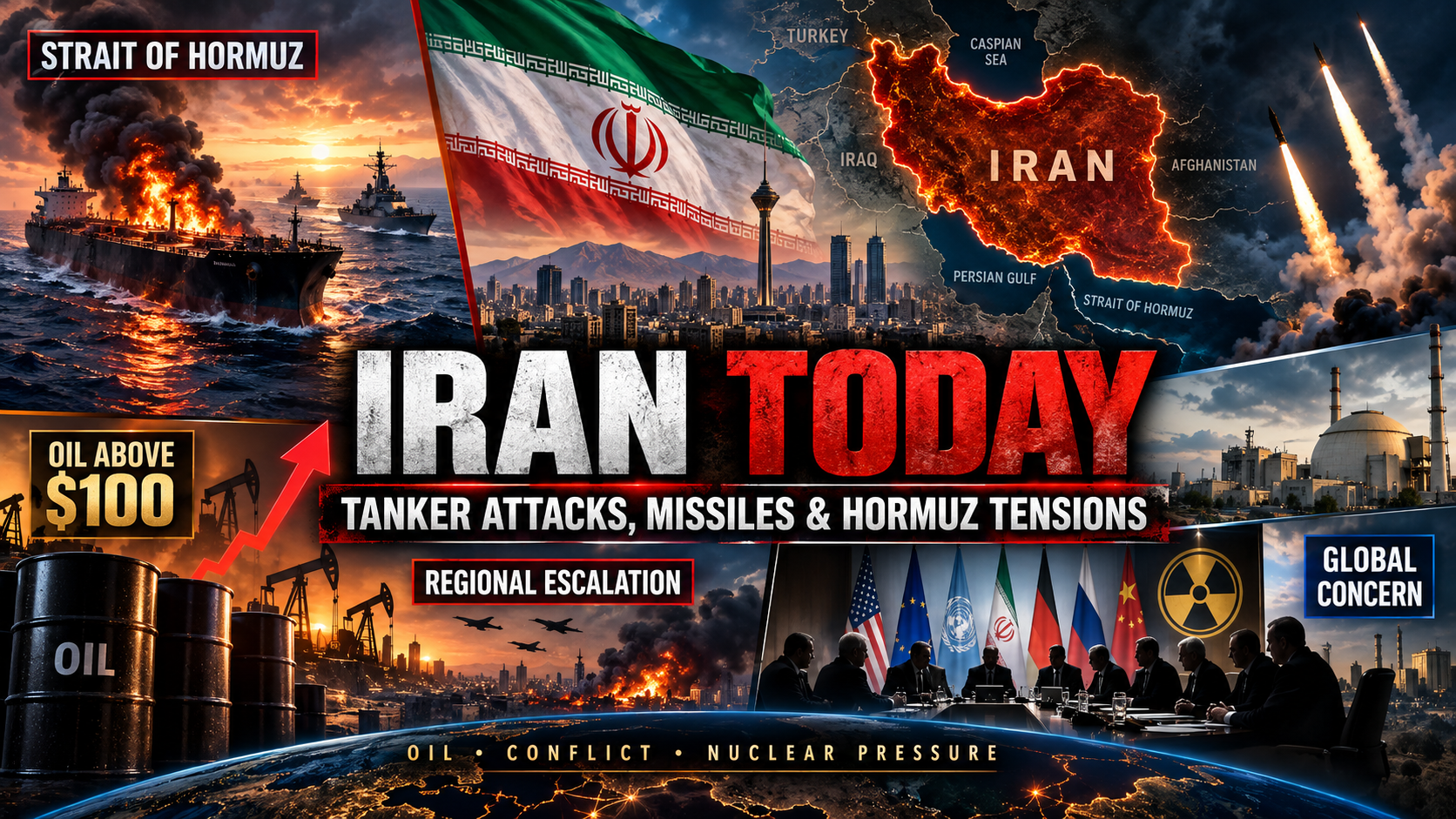
Iran Today: Tanker Attacks, Missile Strikes and a Battle Over the Strait of Hormuz Push the Conflict Into a Dangerous New Phase
September 9, 2026 | Updated this morning, U.S. Central Time
The conflict involving Iran and the United States entered another dangerous phase Wednesday as attacks spread across the Strait of Hormuz, oil tankers, U.S. military positions and neighboring Gulf states, while the economic consequences reached consumers thousands of miles from the battlefield.
The most important development today is a major escalation at sea: the United States says it destroyed five Iranian oil tankers after Iranian missile attacks targeted a U.S. Navy warship. Iran says it responded by attacking 10 vessels near the Strait of Hormuz, including two U.S. vessels and eight oil tankers. Some of Iran's specific claims remain disputed or independently unverified.
At the same time, Iran launched ballistic missiles toward a base used by American forces in Jordan, the cost of moving oil through the Gulf has soared, Brent crude has crossed $100 per barrel, Washington has imposed another major sanctions package, and international concern over Iran's nuclear program is returning to the U.N. system.
This is no longer simply a military story. It is becoming an energy, economic, diplomatic, humanitarian and regional-security crisis at the same time.
What Happened Today at the Strait of Hormuz
Iran's Revolutionary Guards said Wednesday that Iranian forces attacked eight oil tankers and two U.S. vessels operating around the Strait of Hormuz.
The announcement came after the U.S. military said it had destroyed five Iranian oil tankers overnight. Washington said those attacks were retaliation for Iranian attempts to hit an American Navy vessel with ballistic missiles during the previous two days. U.S. officials said no Americans were harmed.
The Associated Press identified the five Iranian tankers targeted by the U.S. as the Kivik, Charminar, Horizon 1, Riesco and Derya. According to AP, crews were warned to evacuate before the vessels were struck.
There is an important distinction between confirmed events and battlefield claims.
Iran says it hit two American vessels. U.S. Central Command says American ships were not damaged. Meanwhile, the United Kingdom Maritime Trade Operations agency received reports of several merchant vessels being struck by disabling fire in the northern Persian Gulf and Gulf of Oman.
So while there is strong evidence of a significant maritime escalation, not every Iranian or American claim about individual targets has been independently verified.
An Oil Tanker Carrying 2 Million Barrels Catches Fire
The maritime danger is not theoretical.
Two Iraqi port officials told Reuters that the New Andros, a tanker carrying approximately 2 million barrels of fuel oil, caught fire after being struck by a drone in Iraqi waters.
The 22-member crew was reported safe.
Another vessel was reported listing after being struck near Port Rashid in the United Arab Emirates, while a maritime security source reported damage to a liquefied natural gas tanker at the Emirati port of Khor Fakkan.
These incidents matter because the Gulf is not simply a military arena.
It is one of the world's most important energy corridors.
Iran Fires Ballistic Missiles Toward U.S. Forces in Jordan
Iran also launched a ballistic-missile attack against a base used by American forces near Al Azraq in eastern Jordan.
Iran claimed the strike caused major damage.
Jordan offered a very different account.
According to Reuters, Jordan said its air defenses intercepted 18 of 20 Iranian missiles, while the remaining two fell in unpopulated areas. Jordan reported no casualties, and a U.S. official said all American personnel were accounted for.
That disagreement illustrates one of the difficulties of covering an active war: governments use battlefield information not only to report events but also to influence public perception.
For readers, the safest approach is to separate:
what a government says happened, what opposing governments say happened, and what independent reporting can verify.
Iran Threatens a Much Larger Restricted Maritime Zone
The Revolutionary Guards say Iran plans to announce a new and substantially larger restricted area for shipping.
According to Reuters, the proposed zone could extend along a much larger section of Iran's coast toward Chabahar near Pakistan. Iranian officials have warned that additional attacks on Iranian assets could bring a dramatically larger response.
This raises the stakes considerably.
Before the conflict, the Strait of Hormuz handled roughly one-fifth of the world's oil trade, making it one of the most strategically important waterways on Earth.
Preliminary shipping data cited by Reuters showed just six vessels with transponders switched on crossing during one recent 24-hour period, illustrating how heavily normal maritime traffic has been disrupted.
Oil Breaks Through $100
The global economic effects are already visible.
Brent crude climbed above $100 per barrel Wednesday, reaching as high as approximately $100.95 in Reuters reporting. U.S. West Texas Intermediate crude rose to roughly $95.60.
Oil passing through Hormuz has fallen dramatically. Reuters reported flows dropping from roughly 8 million to 9 million barrels per day to less than 2 million during the disruption.
That has consequences far beyond Iran.
Higher crude prices can eventually affect:
- gasoline
- diesel
- airline costs
- trucking
- manufacturing
- plastics and chemicals
- food transportation
- inflation
- interest-rate decisions
American consumers are already seeing some of that pressure. The Associated Press reported the U.S. average gasoline price around $4.22 per gallon, while diesel reached roughly $5.94, a record level.
The battlefield may be thousands of miles away, but energy markets transmit the shock quickly.
Shipping Insurance Has Become Enormously Expensive
Even companies willing to move oil through the region face another problem: insurance.
An executive with Emirates National Oil Company told Reuters that war-risk and cargo-insurance charges for some voyages through Hormuz can now push total additional transit costs into the $10 million to $20 million range.
Cargo insurance alone can amount to 5% or 6% of a cargo's value in some cases, while additional war-risk premiums can reach roughly 10%.
Some companies are reportedly considering moving cargo without traditional insurance because premiums have become so expensive.
That is a warning sign.
When the cost of insuring a voyage becomes extraordinary, the market is essentially putting a price tag on the probability that the ship may not arrive safely.
The War Is Spreading Beyond Iran and the United States
Another major development is occurring in Yemen and Saudi Arabia.
Iran-aligned Houthi forces have intensified missile and drone attacks against Saudi Arabia, including energy infrastructure and cities. One recent wave of attacks injured 73 people, according to reporting cited by Reuters.
Saudi-backed forces have responded with airstrikes in Yemen. AP reported Houthi claims of 32 strikes across four Yemeni provinces overnight.
That matters because it potentially reopens another major front.
The Saudi-Houthi conflict had been comparatively quieter for several years. Renewed large-scale fighting risks connecting the Persian Gulf crisis with instability around the Red Sea, another crucial global shipping route.
Suddenly the energy world is looking at pressure around two chokepoints at once.
Iran's Network of Armed Allies Remains a Major Factor
Iran's regional strategy has long relied partly on armed groups outside its own territory.
Associated Press reporting published today describes increasing coordination involving Houthi forces in Yemen and Iran-aligned Iraqi militias, creating another layer of pressure on American allies around the Gulf.
Iran has denied arming the Houthis, although weapons interdictions and investigations have previously documented Iranian-designed or Iranian-made weapons in Houthi possession.
Iraq has now become particularly important.
Iraqi Prime Minister Ali al-Zaidi has pledged to bring powerful Iran-aligned militias under state control by September 30, the same date associated with the withdrawal of remaining U.S.-led coalition forces.
Reuters estimates the armed factions collectively include around 50,000 fighters, and some have rejected orders to surrender their weapons.
That creates a serious dilemma for Baghdad.
Iraq is a U.S. partner, but Iran possesses deep political, military and religious influence inside the country.
Washington Adds Another Layer of Sanctions
Military force is only one half of the current American strategy.
The Trump administration is also dramatically increasing economic pressure on Iran.
On September 8, the U.S. Treasury announced 36 Iran-related sanctions, with a major focus on the country's aviation network.
The measures target Iranian airlines, front companies, cargo handlers and foreign intermediaries that Washington alleges help Tehran obtain aircraft, components or sensitive technology.
Entities in countries including Turkey, the United Arab Emirates, Malaysia and Kazakhstan were included.
The administration also restricted aviation authorizations that previously allowed certain services involving U.S.-origin aircraft and parts.
AP described the move as one of Washington's broadest attempts yet to isolate Iran's civil aviation sector.
Iranian officials argue sanctions harm civilians and have failed to change Tehran's strategic policies.
Iran's Economy Is Under Severe Pressure
Whatever one thinks about the effectiveness of sanctions politically, the economic pressure inside Iran is measurable.
Reuters reported last week that Iran's currency had weakened beyond 2.2 million rials to the U.S. dollar, compared with around 1 million a year earlier.
Official 12-month average inflation was reported at 69.9%, while unemployment had risen to about 9.1%.
Reuters also reported that Iranian oil exports had fallen to around 260,000 barrels per day, compared with approximately 1.7 million barrels per day a year earlier, as sanctions and the maritime blockade reduced Tehran's ability to generate foreign currency.
Separate shipping analysis found Iranian crude loadings collapsed from roughly 2 million barrels per day in March to approximately 220,000 to 255,000 barrels per day in August.
Iran's central bank disputes suggestions that the country is nearing financial collapse and says it retains substantial foreign-currency reserves.
Both things can be true simultaneously: Iran may retain reserves while ordinary households experience severe inflation and falling purchasing power.
The Nuclear Question Has Not Gone Away
Behind the shipping conflict sits the issue that has defined international tensions with Iran for decades: its nuclear program.
The United States, Britain, France and Germany have backed a draft resolution at the International Atomic Energy Agency seeking to formally report Iran to the U.N. Security Council over nuclear safeguards concerns.
Before attacks damaged Iranian nuclear facilities, the IAEA estimated that Iran possessed approximately 440.9 kilograms of uranium enriched to 60%.
That concentration is substantially above normal civilian-reactor fuel levels and close to weapons-grade enrichment.
The quantity could theoretically provide enough material for roughly 10 nuclear weapons if it were further enriched, according to the IAEA assessment cited by AP and Reuters.
That sentence requires an important qualification:
Possessing highly enriched uranium is not the same thing as possessing a nuclear weapon.
Weaponization requires additional enrichment, engineering, weapons design and delivery capability.
Iran has repeatedly said its nuclear program is peaceful.
The present concern is also verification.
Following attacks on Iranian nuclear installations, IAEA inspectors have not received full access to affected sites or been able to fully account for Iran's enriched-uranium inventory.
So the world is not only debating what Iran possesses.
Inspectors are struggling to establish exactly where some of the material is and what has happened to it.
The Human Cost Inside Iran
Military statistics can make war feel clinical.
It isn't.
An Associated Press report published today returned to the ruins of the Shajareh Tayyebeh school in Minab, struck on February 28 during the opening day of the current conflict.
AP reports at least 168 people were killed at the site, most of them children. Iranian authorities say the dead included 120 students and 26 school employees, with three children still listed as missing.
The school has effectively become a memorial.
AP's reporting found evidence that at least one missile struck the school. The Trump administration has not publicly released the findings of a Pentagon investigation into the attack.
Another civilian incident occurred September 1 in Kuhestak, where an explosion at a wedding killed four people, including a child, and injured at least 68.
A Reuters investigation, using verified imagery and outside weapons analysis, concluded the blast was likely a direct strike by a U.S. munition rather than debris or an Iranian missile. U.S. officials have said the incident is being investigated.
These incidents deserve attention regardless of which side one believes bears responsibility for the broader conflict.
Civilians do not experience geopolitics as strategy.
They experience it as missing family members.
How Did This War Begin?
The present conflict escalated dramatically on February 28, 2026, when the United States and Israel launched large-scale strikes across Iran under an American operation called Operation Epic Fury.
The attacks targeted Iranian military leadership, missile systems, air defenses and other strategic facilities. Iran's longtime Supreme Leader Ayatollah Ali Khamenei was killed during the opening assault, along with numerous senior Iranian military and security officials.
Iran responded with missile and drone attacks on Israel and American positions around the Middle East.
The United States has told the United Nations that its military actions were conducted in self-defense, citing threats to American forces, regional allies and commercial shipping through Hormuz.
Iran, meanwhile, has argued before the U.N. Security Council that American attacks violate Iranian sovereignty and that Tehran's own strikes constitute legitimate self-defense.
Those competing legal arguments remain sharply disputed internationally.
Diplomacy Is Still the Exit, but It Is Getting Harder
Despite months of hostilities, diplomatic channels have never disappeared completely.
Pakistan, Qatar, Egypt and other regional actors have attempted at various points to bring Washington and Tehran back into negotiations. Previous discussions focused heavily on reopening the Strait of Hormuz and addressing Iran's nuclear program.
But negotiations have repeatedly stalled.
Reuters reported this week that neither Washington nor Tehran has signaled willingness to accept the other's central demands.
That creates the central danger.
Both sides appear to believe additional pressure may improve their bargaining position.
But when two opponents use escalation to improve their position before negotiations, escalation can acquire a momentum of its own.
The war begins driving the strategy instead of strategy controlling the war.
What Matters Most Now
There are several developments worth watching very closely in the coming days.
First is the Strait of Hormuz. If Iranian attacks, U.S. strikes and exclusion zones increasingly prevent commercial vessels from moving safely, oil prices could climb far beyond their present levels.
Second is Saudi Arabia and Yemen. A renewed large-scale Saudi-Houthi conflict could create another major energy and shipping crisis.
Third is Iran's nuclear inventory. The IAEA's ability, or inability, to verify Iran's enriched uranium could heavily influence the next diplomatic and military decisions.
Fourth is Iraq. Attempts to disarm Iran-aligned militias could either reduce regional escalation or trigger another confrontation.
Fifth is Iran's economy. Extreme inflation, falling oil revenue and sanctions create increasing pressure on Iranian households and the government.
And finally, there is diplomacy.
Wars are easy to expand because each attack creates a reason for another.
They are much harder to shrink.
The Bigger Picture
The most consequential Iran story today is not any single missile or tanker.
It is the way several conflicts are beginning to connect.
Iran and the United States are fighting over shipping.
Iran-aligned groups are pressuring Saudi Arabia.
Saudi forces are striking Yemen.
Iraq is struggling with Iran-aligned militias.
Oil is above $100.
International nuclear inspectors are seeking answers.
Civilian casualties continue accumulating.
And every military action generates political pressure for retaliation.
That is how a regional confrontation can become something larger without any government formally deciding that it wants a wider war.
The immediate challenge is therefore not simply determining which side can strike harder.
It is finding a way to make escalation stop producing escalation.
Until that happens, the Strait of Hormuz will remain more than a shipping lane.
It will be one of the most dangerous pressure points in the world.
I Am Refocused Radio | World News
Sources and full links
1. Reuters, September 9: Iran and U.S. hit tankers in largest maritime escalation of the conflict
https://www.reuters.com/world/middle-east/iran-attacks-us-base-jordan-ships-near-hormuz-after-tankers-sunk-2026-09-09/
2. Associated Press: U.S. military destroys five Iranian oil tankers
https://apnews.com/article/dfc9a1d9c9a5b8bc7b47fcc004025e65
3. Reuters: Iran retaliates after destruction of oil tankers
https://www.reuters.com/world/middle-east/iran-says-it-plans-new-gulf-exclusion-zone-threatens-us-with-new-missiles-2026-09-08/
4. Associated Press: Wider Middle East escalation and shipping attacks
https://apnews.com/article/ae03ad7a30b113a8acca045ea10ad8b2
5. Reuters: Brent crude rises above $100 as conflict intensifies
https://www.reuters.com/business/energy/brent-crude-rises-above-100-barrel-middle-east-conflict-escalates-2026-09-09/
6. Reuters: Hormuz shipping and insurance costs surge
https://www.reuters.com/world/middle-east/oil-vessel-transit-costs-through-hormuz-escalated-after-iran-war-enoc-exec-says-2026-09-09/
7. Associated Press: Iran's evolving network of regional proxy groups
https://apnews.com/article/41b104b908daeb58ad1d714224f8f570
8. Reuters: Iraq struggles to disarm Iran-aligned militias
https://www.reuters.com/world/middle-east/why-is-us-ally-iraq-unable-disarm-irans-militia-allies-2026-09-09/
9. Reuters: New U.S. aviation sanctions targeting Iran
https://www.reuters.com/business/aerospace-defense/us-issues-fresh-iran-related-sanctions-treasury-website-shows-2026-09-08/
10. Associated Press: U.S. targets remaining Iranian aviation sector
https://apnews.com/article/59b9b99d8dbb6dfbb519af565c995c85
11. Reuters: Economic pressure, inflation and currency crisis inside Iran
https://www.reuters.com/world/middle-east/us-pressure-iran-starting-tell-sanctions-blockade-bite-2026-09-03/
12. Reuters: U.S. blockade sharply reduces Iranian oil exports
https://www.reuters.com/business/energy/blockade-succeeds-where-sanctions-failed-iran-oil-exports-stall-2026-09-01/
13. Reuters: Iranian central bank says foreign reserves remain sufficient
https://www.reuters.com/world/middle-east/iran-says-it-has-enough-foreign-currency-despite-us-sanctions-2026-09-01/
14. Associated Press: IAEA members consider referring Iran to U.N. Security Council
https://apnews.com/article/5c475d08b5206ca560ffb33b9f646c4b
15. Reuters: U.S. and European allies seek IAEA action over Iran
https://www.reuters.com/world/europe/us-allies-want-iaea-board-report-iran-un-security-council-diplomats-say-2026-09-04/
16. Associated Press: Families remember victims of Minab school strike
https://apnews.com/article/d1edcacd8bd3fc64badaa5a4caf184c9
17. Reuters investigation: Deadly strike on Iranian wedding
https://www.reuters.com/investigations/deadly-strike-iranian-wedding-was-likely-direct-hit-by-us-munition-analysis-2026-09-03/
18. Reuters: Background on February 28 launch of Operation Epic Fury
https://www.reuters.com/world/us/ahead-strikes-trump-told-iran-attack-was-high-risk-high-reward-2026-02-28/
19. Associated Press: Khamenei killed during opening U.S.-Israeli attack
https://apnews.com/article/c2f11247d8a66e36929266f2c557a54c
20. United Nations: U.S. letter explaining its legal justification for combat operations
https://documents.un.org/api/symbol/access?l=en&s=S%2F2026%2F161&t=pdf