
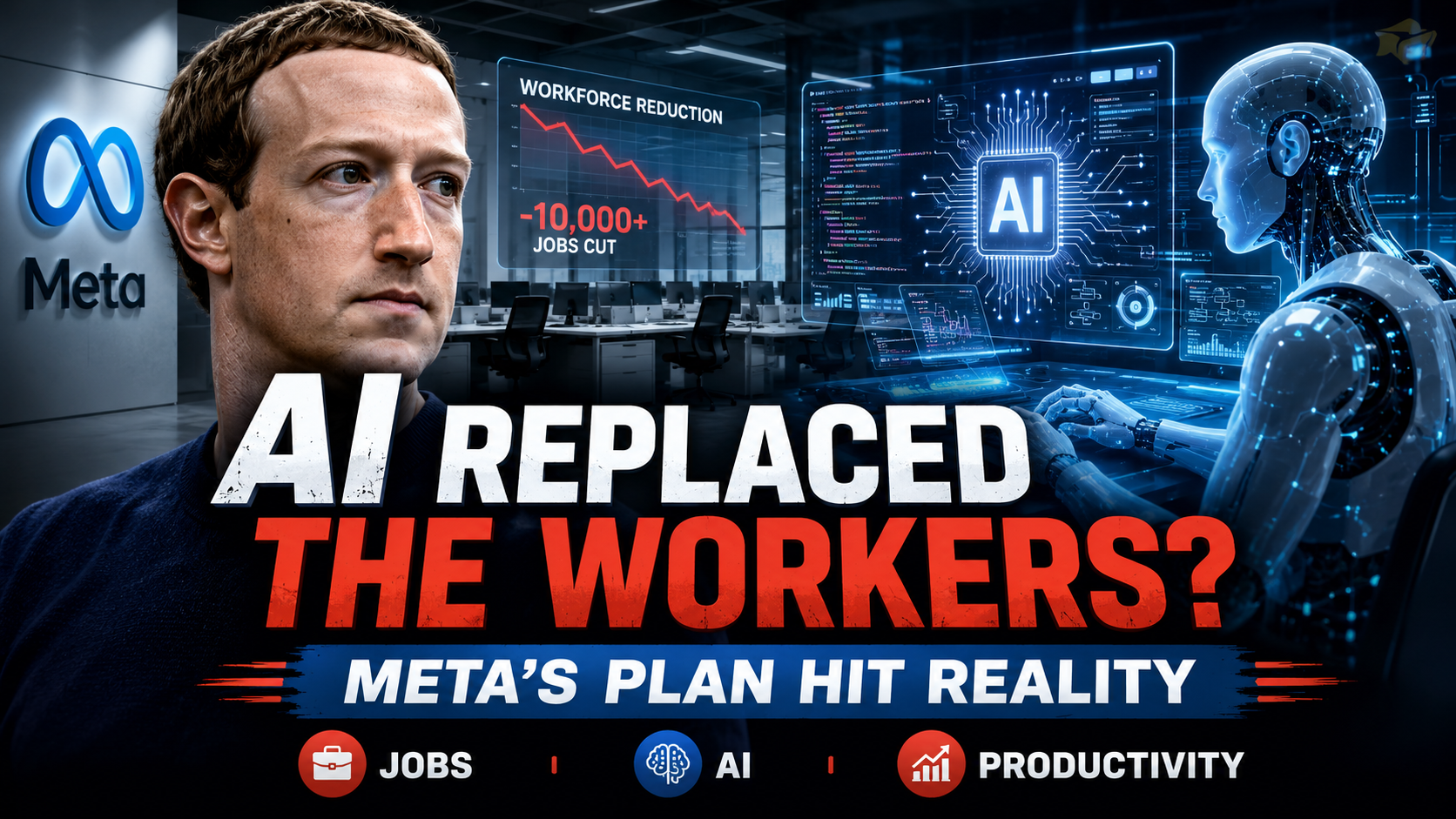
Meta Tried to Replace Workers With AI. Here’s What Happened Next
August 31, 2026
Artificial intelligence has been sold to corporate America as a productivity revolution: faster work, smaller teams, smarter automation and machines capable of handling tasks that once required entire departments.
Meta reportedly decided to test just how far that idea could go.
Earlier this year, the parent company of Facebook, Instagram and WhatsApp explored an ambitious internal restructuring plan that would make its workforce more “AI native,” according to an extensive Reuters investigation published Aug. 26.
The initiative, known internally as Project OT, short for Organization Transformation, considered reducing some teams by as much as 60%, removing layers of management and allowing AI agents to perform portions of the daily work previously handled by employees.
But the experiment encountered a problem that could become one of the defining business lessons of the AI era:
Automating work is not the same thing as improving work.
Meta ultimately abandoned significant portions of the plan after employee resistance, concerns about AI reliability and questions about whether the technology was delivering the productivity improvements executives expected.
The story offers a fascinating preview of the challenge facing nearly every major organization racing to adopt artificial intelligence.
Meta's plan: smaller teams powered by AI
According to Reuters, Meta began developing Project OT in early 2026 as executives considered how artificial intelligence could fundamentally change the company's organizational structure.
The vision went much further than simply giving employees access to an AI chatbot.
Meta explored creating smaller, more agile teams supported by AI agents capable of performing analysis, software development and other everyday tasks.
Some scenarios reportedly examined reducing team headcount by as much as 60%.
Instead of large traditional departments, employees could operate in smaller groups or “pods,” with artificial intelligence doing a greater share of routine work.
Meta confirmed to Reuters that teams had been asked to conduct scenario planning involving redeployments, eliminating open positions and potential workforce reductions.
However, the company emphasized that not every scenario was implemented and said some employees were moved into newly created priority teams instead.
That distinction matters.
The most dramatic proposals Reuters uncovered were planning scenarios, not a completed transformation of Meta's entire workforce.
Still, the fact that one of the world's largest technology companies seriously explored such a dramatic restructuring illustrates how aggressively corporate leaders are thinking about AI.
Meta still cut jobs
Meta moved forward with a first round of restructuring in May.
Reuters reported that roughly 10% of Meta's workforce was ultimately affected, although the broader restructuring scenarios explored even deeper reductions.
A second major round of cuts had been contemplated for later in the year.
Then the direction changed.
Hours before the May layoffs, CEO Mark Zuckerberg reportedly halted planning for a second company-wide round that had been considered for November.
Meta subsequently told employees there would be no additional company-wide layoffs in 2026.
Why the retreat?
There does not appear to have been one single reason.
Instead, several problems were emerging at once.
Employees were pushing back
One was trust.
Reports of potential layoffs began circulating internally months before employees had clear answers about what the restructuring would actually mean.
Workers also became concerned about Meta experimenting with systems that tracked employee activity, including keyboard and mouse behavior, to help train internal AI tools.
Reuters reported that the program was later paused.
That created a larger cultural problem.
If employees believe they are being asked to help train technology that may eventually eliminate their own jobs, enthusiasm for adopting that technology can disappear very quickly.
That isn't simply an HR issue.
It becomes an implementation problem.
The most sophisticated AI platform in the world will struggle to transform an organization if the people expected to use it no longer trust the organization deploying it.
Then came the productivity question
The bigger surprise may have been what Meta's own internal numbers appeared to show.
AI clearly helped employees produce more activity.
But increased activity did not always translate into equally large improvements for customers.
According to internal information reviewed by Reuters and reported by Ars Technica, code changes to Meta's internal software platforms and infrastructure were up approximately 220% year over year.
That sounds extraordinary.
However, changes resulting in new or improved features actually reaching Meta users reportedly increased by only about 36%.
That gap reveals something important about the AI productivity conversation.
Generating more code does not automatically mean creating more value.
Writing more reports does not automatically mean making better decisions.
Producing more content does not automatically mean producing better content.
Moving faster only helps when you are moving in the right direction.
AI agents reportedly created new problems
There were also concerns about reliability.
Internal posts reviewed by Reuters reportedly showed AI agents sometimes making unusually large or disruptive technical actions that human employees would have been less likely to execute.
Ars Technica reported that major technical and security incidents increased approximately 40% compared with the previous year, according to internal information cited in the Reuters investigation.
Employee time spent responding to some of those problems reportedly increased by as much as 70%.
Meta declined to comment to Reuters about those particular internal posts.
The numbers nevertheless highlight one of the biggest challenges facing autonomous AI.
An AI assistant that drafts an email incorrectly is inconvenient.
An autonomous AI agent operating inside a massive technology company's infrastructure can make mistakes at an entirely different scale.
The more authority companies give AI systems, the more important safeguards, human oversight and accountability become.
Even Zuckerberg reportedly acknowledged the slowdown
Meta has hardly abandoned AI.
Quite the opposite.
The company continues spending enormous sums building AI infrastructure, recruiting researchers and developing new models and products.
But Zuckerberg reportedly acknowledged during a July company meeting that progress with agent-based software development had not accelerated as quickly as Meta expected over the previous several months.
That is significant because Meta is not an organization lacking engineers, computing power or money.
If Meta encounters difficulties turning autonomous AI agents into reliable replacements for complex human workflows, companies with fewer resources should probably pay attention.
Meta is still betting enormous money on AI
None of this means Meta believes artificial intelligence has failed.
Its financial commitments suggest exactly the opposite.
In its 2025 annual report, Meta said it expected to spend approximately $115 billion to $135 billion in capital expenditures during 2026, largely supporting AI initiatives and its core business.
Meta reported having 78,865 employees worldwide at the end of 2025 and explicitly stated that it wanted AI utilization to become core to how its workforce operates.
The company has separately committed hundreds of billions of dollars toward U.S. infrastructure and AI development over multiple years.
So the takeaway is not that Meta turned against AI.
The strategy appears to have evolved from:
“How many humans can AI replace?”
toward something closer to:
“How can humans use AI effectively without breaking the organization?”
That is a much more complicated question.
The AI jobs debate is getting bigger
Meta's experience arrives as companies across technology, finance and other industries reconsider how many employees they need in an AI-powered workplace.
Reuters has documented numerous companies cutting positions while redirecting investment toward artificial intelligence and automation.
But the connection between AI and employment remains difficult to measure precisely.
Companies rarely eliminate jobs for only one reason.
Automation, slower growth, reorganizations, higher costs, changing consumer behavior and traditional cost cutting often occur simultaneously.
Economists are therefore still debating exactly how much AI is responsible for current employment changes.
The Federal Reserve has also been watching the issue.
Reuters reported this month that AI's measurable footprint on the overall U.S. labor market remains relatively small so far, even though AI has increasingly appeared in corporate layoff announcements.
That distinction is important.
AI is clearly changing individual companies and professions.
That does not necessarily mean millions of jobs disappear overnight.
The transformation may happen much more unevenly.
The future may be smaller teams, not empty offices
One possible outcome is already becoming visible.
Companies may not replace entire workforces with AI.
Instead, they may redesign jobs.
A team that once required 20 people might eventually operate with 12 people using AI tools.
A designer may create faster.
A programmer may supervise AI-generated code.
A marketer may produce dozens of campaign variations instead of three.
A manager may use AI to summarize information before making a decision.
That still has consequences for employment.
But it is different from the popular image of an AI system simply sitting in someone's chair and taking over the entire job.
The more realistic transformation may involve humans working alongside increasingly capable software while organizations continually redefine how many humans are required.
The leadership lesson is bigger than Meta
This story should get the attention of every executive rushing to announce an “AI-first” strategy.
Technology does not eliminate the fundamentals of leadership.
Employees still need clarity.
Organizations still need trust.
Customers still need quality.
Systems still need security.
Someone still has to be accountable when something goes wrong.
And productivity still has to be measured by meaningful outcomes rather than sheer volume.
If AI allows employees to generate 200% more work but customers receive only slightly more value, the organization has not achieved a 200% productivity increase.
It has simply created a bigger pile of work.
That distinction could become increasingly important as companies spend trillions of dollars building AI infrastructure.
What workers should take from this
There is also a lesson for employees.
Ignoring AI probably isn't a winning strategy.
Meta's retreat from its most aggressive restructuring plans does not mean companies will stop automating work.
The technology will continue improving.
The safer career strategy may be learning where AI makes you dramatically more capable while strengthening the abilities that remain difficult to automate:
judgment, leadership, creativity, communication, relationships, accountability, context and trust.
The valuable worker of the future may not necessarily be the person who can outperform AI.
It may be the person who knows when to use AI, when not to use it, and how to recognize when the machine is confidently heading toward a wall.
The bigger question
The Meta experiment exposes a tension that could define the next decade of business.
Companies have spent years asking:
What can artificial intelligence do?
Now they are beginning to confront a harder question:
What should artificial intelligence be allowed to do?
AI agents can write software, analyze documents, generate marketing material, research problems and automate increasingly complex workflows.
But organizations are made of more than tasks.
They are made of decisions, relationships, institutional knowledge, responsibility and people.
Meta's experience suggests that replacing tasks may be much easier than replacing the humans who understand why those tasks matter.
The AI revolution is still moving forward.
But the future of work may not belong entirely to machines or entirely to people.
It may belong to organizations that learn how to combine both without confusing automation with intelligence, activity with productivity, or speed with progress.
And that lesson could end up being worth considerably more than whatever companies initially hoped to save through layoffs.
Sources
Reuters Investigation: Mark Zuckerberg had a bold plan to replace Meta staff with AI. Here's how it imploded
https://www.reuters.com/investigations/mark-zuckerberg-had-bold-plan-replace-meta-staff-with-ai-heres-how-it-imploded-2026-08-26/
Reuters: How Meta's AI workforce transformation plans went kaput
https://www.reuters.com/technology/artificial-intelligence/how-metas-ai-workforce-transformation-plans-went-kaput-2026-08-26/
Ars Technica: AI agents meant to replace Meta workers made disruptive actions
https://arstechnica.com/ai/2026/08/metas-scrapped-plans-to-go-ai-native-included-slashing-teams-by-60-percent/
Reuters: Companies cutting jobs as investments shift toward AI
https://www.reuters.com/business/world-at-work/companies-cutting-jobs-investments-shift-toward-ai-2026-06-29/
Reuters: AI creeps onto the Federal Reserve's radar, but its footprint remains small so far
https://www.reuters.com/commentary/reuters-open-interest/ai-creeps-onto-fed-radar-footprint-is-small-so-far-2026-08-13/
Meta 2025 Annual Report filed with the U.S. Securities and Exchange Commission
https://www.sec.gov/Archives/edgar/data/1326801/000162828026003942/meta-20251231.htm
Reuters Morning Bid, Aug. 31: U.S.-Iran strikes, Meta's AI layoff plan and other developing stories
https://www.reuters.com/podcasts/us-iran-strikes-metas-ai-layoff-plan-bear-break-ins-2026-08-31/