
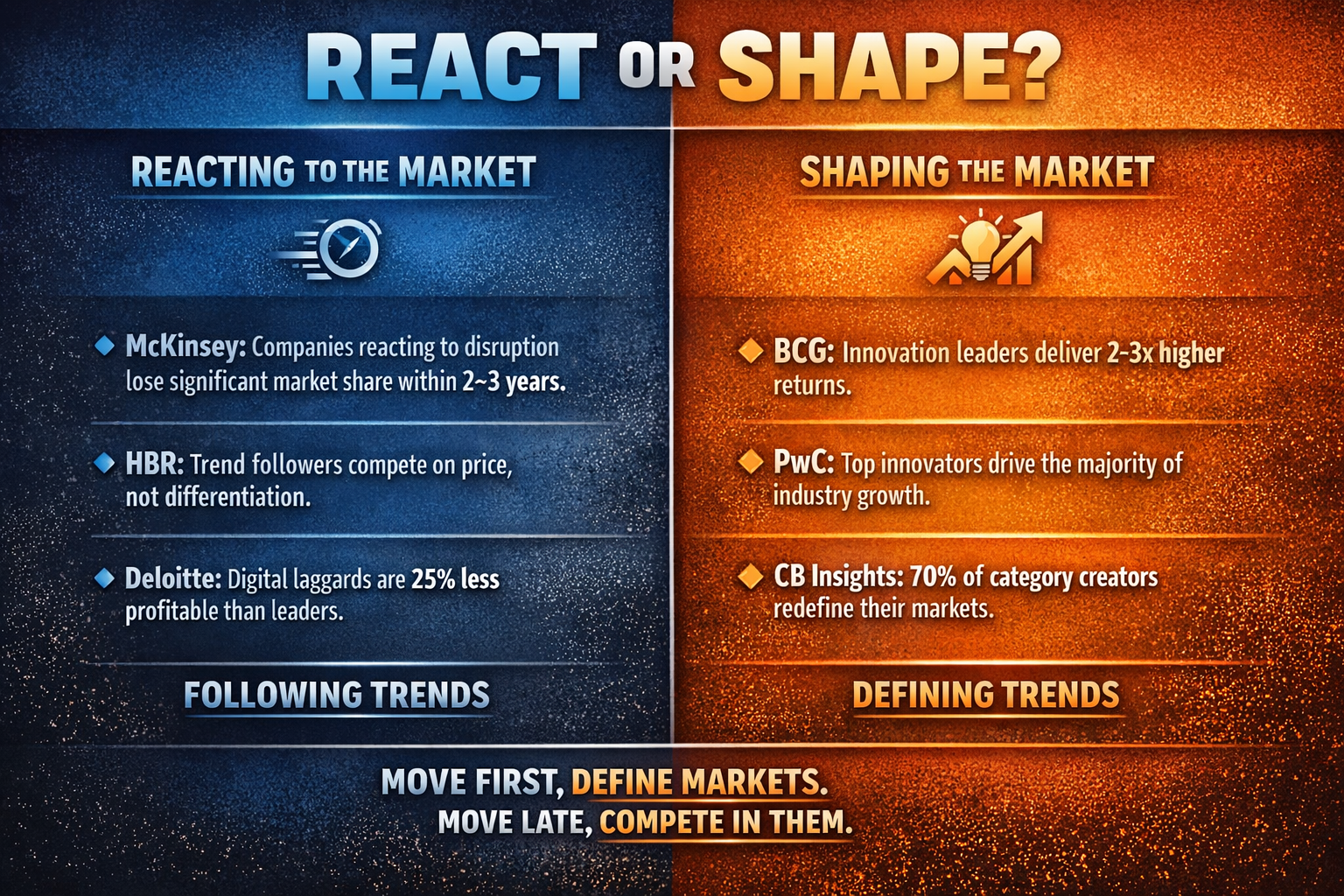
Reacting to the Market vs. Shaping It: What the Data Actually Shows
In business, there’s a clean divide between companies that respond to change and those that create it. This isn’t just philosophy. It shows up clearly in performance data, growth patterns, and long-term market share.
The Cost of Reacting
Most organizations operate in a reactive mode. They wait for signals, then adjust.
There are consequences to that:
- According to McKinsey & Company, companies that delay strategic moves in response to disruption often see significant erosion in market share within just a few years. In fast-moving sectors, the window to respond effectively can be less than 12–24 months.
- Research from Harvard Business Review shows that organizations that follow trends rather than lead them typically compete on price and operational efficiency, not differentiation. That reduces margins over time.
- A study by Deloitte found that “laggard” companies in digital transformation are significantly less profitable than leaders, often trailing by double-digit percentages in operating margin.
Reactive companies are not inactive. They are just operating after the advantage has already been claimed.
The Advantage of Shaping the Market
Companies that shape markets behave differently. They invest earlier, define categories, and influence customer expectations.
The data supports this:
- Boston Consulting Group found that companies classified as “innovation leaders” deliver shareholder returns up to 2–3x higher than their peers over the long term.
- According to PwC’s global innovation studies, top innovators generate a disproportionate share of industry growth, even when they represent a smaller percentage of total companies.
- Research from CB Insights shows that 70% of corporate innovation initiatives fail, but the companies that succeed often redefine entire categories, creating outsized returns that compensate for failed attempts.
- Historical analysis of companies like Apple Inc. and Netflix shows that early category creation (smartphones, streaming) allowed them to set pricing power, user expectations, and ecosystem control before competitors entered.
Timing Is the Real Divider
The difference between reacting and shaping often comes down to when decisions are made.
- Reactors wait for validation → lower risk, lower upside
- Shapers act before validation → higher risk, higher potential control
According to Gartner, organizations that adopt emerging technologies early can gain multi-year competitive advantages, especially when they integrate those technologies into their core business model rather than treating them as add-ons.
Where Most Businesses Get Stuck
Data consistently shows a gap between intent and execution:
- Many companies claim innovation is a priority
- Few allocate sufficient budget, time, or leadership focus to it
A PwC survey found that while over 75% of executives say innovation is critical, only a small fraction are satisfied with their innovation outcomes.
That gap is where companies slide from shaping → reacting.
Practical Takeaways
Based on the data, a few patterns are clear:
- Speed matters
Delayed responses reduce strategic options and compress margins. - Category creation drives outsized returns
Even with failure risk, successful innovation produces disproportionate impact. - Early adoption compounds advantage
The earlier a company integrates change, the harder it is for competitors to catch up. - Execution beats intention
Most companies know innovation matters. Few operationalize it effectively.
Bottom Line
Businesses are not judged by how well they understand change, but by how early and effectively they act on it.
- Reacting keeps a company competitive in the short term
- Shaping positions a company to control direction in the long term
The data is consistent across industries:
The companies that move first, define markets.
The companies that move later, compete inside them.