
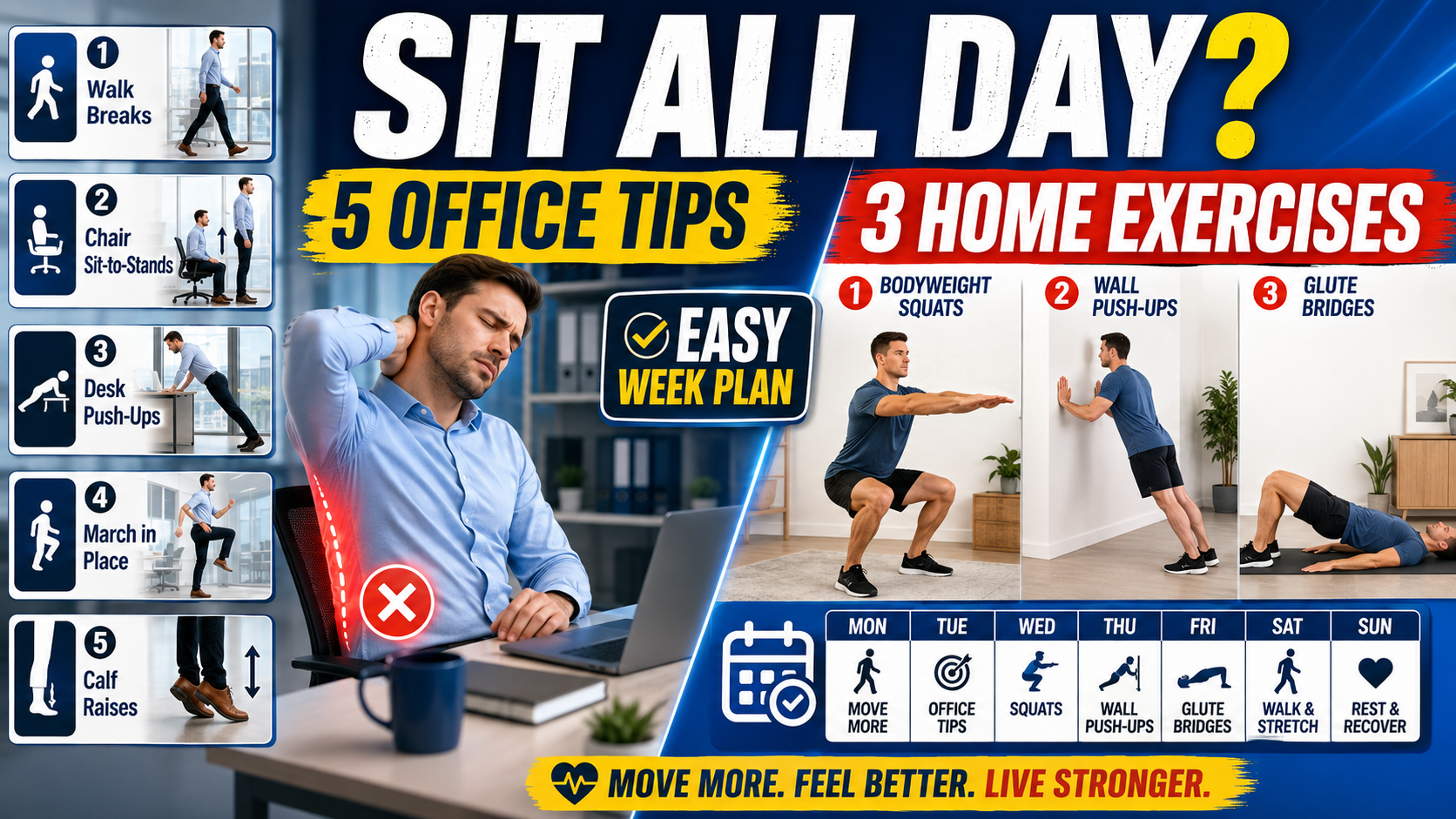
Sitting at a Desk All Day? 5 Simple Office Exercises + an Easy Weekly Plan
For many people, the problem isn't that they don't care about exercise.
It's that they spend eight hours working, commute home, handle everything else life throws at them, and suddenly the day is gone.
The good news?
Movement doesn't have to happen only at the gym.
The American Heart Association recommends finding small opportunities to stand, walk and move throughout the workday, including getting up and walking around at least once an hour.
Federal guidelines also emphasize a simple message:
Move more and sit less.
Adults should aim for at least 150 minutes of moderate-intensity aerobic activity each week, along with muscle-strengthening activity on at least two days. That activity can be broken into smaller sessions throughout the week.
So if your job keeps you glued to a chair, here are some realistic ways to fight back.
1. Take a 5-Minute Walking Break
This may be the simplest option on the entire list.
Get up.
Walk down the hallway.
Walk around the building.
Take the stairs.
Walk while you're on a phone call.
Even a short movement break interrupts a long stretch of sitting.
The American Heart Association specifically recommends standing or moving during calls and walking around at least once each hour during the workday.
Try this:
Set a reminder once every hour.
When it goes off, walk for 3 to 5 minutes if your schedule allows.
Over an eight-hour workday, those little breaks can add a surprising amount of movement.
2. Chair Sit-to-Stands
You already have the equipment.
It's your chair.
Sit near the front of a stable, non-rolling chair.
Place your feet approximately shoulder-width apart.
Stand up.
Slowly sit back down.
Repeat.
This movement works many of the major muscles in the lower body and turns something you already do every day into a simple strengthening exercise.
Try: 8 to 12 repetitions.
CDC guidance notes that 8 to 12 repetitions can count as one set for muscle-strengthening activity.
Do one or two sets during the workday.
Your coworkers may wonder what you're doing.
Tell them you're upgrading the office chair. 😄
3. Standing Calf Raises
Stand behind your chair or next to your desk for support.
Slowly rise onto the balls of your feet.
Pause briefly.
Lower your heels back to the floor.
Repeat.
This is an easy way to get your lower legs working after sitting for long periods.
Try: 10 to 15 repetitions.
You can do these while waiting for a meeting to begin, reading something on your screen or taking a phone call.
No workout clothes required.
4. Desk Push-Ups
Push-ups don't have to happen on the floor.
Place your hands on a stable desk or countertop.
Step your feet backward.
Keeping your body relatively straight, bend your elbows and lower your chest toward the desk.
Push yourself back up.
The CDC includes bodyweight exercises such as push-ups as legitimate muscle-strengthening activities.
Try: 8 to 12 repetitions.
The farther your feet are from the desk, the more challenging the movement generally becomes.
Start comfortably.
5. March in Place During Calls
Not every phone call requires a chair.
If you're listening rather than typing, stand up and gently march in place.
You can also pace around your office if space allows.
The American Heart Association specifically suggests standing, marching in place or pacing while taking phone calls.
Try doing this for 2 to 5 minutes during longer calls.
A boring conference call just became cardio's weird little cousin. 😂
3 Simple Exercises You Can Do at Home
The office movements help break up long periods of sitting.
At home, you can add a short strength routine.
You don't necessarily need dumbbells or expensive equipment. The CDC recognizes bodyweight exercises as muscle-strengthening activity.
Start with these three.
1. Bodyweight Squats
Stand with your feet approximately shoulder-width apart.
Push your hips backward as though you're sitting into a chair.
Bend your knees while keeping your movement controlled.
Stand back up.
Beginner goal:
8 to 12 repetitions
1 to 3 sets
If a full squat is uncomfortable, use a chair and practice controlled sit-to-stands instead.
2. Wall Push-Ups
Stand facing a wall.
Place your hands against it around shoulder height.
Step your feet slightly backward.
Slowly bend your elbows and bring your chest toward the wall.
Push yourself back.
Beginner goal:
8 to 12 repetitions
1 to 3 sets
As you get stronger, you can progress to desk or countertop push-ups and eventually traditional floor push-ups if appropriate for your fitness level.
3. Glute Bridges
Lie on your back with your knees bent and feet flat on the floor.
Keep your feet comfortably near your hips.
Push through your feet and raise your hips.
Pause briefly at the top.
Lower yourself slowly.
Beginner goal:
8 to 12 repetitions
1 to 3 sets
This gives your hips and lower body something very different to do after spending much of the day sitting.
A Simple 7-Day Movement Plan
Don't make the first week complicated.
Consistency beats creating a heroic workout schedule that survives exactly three days.
Monday
At work
Take a 5-minute walk three times during the day.
Do:
10 chair sit-to-stands
10 calf raises
At home
2 rounds:
10 squats
10 wall push-ups
10 glute bridges
Tuesday
At work
Stand or walk during at least two phone calls.
Take a 10-minute walk during lunch or after work.
Do:
10 desk push-ups
15 calf raises
At home
Easy 15 to 20-minute walk.
Wednesday
At work
Take a short movement break approximately once each hour when possible.
Do:
10 chair sit-to-stands
2 minutes marching in place
At home
2 rounds:
10 squats
10 wall push-ups
10 glute bridges
Thursday
Make this a lighter day.
At work
Walk for 5 minutes in the morning.
Walk for 5 minutes after lunch.
Stand during one meeting or phone call if practical.
At home
10 to 20 minutes of easy walking or stretching.
Friday
Finish the workweek moving.
At work
10 chair sit-to-stands
10 desk push-ups
15 calf raises
Take a short walk at lunch.
At home
Optional easy walk.
Saturday
Make this your longer movement day.
Aim for approximately 30 minutes of moderate activity such as brisk walking, cycling or another activity you enjoy.
Federal recommendations suggest adults work toward at least 150 minutes of moderate-intensity activity per week.
Sunday
Recovery and reset.
Take an easy walk.
Stretch.
Prepare for the coming week.
Then decide when your movement breaks will happen Monday.
The Goal Isn't Perfection
Here is where people often make exercise harder than it needs to be.
They think:
“If I don't have 60 minutes, what's the point?”
But federal health guidance says otherwise.
Small amounts of activity add up, and some physical activity is better than none.
A five-minute walk matters.
Ten squats matter.
Getting out of your chair matters.
Doing it again tomorrow matters even more.
The goal isn't to turn your office into a CrossFit gym.
It's to stop allowing the chair to own your entire day.
Start Here
If this whole plan feels like too much, make your first goal ridiculously simple:
Every hour, get out of your chair.
Walk.
Stretch.
Stand.
Do a few repetitions.
Then get back to work.
Build the habit first.
You can always build the workout later.
Move more. Sit less. Start where you are.
Exercise should be adjusted to your fitness level and abilities. Stop if an activity causes pain, dizziness, unusual shortness of breath or other concerning symptoms. People with chronic medical conditions or those planning to begin vigorous exercise may want to discuss an appropriate activity level with a healthcare professional.
Sources
Centers for Disease Control and Prevention — Adult Activity: An Overview
https://www.cdc.gov/physical-activity-basics/guidelines/adults.html
Centers for Disease Control and Prevention — What Counts as Physical Activity for Adults
https://www.cdc.gov/physical-activity-basics/adding-adults/what-counts.html
Centers for Disease Control and Prevention — Adding Physical Activity as an Adult
https://www.cdc.gov/physical-activity-basics/adding-adults/index.html
U.S. Department of Health and Human Services — Move Your Way
https://odphp.health.gov/moveyourway
U.S. Department of Health and Human Services — Physical Activity Guidelines for Americans
https://odphp.health.gov/our-work/nutrition-physical-activity/physical-activity-guidelines
American Heart Association — Be More Active During Your Work Day
American Heart Association — Recommendations for Physical Activity in Adults
American Heart Association — 10-Minute Home Workout