
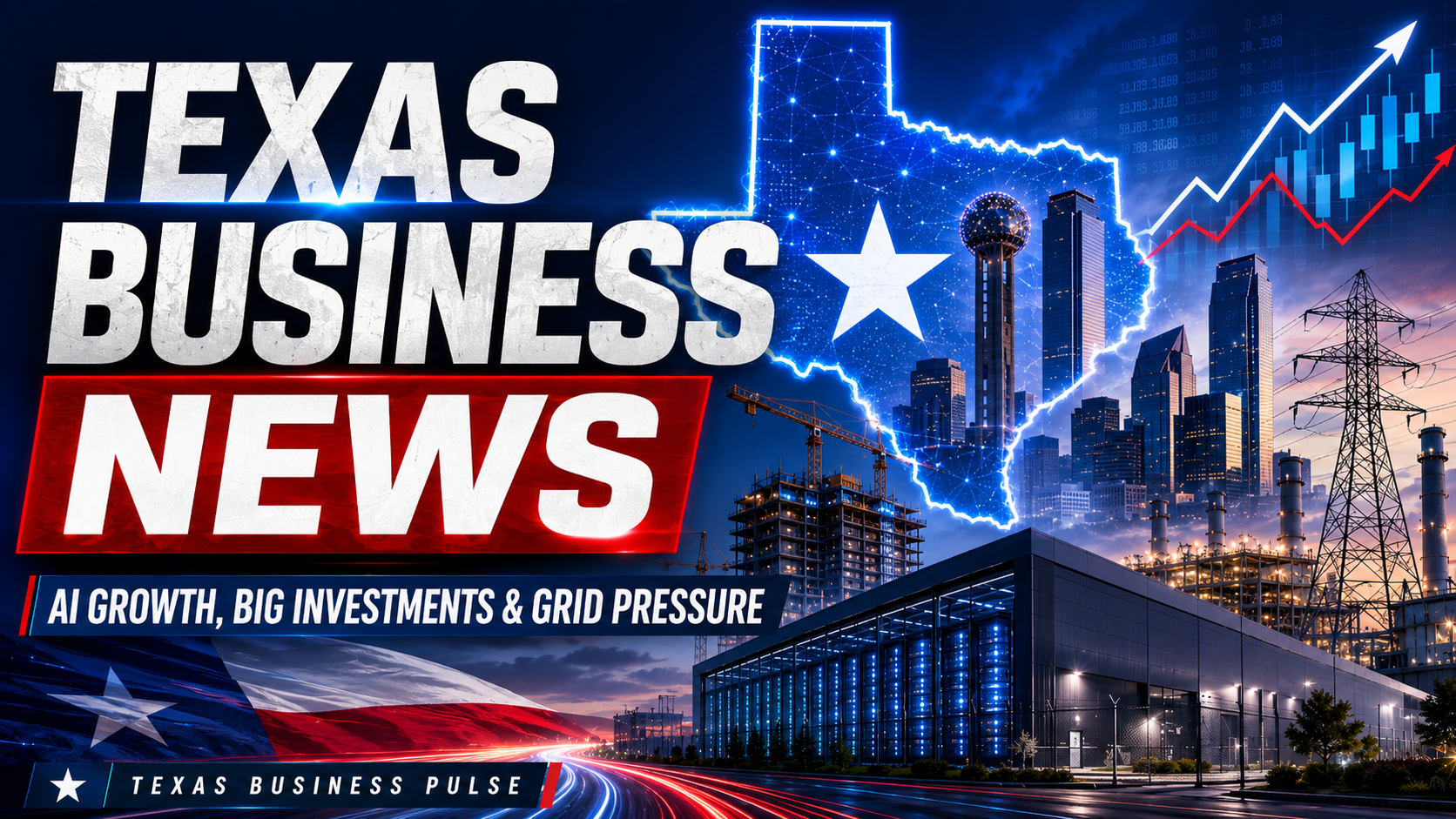
Texas Business Pulse: Big Investments Meet Growing Pains as Energy, AI and Jobs Reshape the State
August 24, 2026
Texas remains one of the nation’s most closely watched business markets, but the latest numbers and investment announcements show an economy entering a more complicated phase.
Billions of dollars are flowing into data centers, energy infrastructure, manufacturing and supply-chain projects. At the same time, employers are navigating higher costs, tighter labor conditions and a Texas electrical grid being asked to support an extraordinary amount of new industrial demand.
From Amazon’s massive data center plans near Houston to H-E-B’s expansion in San Antonio, here are some of the biggest Texas business developments to watch.
Texas Job Growth Slows, But Forecast Still Points Higher
The Federal Reserve Bank of Dallas now forecasts Texas employment will grow 1.7% in 2026, which would translate to approximately 241,300 additional jobs and bring statewide employment to roughly 14.6 million by December.
The projection was lowered from the Dallas Fed’s July estimate of 2.0%.
Texas employment declined at a 0.1% annualized rate in July, representing a loss of roughly 1,480 jobs. Construction, financial activities and manufacturing were among the sectors losing employment during the month.
Despite that pullback, the broader picture is far from recessionary. Texas employment expanded at an annualized 2.4% during the second quarter, and Dallas Fed economists have noted continued strength in business activity despite labor-supply constraints and rising costs.
For Texas businesses, that creates an interesting environment: expansion is continuing, but companies may be more selective about hiring and investment as wage pressures and operating costs increase.
Amazon's $10 Billion Texas Data Center Bet Shows the Scale of the AI Boom
Few projects demonstrate Texas' transformation more clearly than Amazon's plans in Wharton County southwest of Houston.
Amazon Web Services is developing what has been reported as a roughly $10 billion data center campus near Boling. The development, known as Project Eagle, would cover nearly 3,000 acres and could eventually include at least 10 major data center buildings.
Texas regulatory filings confirm Amazon Data Services as the owner of multiple Project Eagle data center buildings. Individual buildings have estimated construction costs of approximately $300 million each.
The project is expected to create construction work along with permanent technology and operations jobs, but it also illustrates the enormous infrastructure requirements arriving with artificial intelligence and cloud computing.
Power and water are quickly becoming economic-development questions rather than simply utility questions.
Texas Faces a Data Center Power Dilemma
The AI boom has created another challenge: Texas must decide how quickly it can safely connect massive new electricity users to the grid.
ERCOT is reviewing hundreds of proposed large-load projects, many of them data centers. Texas officials have ordered additional verification of roughly 250 to 300 projects, representing potential electricity demand far beyond the state's current peak load.
On Monday, August 24, The Texas Tribune reported warnings from energy regulators and industry representatives that delays involving data centers and major West Texas transmission projects could have unintended economic consequences.
ERCOT has warned that parts of West Texas could face increased reliability risks if necessary transmission infrastructure is not built. Oil and gas companies also argue that limited power infrastructure could restrict industrial expansion.
Texas therefore faces a delicate balancing act.
The state wants the investment and technological leadership associated with AI, but attracting hyperscale computing facilities requires enormous amounts of electricity, transmission infrastructure, land and, in some cases, water.
The next chapter of Texas economic development may depend almost as much on megawatts as tax incentives.
H-E-B Moves Forward With Massive San Antonio Expansion
Another Texas giant is making a substantial investment of its own.
Bexar County commissioners have approved a roughly $16.4 million tax incentive connected to H-E-B's proposed $700 million expansion of its manufacturing and distribution operations on San Antonio's East Side.
H-E-B's plans include a new bakery, refrigerated warehouse, transportation facility and expanded manufacturing capabilities at its Foster Road campus.
The San Antonio-based company has said the investment could create 720 jobs in the earlier stages of the project and more than 1,200 new full-time jobs over the next decade.
For San Antonio, the investment is particularly important because it goes beyond retail. Warehousing, logistics, transportation and food manufacturing create an economic footprint stretching throughout the regional supply chain.
It also reinforces H-E-B's position as one of Texas' most influential privately held companies.
Houston Adds More Power as Electricity Becomes an Economic Development Tool
Texas' demand for new generation is producing major investments in traditional energy infrastructure as well.
Houston City Council recently approved an approximately $11 million tax abatement connected to a new NRG Energy natural-gas power project in northeast Houston.
The roughly 455-megawatt plant is expected to provide additional dispatchable electricity during periods of high demand.
The investment arrives as NRG continues a broader Texas generation expansion. The company recently reported commercial operations beginning at additional generation at its T.H. Wharton facility and said other Texas Energy Fund-supported projects remain on schedule.
Energy infrastructure is becoming a competitive advantage for cities hoping to attract data centers, advanced manufacturing, semiconductor projects and other power-intensive operations.
Companies may increasingly evaluate Texas locations not simply by taxes, land prices and workforce availability, but by one crucial question: Can the grid support us?
Manufacturing and Services Continue to Expand
There are also encouraging signs beneath the headline projects.
The Dallas Fed's most recent Texas Manufacturing Outlook Survey showed manufacturing output accelerating in July. Its production index climbed to 10.1, while new orders also increased.
Business executives reported a significant improvement in company outlooks.
Texas' service sector also continued expanding in July, with the Dallas Fed's revenue index holding at a positive 9.5. Businesses nevertheless reported greater selling-price pressures, showing that inflation and cost management remain important concerns.
That combination tells an important story.
Texas businesses are still producing, investing and expanding, but growth is no longer frictionless.
The Bigger Picture
Texas enters the final months of 2026 with considerable economic momentum.
Amazon is pouring billions into computing infrastructure. H-E-B is expanding its Texas supply chain. Power companies are investing hundreds of millions of dollars in new generation. Manufacturing and service businesses continue reporting expansion.
Yet the state is discovering that extraordinary growth creates extraordinary infrastructure demands.
Electricity generation, transmission capacity, water availability, skilled workers, construction costs and community acceptance are becoming critical pieces of Texas' economic equation.
For years, the Texas business story was largely about attracting companies.
The next challenge may be ensuring the state has enough infrastructure to support everything it has attracted.
Sources and Full Links
- Federal Reserve Bank of Dallas, Texas Employment Forecast, August 21, 2026: https://www.dallasfed.org/research/forecast/2026/emp260821
- Federal Reserve Bank of Dallas, “Momentum builds in the Texas economy; wage pressures broaden”: https://www.dallasfed.org/research/swe/2026/2618
- The Texas Tribune, August 24, 2026, Texas data centers and transmission lines: https://www.texastribune.org/2026/08/24/texas-765-transmissions-lines-data-centers-pauses-delays/
- The Texas Tribune, Texas audit of data center projects: https://www.texastribune.org/2026/08/14/texas-data-center-approval-pause-ercot-power-grid/
- Houston Chronicle, Amazon AWS Project Eagle near Houston: https://www.houstonchronicle.com/business/article/amazon-aws-data-center-houston-wharton-boling-22391947.php
- Texas Department of Licensing and Regulation, Amazon Project Eagle filing: https://www.tdlr.texas.gov/TABS/Search/Project/TABS2026023832
- San Antonio Express-News, H-E-B $700 million expansion: https://www.expressnews.com/news/article/heb-east-side-manufacturing-expansion-county-22397016.php
- H-E-B Newsroom, $700 million supply-chain investment: https://newsroom.heb.com/h-e-b-announces-plans-to-invest-700-million-to-expand-its-supply-chain-operations/
- Houston Chronicle, NRG Houston power plant investment: https://www.houstonchronicle.com/politics/houston/article/houston-tax-break-nrg-power-plant-grid-22393916.php
- NRG Energy, Second Quarter 2026 results and Texas power investments: https://investors.nrg.com/news-releases/news-release-details/nrg-energy-reports-second-quarter-2026-results-and-reaffirms