
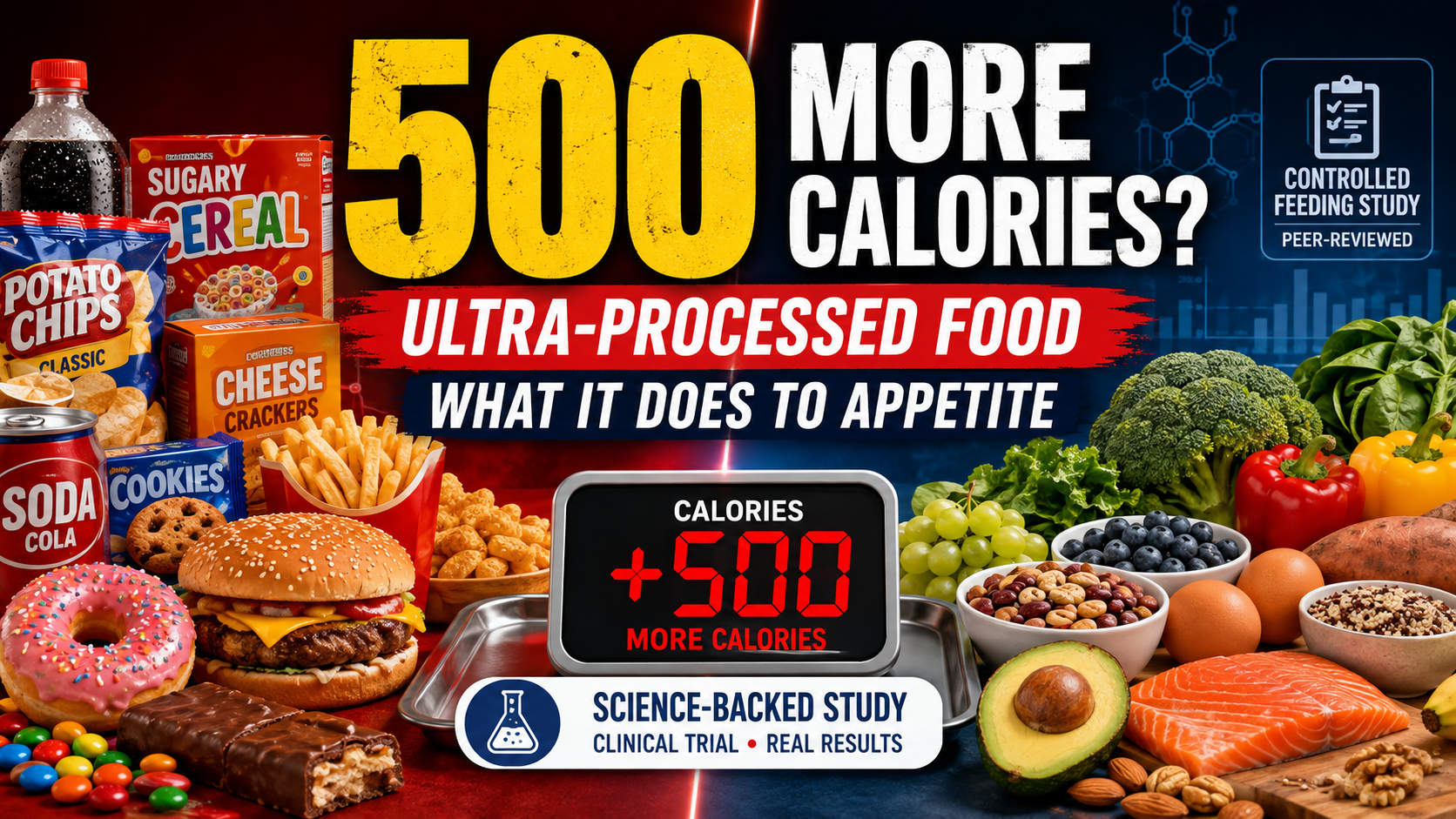
The 500-Calorie Experiment: What Ultra-Processed Food May Do to Your Appetite
What if two diets offered similar amounts of calories, carbohydrates, fat, protein, sugar, sodium and fiber, but people still ate dramatically more on one of them?
That is exactly what researchers at the National Institutes of Health set out to investigate.
The result?
People eating an ultra-processed diet consumed roughly 500 extra calories per day and gained about 2 pounds in just two weeks.
The experiment raises an interesting question:
Could the way our food is processed influence how much we want to eat?
First, What Is Ultra-Processed Food?
Not all food processing is bad.
Freezing vegetables, pasteurizing milk or cooking beans all involve processing.
The term ultra-processed food, often defined through the NOVA classification system, generally refers to industrial formulations made with ingredients extracted or derived from foods, often combined with additives and other ingredients not commonly used in home cooking.
Examples can include certain packaged snacks, sweets, breakfast cereals, ready-to-eat meals, soft drinks and mass-produced breads.
But scientists are still debating exactly which characteristics of these foods matter most.
That is where the NIH experiment gets interesting.
Researchers Put 20 Adults in a Controlled Environment
In the 2019 randomized controlled trial, 20 adults lived at the NIH Clinical Center for four weeks.
For two weeks, participants ate an ultra-processed diet.
For another two weeks, they ate an unprocessed diet.
The order was randomized.
Researchers provided all of the participants' meals and snacks and allowed them to eat as much or as little as they wanted.
This wasn't simply researchers asking people:
"What did you eat last Tuesday?"
They controlled the food themselves.
The Diets Were Designed to Be Nutritionally Similar
Here's what makes the experiment fascinating.
The meals presented to participants were designed to be matched for:
- calories
- carbohydrates
- fat
- protein
- sugar
- sodium
- fiber
- overall energy density
Yet participants behaved very differently depending on which diet they were eating.
About 500 Extra Calories Every Day
When participants were eating the ultra-processed diet, they consumed approximately 500 more calories per day than when eating the unprocessed diet.
They also ate faster.
That difference added up quickly.
During the two weeks of ultra-processed eating, participants gained an average of approximately 0.9 kilograms, or about 2 pounds.
During the two weeks of eating unprocessed foods, they lost approximately the same amount.
That is a roughly 4-pound swing between the two dietary periods.
And nobody was instructed to count calories or intentionally lose or gain weight.
They simply ate until they were satisfied.
Why Did People Eat More?
That's the million-calorie question. 😄
Researchers have explored several possibilities.
1. They Ate Faster
Participants consumed the ultra-processed meals at a faster rate.
Eating quickly may allow someone to consume more calories before the body's fullness signals have enough time to influence eating behavior.
Food texture may play a role too.
Many ultra-processed foods are softer or easier to chew, making it possible to consume a lot of energy very quickly.
2. Calories Can Be Easier to Consume
Ultra-processed foods can sometimes pack more calories into smaller amounts of food.
Researchers studying eating behavior have found that energy density and eating rate can both influence how much energy people consume during meals.
Think about the difference between slowly eating an apple and quickly drinking or eating something engineered to be extremely easy to consume.
Your stomach doesn't own a calorie calculator.
Your brain and digestive system respond to signals arriving over time.
3. Processing May Matter Beyond Traditional Nutrition Labels
This is where the original NIH trial challenged conventional thinking.
If two diets are designed around similar amounts of sugar, fat, carbohydrates, sodium and fiber, why would people still eat substantially more of one?
Researchers have continued investigating whether factors including food structure, texture, eating speed, energy density and formulation contribute to the effect.
The answer is probably more complicated than one ingredient.
But Does This Mean Every Ultra-Processed Food Is Bad?
No.
And this is where an important newer study adds some nuance.
A 2025 randomized crossover trial published in Nature Medicine studied adults with overweight or obesity who ate both minimally processed and ultra-processed diets for eight weeks.
Importantly, both diets followed healthy-eating guidelines.
Participants lost weight during both diets.
However, the minimally processed diet produced significantly greater weight loss.
Participants lost approximately:
2.06% of body weight on the minimally processed diet
versus
1.05% on the ultra-processed diet.
Researchers also observed greater reductions in body fat and food cravings during the minimally processed period.
That tells us something important.
The science isn't simply:
Processed food = bad.
Whole food = good.
Nutrition rarely fits that neatly into two boxes.
The bigger question may be how processing interacts with diet quality, food structure, portion size, energy density and how quickly we eat.
What Should You Take From This?
You don't need to throw everything in your pantry into a dumpster.
Instead, start paying attention to the balance of your diet.
More meals built around foods such as:
- vegetables
- fruit
- beans
- whole grains
- eggs
- fish
- lean meats
- nuts
- seeds
can naturally reduce reliance on heavily formulated packaged foods.
And when you do eat processed foods, remember:
The nutrition label tells you what's in the food. It doesn't necessarily tell you how that food might influence how quickly or how much you eat.
The Bigger Lesson
For decades, weight management has often been reduced to a simple equation:
Calories in versus calories out.
Energy balance absolutely matters.
But the NIH experiment showed something deeper.
The type of food we eat may influence the amount of calories we naturally choose to consume.
In one tightly controlled experiment, people weren't told to overeat.
They simply did.
About 500 additional calories every day.
That's what makes this research so interesting.
Sometimes the question isn't only:
“How many calories are in this?”
It may also be worth asking:
“What makes me want to keep eating it?”
Sources
National Institutes of Health — NIH study finds heavily processed foods cause overeating and weight gain
Cell Metabolism — Ultra-Processed Diets Cause Excess Calorie Intake and Weight Gain: An Inpatient Randomized Controlled Trial of Ad Libitum Food Intake
https://www.cell.com/cell-metabolism/fulltext/S1550-4131(19)30248-7
PubMed — Ultra-Processed Diets Cause Excess Calorie Intake and Weight Gain
https://pubmed.ncbi.nlm.nih.gov/31105044/
NIH Clinical Center — First randomized, controlled study finds ultra-processed foods cause people to eat more and gain weight
https://www.cc.nih.gov/news/2019/summer/story-01
Nature Medicine — Ultraprocessed or minimally processed diets following healthy dietary guidelines on weight and cardiometabolic health: a randomized, crossover trial
https://www.nature.com/articles/s41591-025-03842-0
PubMed — 2025 randomized crossover trial of ultra-processed versus minimally processed diets