The Science of Habit Formation: Why Deciding Isn’t the Hard Part
Most people think habits begin with a decision.
Science says that’s the easiest part.
Real habit formation is a neurological process, not a motivational one. Once you understand how it actually works, the game changes.
The Biology Behind Habits
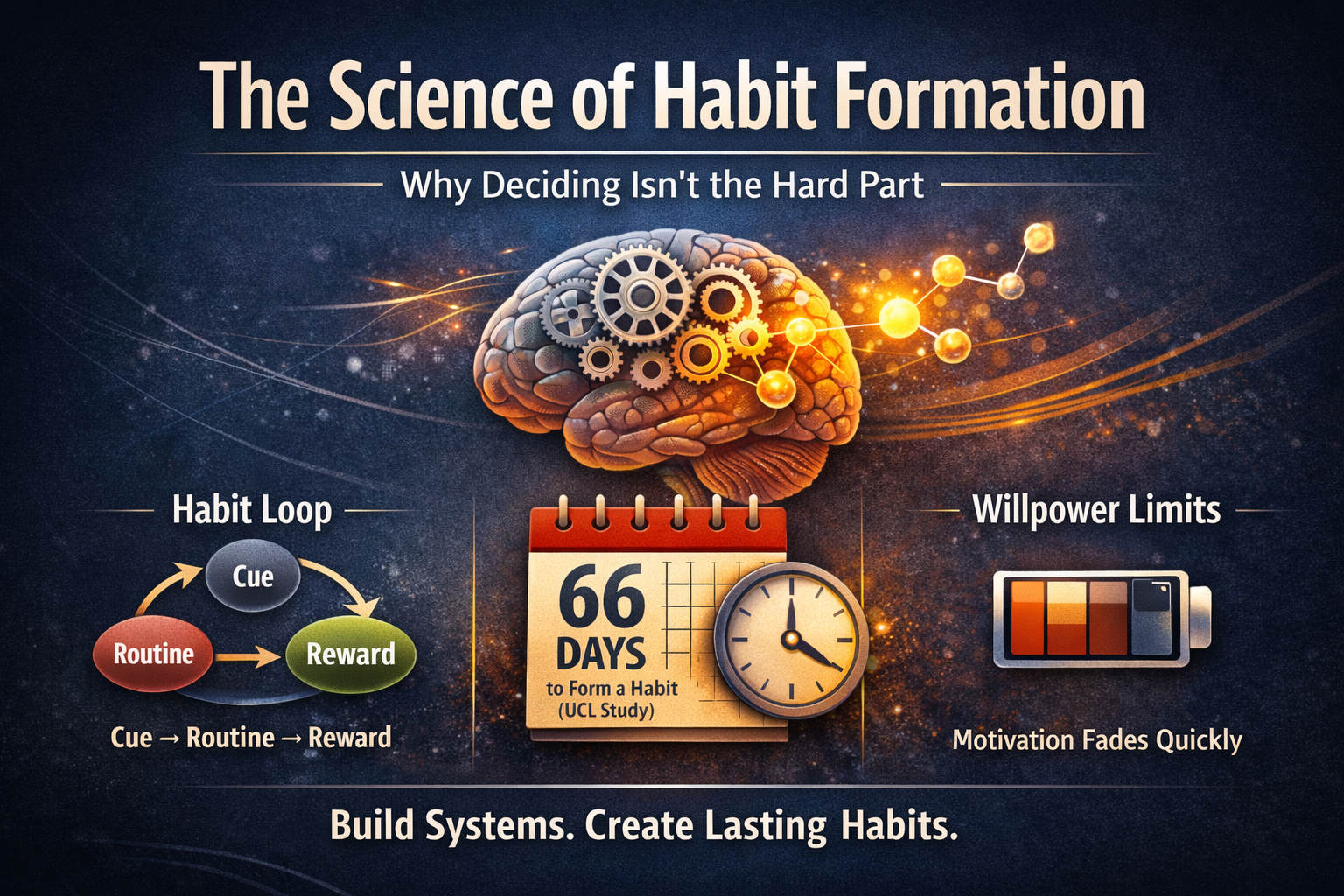
At the core of every habit is a loop:
Cue → Routine → Reward
This framework, studied extensively by Massachusetts Institute of Technology researchers, shows how behaviors become automatic over time.
- Cue: a trigger (time, location, emotion)
- Routine: the behavior itself
- Reward: the benefit your brain associates with it
When repeated, this loop is stored in the basal ganglia, the part of the brain responsible for automatic behaviors.
Here’s the key:
👉 The brain is trying to save energy
👉 Habits are its way of putting actions on autopilot
That’s why once something becomes a habit, it feels effortless. And why starting one feels like pushing a car uphill.
How Long Does It Actually Take?
Forget the “21 days” myth.
A widely cited study from University College London found:
- It takes an average of 66 days for a behavior to become automatic
- The range can vary from 18 to 254 days, depending on complexity
Translation:
👉 Simple habits (drink water, short walk) form faster
👉 Complex habits (gym routines, content systems) take longer
Consistency matters more than speed.
Why Decisions Don’t Create Habits
Making a decision activates the prefrontal cortex. That’s your planning and willpower center.
But habits live elsewhere.
According to research summarized in Harvard Business Review:
- Willpower is limited and depletes throughout the day
- Behavior change fails when it relies only on conscious effort
So when people say:
“I decided to change, but I didn’t stick with it”
They’re not wrong. They’re just relying on the wrong system.
👉 Decisions start the process
👉 Systems sustain it
The Role of Dopamine (Motivation vs. Momentum)
Dopamine isn’t just about pleasure. It’s about anticipation.
Research from Stanford University shows:
- Dopamine spikes before a reward, not after
- Your brain learns to crave the cue, not just the outcome
That’s why:
- You check your phone before thinking
- You snack when bored, not hungry
Your brain is chasing predicted rewards.
To build a habit, you need to engineer that anticipation.
Step-by-Step: How to Choose a Habit That Actually Sticks
This isn’t guesswork. It’s structure.
1. Start With Friction, Not Motivation
Ask:
👉 Where is my life harder than it should be?
Research shows people are more consistent when habits reduce daily friction, not just chase long-term goals.
Examples:
- Low energy → sleep routine
- Disorganized workflow → planning habit
- Inconsistent content → posting system
2. Make It Small Enough to Win Daily
According to behavior scientist BJ Fogg (Stanford Behavior Design Lab):
👉 “Tiny habits” are more sustainable than ambitious ones
Start with:
- 5 minutes, not 60
- 1 post, not a full campaign
- 10 push-ups, not a full workout
Consistency wires the brain. Intensity comes later.
3. Attach It to an Existing Cue
This is called habit stacking.
Example:
- After brushing teeth → read 5 pages
- After coffee → plan your day
- After posting → review analytics
The cue already exists. You’re just plugging into it.
4. Design the Environment
According to Duke University research:
- Over 40% of daily actions are habitual, driven by environment, not decision-making
So:
- Want to eat better? Change what’s visible
- Want to create more? Remove distractions
- Want consistency? Reduce setup time
Environment beats intention.
5. Track and Reward Progress
Small wins matter.
Research shows that visible progress increases adherence because it reinforces the reward loop.
- Checklists
- Streak counters
- Simple logs
Your brain needs proof that the effort is working.
Why the Real Work Starts After the Decision
Here’s the truth most people avoid:
👉 A decision is a moment
👉 A habit is a system repeated under friction
The drop-off happens because:
- Motivation fades
- Life interrupts
- Results are delayed
According to American Psychological Association:
- Behavior change fails most often due to lack of consistency, not lack of knowledge
People know what to do.
They don’t build systems to keep doing it.
The Bottom Line
Habit formation isn’t about discipline alone. It’s about design.
- The brain automates what is repeated
- The environment shapes what is repeated
- Systems determine what survives over time
So the question isn’t:
👉 “What habit should I start?”
It’s:
👉 “What system will make this habit unavoidable?”
Because once the system is right, the habit doesn’t feel like effort anymore.
It feels like identity.
#stayfocused