
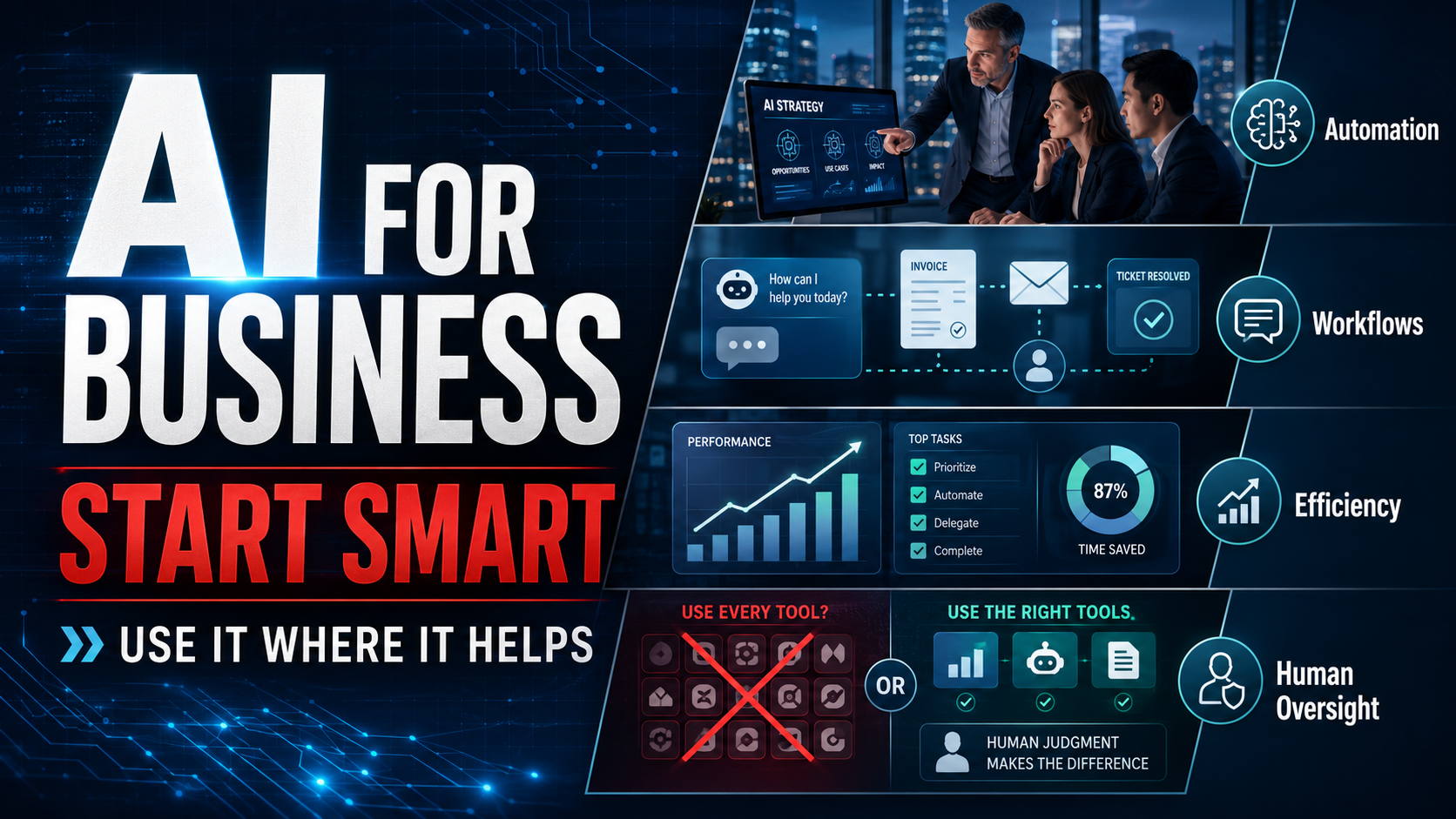
The Smart Way for Businesses to Start With AI: Solve the Problem, Not the Trend
As AI agents, enterprise tools, and automation platforms expand, businesses do not need to chase every new tool. They need to identify where help is actually needed and apply AI with purpose.
By Refocused Network News Desk
July 9, 2026
Artificial intelligence is no longer sitting in the corner of the tech world waiting to be understood. It is now walking straight into the office, the warehouse, the customer-service inbox, the sales meeting, the finance department, and the creator’s workflow.
But here is the truth businesses need to hear: using AI well does not mean trying every new tool that hits the market. That is not strategy. That is digital window-shopping with a company credit card.
The real opportunity is much more practical. Businesses should start with AI by asking one clear question: Where do we actually need help?
That question matters more than ever because the AI market is moving fast. Microsoft recently launched Microsoft Frontier Company with $2.5 billion in funding to help companies choose and integrate AI tools that fit their business needs, rather than relying on one model or one provider. Reuters reported that large corporations are increasingly using a mix of AI technologies, including open-source models, customized around internal data and specific goals.
Meta has also moved deeper into enterprise AI, launching a business-focused AI agent designed to help companies automate daily operations. That signals where the market is heading: AI is becoming less about flashy demos and more about everyday business work.
At the same time, the United Nations’ digital technology agency has launched an initiative to improve trust in AI agents, citing concerns around accountability, human oversight, impersonation, and unauthorized decision-making. The International Telecommunication Union said AI agents can handle tasks from scheduling and purchasing to complex business processes, but they must remain identifiable, trustworthy, and under meaningful human control.
That is the balance every business needs: use AI, but do not hand it the keys without checking the locks.
AI adoption is growing, but value is still uneven
The business world has already entered the AI adoption era, but adoption and impact are not the same thing.
McKinsey’s 2025 global AI survey found that 88% of organizations reported regular AI use in at least one business function, up from 78% the previous year. But most organizations were still experimenting or piloting AI, and only about one-third had begun scaling their AI programs. McKinsey also reported that just 39% of respondents saw enterprise-level EBIT impact from AI, even though many reported benefits at the individual use-case level.
That is the warning light on the dashboard. A company can have AI everywhere and still not have AI working.
Business Insider reported similar findings, noting that companies have raced to deploy chatbots, coding assistants, and agents, but the harder part is using them well. A study of nearly 22,000 U.S. firms found stronger workforce gains among companies making sustained, high-intensity AI investments, while a Boston Consulting Group survey found that strategy mattered more than simple tool access. Workers with clear strategic direction reported stronger measurable impact than those with strong access but little direction.
In plain terms: buying tools is easy. Building better work is harder.
Start where the pain is obvious
Businesses should not begin their AI journey with the question, “What is the coolest AI tool right now?”
They should begin with a much sharper question: What is slowing us down every week?
For some companies, that may be customer service emails that pile up like laundry after a long road trip. For others, it may be sales follow-ups, meeting notes, proposal drafts, invoice review, social media captions, inventory updates, hiring screenings, training documents, or repetitive data entry.
The best first AI use case is usually not glamorous. It is the boring task that steals hours, causes mistakes, frustrates employees, or delays customers.
That is where AI earns trust.
A small business does not need ten AI platforms on day one. It may only need one assistant that helps draft customer replies, summarize calls, clean up product descriptions, or organize weekly reports. A local service company may need AI to create faster estimates. A podcast team may need AI to turn interviews into clips, descriptions, titles, and newsletters. A sales team may need AI to help research leads and draft better outreach.
The point is not to “have AI.” The point is to remove friction.
Do not chase tools. Build workflows.
The companies getting real value from AI are not simply handing employees a login and hoping magic happens. They are redesigning how work moves.
McKinsey found that high-performing AI organizations are much more likely to redesign workflows, define where human validation is needed, track AI performance, and have senior leaders actively involved in adoption.
That is the difference between AI as a toy and AI as a system.
A smart workflow might look like this:
Step one: Identify a repetitive task.
Step two: Use AI to create a first draft, summary, recommendation, or checklist.
Step three: Let a human review and approve the output.
Step four: Measure whether the process saved time, improved quality, reduced errors, or helped customers.
Step five: Only then decide whether to expand.
That simple process keeps AI in its proper place. It becomes a skilled assistant, not a runaway intern with a rocket launcher.
AI should support people, not confuse them
One of the biggest mistakes companies make is dropping AI into the workplace without giving employees direction.
If a business adds AI but does not explain when to use it, what it is allowed to do, what data can be entered, who checks the output, and what success looks like, the result is confusion. Some employees will overuse it. Some will avoid it. Some will use it in risky ways. Some will quietly build their own workaround stack in the shadows.
That is not innovation. That is a digital junk drawer.
Businesses need simple AI rules:
Use AI for drafts, summaries, research support, idea generation, process checks, and repetitive work.
Do not use AI as the final authority for legal, medical, financial, hiring, safety, or sensitive customer decisions without qualified human review.
Do not paste confidential information into tools that have not been approved.
Do not measure AI success by how many tools the company buys. Measure it by what improves.
Be careful with AI agents
AI agents are becoming one of the biggest trends in technology. Unlike basic chatbots, agents can take steps, use tools, complete tasks, and act with more independence. That can be powerful for scheduling, operations, purchasing, research, customer support, and internal coordination. But the same autonomy that makes agents useful also makes them risky.
The ITU’s new trust initiative shows that global leaders are already thinking about how to keep AI agents accountable, identifiable, and under human control.
For businesses, the rule should be simple: the more authority an AI system has, the stronger the guardrails must be.
An AI that drafts an email is low risk.
An AI that sends refunds is higher risk.
An AI that approves purchases, changes pricing, handles customer data, or makes financial decisions needs clear permissions, logs, review systems, and human oversight.
AI should never be mysterious inside a business. Leaders should know what it is doing, who approved it, what data it used, and how mistakes can be corrected.
The hidden cost: AI is not free, even when the tool looks cheap
Another reason businesses should avoid trying too many AI tools at once is cost. AI is not only a subscription line item. It also carries hidden costs: employee training, data cleanup, security review, integration time, quality control, and workflow redesign.
On the infrastructure side, AI demand is also increasing energy pressure. Reuters reported that U.S. power use is expected to hit record highs in 2026 and 2027, with AI-driven data centers among the forces increasing electricity demand.
That does not mean businesses should avoid AI. It means leaders should respect the full cost of using it. Smart adoption is not fear. It is stewardship.
A practical starter plan for businesses
A business can start with AI in a disciplined way by choosing one or two clear use cases for 30 days.
Start with a department that already feels pressure. Customer service, marketing, admin operations, sales, finance, HR, or content creation are often strong first areas.
Pick one task that happens every week. Document how long it takes today. Use AI to help with the first draft, first summary, first analysis, first outline, or first response. Keep a human in the review seat. Track the difference.
After 30 days, ask four questions:
Did this save meaningful time?
Did quality improve?
Did customers or employees benefit?
Did the process become easier to repeat?
If the answer is yes, build a repeatable workflow. If the answer is no, do not force it. Move to a better use case.
That is how businesses avoid the AI trap. They stop collecting tools and start building leverage.
Why this matters
AI is not just a tech trend anymore. It is becoming part of how modern work gets done. Stanford’s 2026 AI Index reported that generative AI reached 53% population adoption within three years, faster than the PC or the internet, while the estimated value of generative AI tools to U.S. consumers reached $172 billion annually by early 2026.
But the future does not belong to the business that uses the most AI. It belongs to the business that uses AI with the most clarity.
The winning companies will not be the ones chasing every shiny platform. They will be the ones that know their bottlenecks, protect their people, respect their data, measure results, and use AI where it actually helps.
AI should not become a badge a business wears to look modern.
It should become a quiet engine under the hood, helping the team move better, serve faster, think clearer, and create more room for the human work that still matters most.
Sources
Reuters: Microsoft launches Microsoft Frontier Company to help businesses adopt AI.
Reuters: UN digital technology agency launches initiative to improve trust in AI agents.
Reuters: Meta launches enterprise-focused AI business agent.
McKinsey: The state of AI in 2025: Agents, innovation, and transformation.
Business Insider: Companies are buying AI tools, but strategy determines impact.
Stanford HAI: 2026 AI Index Report.
Reuters: U.S. power use expected to hit record highs as AI demand rises.
Reuters: Microsoft launches firm to help companies adopt AI
https://www.reuters.com/business/retail-consumer/microsoft-launches-firm-help-companies-adopt-ai-with-25-billion-2026-07-02/
Reuters: UN digital technology agency launches initiative to improve trust in AI agents
https://www.reuters.com/legal/litigation/un-digital-tech-agency-launches-initiative-improve-trust-ai-agents-2026-07-09/
Reuters: Meta launches enterprise-focused AI business agent
https://www.reuters.com/business/meta-launches-enterprise-focused-ai-business-agent-automate-daily-operations-2026-06-03/
McKinsey: The state of AI
https://www.mckinsey.com/capabilities/quantumblack/our-insights/the-state-of-ai
Business Insider: AI adoption strategies companies
https://www.businessinsider.com/ai-adoption-strategies-companies-2026-7
Stanford HAI: 2026 AI Index Report
https://hai.stanford.edu/ai-index/2026-ai-index-report
Reuters: U.S. power use expected to hit record highs as AI use surges
https://www.reuters.com/business/energy/us-power-use-beat-record-highs-2026-2027-ai-use-surges-eia-says-2026-07-07/