
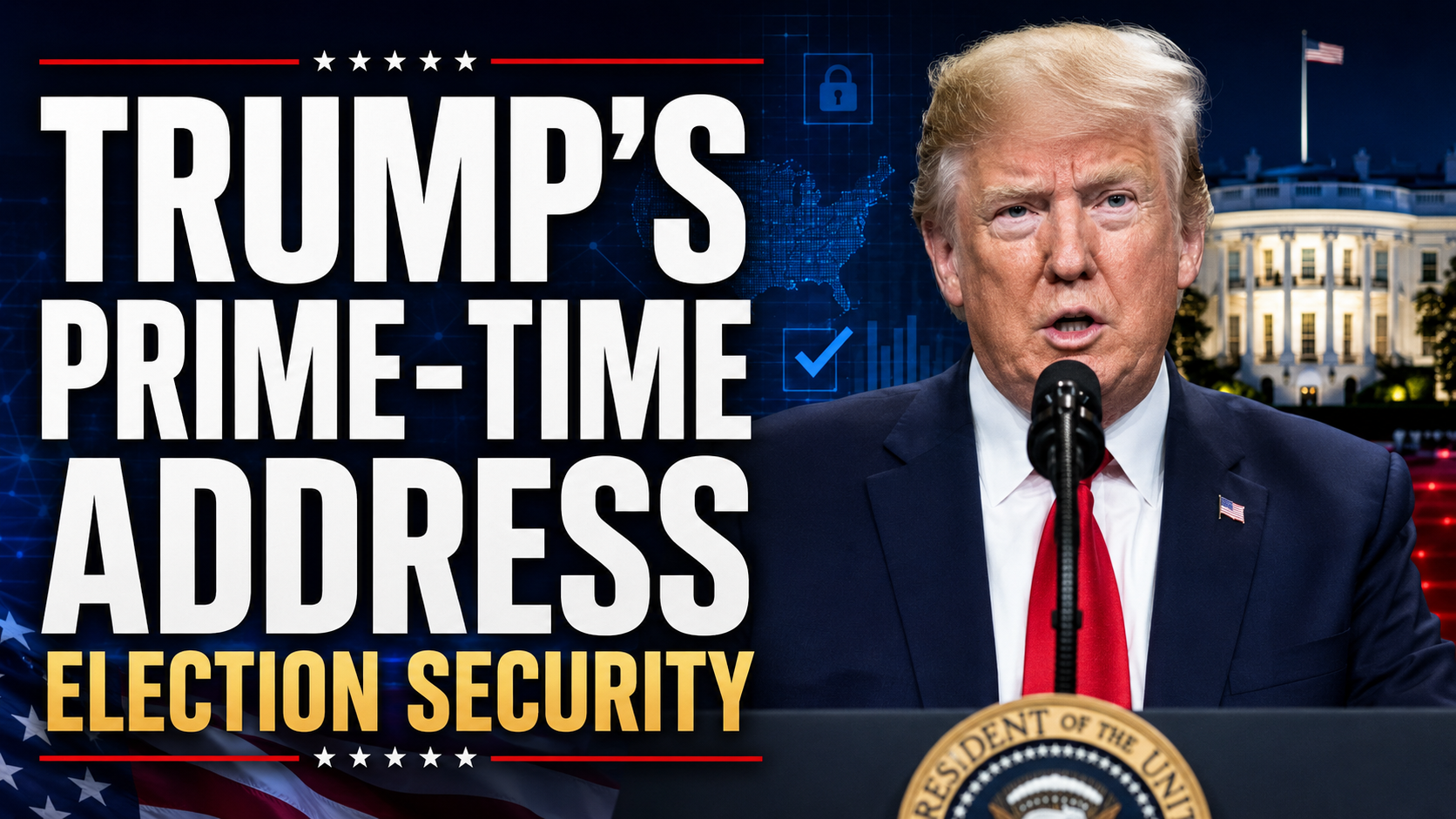
Trump Uses Prime-Time Address to Renew Election-Security Push and Release Declassified Records
By Refocused News Desk | July 16, 2026
WASHINGTON — President Donald Trump used a prime-time address Thursday night to argue that the United States’ election system remains dangerously vulnerable to foreign interference, cyberattacks and improper voter registrations. He also announced the release of previously classified government documents that the White House says support its concerns.
Speaking from the White House, Trump began by promoting his administration’s economic record and other accomplishments before turning to election security—the central subject of the address.
Trump said every American should be confident that legally cast ballots are counted accurately. He argued, however, that the current system “falls catastrophically short” of that standard and called for significant changes before the November midterm elections.
China and American voter information
One of Trump’s largest claims involved China and American voter-registration data.
Trump alleged that China obtained approximately 220 million U.S. voter files containing names, addresses, telephone numbers, party affiliations and other personal information. The White House described the alleged operation as the largest compromise of election-related information in history.
The administration also accused members of the intelligence community of suppressing information about the scope of China’s activities. Trump ordered intelligence agencies and federal law enforcement to investigate whether government officials improperly concealed election-related intelligence.
However, gaining access to voter-registration information is not the same as altering ballots or changing election results. Much voter-registration information is already publicly available, although the exact records released vary by state.
A declassified 2021 intelligence assessment concluded that China considered influence operations but did not deploy an operation intended to change the outcome of the 2020 presidential election. That assessment also found no indication that any foreign actor altered voter registration, ballots, vote totals or the reporting of results. The Office of the Director of National Intelligence assessment remains an important point of comparison with the claims presented Thursday.
China’s embassy in Washington denied interfering in American elections.
Noncitizens reportedly found on voter rolls
Trump also said a Department of Homeland Security review identified approximately 278,000 noncitizens registered to vote in federal elections.
The president claimed the actual number could be higher because some Democratic-led states did not provide their complete voter files. He said he had directed DHS to remove ineligible registrations.
The White House published a summary of the finding but had not immediately provided enough publicly accessible detail for independent analysts to verify how the figure was calculated, which states were examined or how many of the identified individuals may have actually voted.
That distinction matters. An inaccurate or outdated registration does not automatically mean an illegal ballot was cast.
Voting machines and election infrastructure
The White House also released documents concerning potential vulnerabilities in electronic voting and ballot-counting systems.
The administration emphasized intelligence findings that adversaries including China, Russia, Iran and North Korea possess the technical ability to target American election infrastructure. It also cited intelligence concerning alleged methods developed by Venezuela’s Maduro government to manipulate that country’s elections.
Cybersecurity specialists have long acknowledged that election databases and electronic systems can face attempted attacks. However, Reuters reported that election-security experts have found no credible evidence of widespread manipulation that changed the outcome of the 2020 U.S. election.
The earlier intelligence assessment similarly found that foreign governments conducted influence campaigns and attempted to access government networks, but it did not find that those activities altered the technical voting process.
In plain English: vulnerabilities deserve serious attention, but the existence of a vulnerability does not prove that an election was stolen.
Michigan investigation reopened
Trump announced that he had directed FBI Director Kash Patel to fully investigate allegations involving a 2020 voter-registration campaign in Muskegon, Michigan.
According to the White House, canvassers connected to the operation allegedly admitted signing other people’s names, submitting registrations for nonexistent individuals and receiving incentives based on the number of applications collected.
The president accused the Biden-era Justice Department of failing to pursue the case aggressively. The new investigation will determine whether prosecutable crimes occurred and whether fraudulent registration applications resulted in any illegal votes.
Trump calls for the SAVE America Act
Trump used the address to pressure Congress to pass the SAVE America Act, which would establish proof-of-citizenship requirements for voter registration and photo-identification requirements at the polls.
Supporters describe the legislation as a necessary safeguard against noncitizen voting and registration fraud. Opponents argue that strict documentation requirements could prevent eligible citizens—particularly older, low-income and rural voters—from registering if they cannot easily obtain the required records.
The bill currently faces steep obstacles in the Senate.
Major networks limit live coverage
The speech also created a significant media controversy before Trump stepped to the podium.
ABC, NBC and CNN declined to carry the entire address live on their primary television channels. ABC and NBC made it available through their digital news services, while CNN offered access online and through its subscription platform.
The networks did not publicly describe the decision as a fact-checking measure, but it came amid concerns that Trump would repeat disputed or unsupported claims concerning the 2020 election. The White House accused the networks of denying Americans direct access to an important presidential address.
CBS offered special coverage, while Fox News carried the speech.
What happens next
Thursday’s address was less a single announcement than the opening of a broader administration campaign focused on election administration, voter eligibility, voting technology and the handling of intelligence surrounding the 2020 election.
The White House has established a new election-integrity webpage containing documents related to voting-system vulnerabilities, Chinese acquisition of voter information, the Michigan registration investigation and alleged noncitizen registrations.
Those materials will now face examination by Congress, cybersecurity specialists, election administrators and independent journalists. The central question is whether the newly released records demonstrate previously unknown interference affecting actual votes—or primarily document risks, attempted intrusions and data-security failures.
With the midterm elections only months away, the debate will not remain confined to what happened in 2020. It will directly shape public confidence in the elections coming next.
Sources and full links
- White House — Election Integrity documents and administration claims
https://www.whitehouse.gov/election-integrity/ - Office of the Director of National Intelligence — Foreign Threats to the 2020 U.S. Federal Elections
https://www.dni.gov/files/ODNI/documents/assessments/ICA-declass-16MAR21.pdf - Associated Press — Trump delivers prime-time address to the nation
https://apnews.com/article/6b9a3a0d2c010d98b7f526991901e114 - Reuters — Trump’s election claims and the approaching midterms
https://www.reuters.com/legal/government/trumps-championing-debunked-vote-conspiracies-casts-shadow-over-midterms-2026-07-16/ - Reuters — ABC, NBC and CNN decline primary-channel coverage
https://www.reuters.com/legal/government/us-networks-face-dilemma-over-whether-air-trumps-election-security-speech-2026-07-16/ - The Washington Post — Live reporting and fact checks from the address
https://www.washingtonpost.com/politics/2026/07/16/live-updates-trump-give-speech-election-security/