
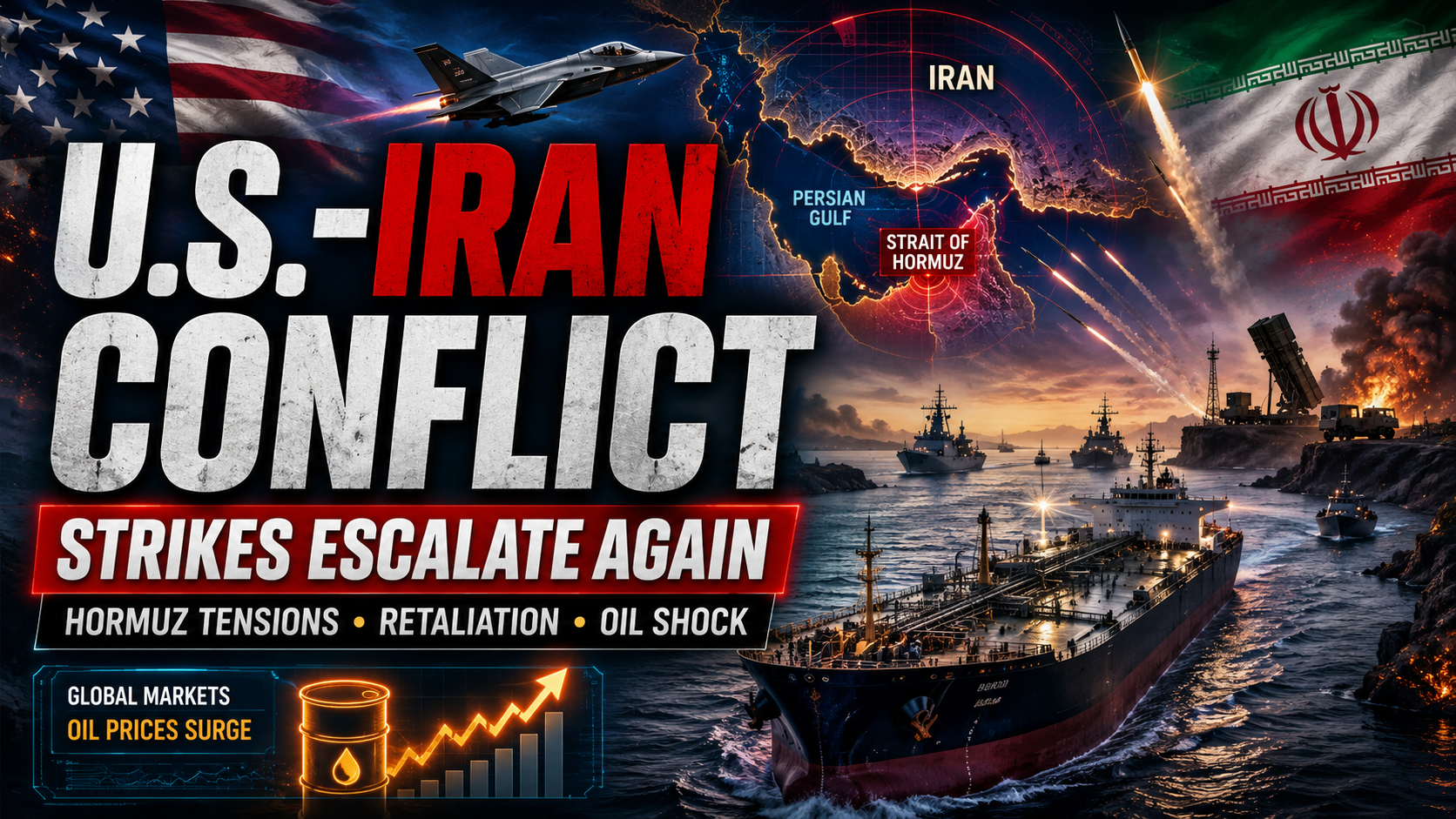
U.S.-Iran Conflict Escalates Again as Military Strikes Resume Near Strait of Hormuz
August 31, 2026
A dangerous new chapter in the U.S.-Iran conflict unfolded over the weekend as American forces struck Iranian military launchers near the Strait of Hormuz, Iran retaliated toward locations hosting U.S. forces in Jordan, and the United Arab Emirates reported intercepting an Iranian drone.
The exchange marks the first major direct military confrontation between the United States and Iran in roughly a month, raising fresh concerns that a period of relative military restraint could give way to another broader escalation across the Gulf.
U.S. strikes Iranian launchers on Larak Island
The confrontation began Sunday, Aug. 30, when U.S. forces struck two Iranian launchers on Larak Island, an Iranian island strategically located in the Strait of Hormuz.
The United States said forces associated with Iran's Islamic Revolutionary Guard Corps were preparing to use the launchers as part of an operation involving sea mines that could threaten vessels traveling through the waterway.
According to Associated Press reporting, the U.S. characterized the strike as a defensive action intended to protect international shipping. Iran rejected the American explanation and described the attack as an act of aggression.
The Strait of Hormuz is not simply another patch of water on the map. It is one of the most important energy corridors in the world, connecting Persian Gulf producers with global markets.
U.S. Energy Information Administration data has historically shown that roughly one-fifth of global petroleum liquids consumption has moved through the Strait during normal conditions. There are only limited pipeline alternatives capable of bypassing the waterway, meaning disruptions can quickly affect global oil markets.
Iran retaliates toward U.S.-linked bases in Jordan
Iran responded by launching missiles toward locations in Jordan associated with U.S. military forces.
Iran's Revolutionary Guard said its operation targeted American bases, including facilities at Al Azraq and King Hussein.
Jordan, however, reported that its air-defense systems successfully intercepted and destroyed eight missiles that violated Jordanian airspace early Monday.
Jordan's Armed Forces said the projectiles were destroyed before they posed a threat to civilians or property.
That distinction is important.
Iran has described the retaliation as attacks against U.S. military targets, while Jordan's official account emphasizes that incoming missiles were intercepted. Wartime claims from opposing governments can differ significantly, and independent verification of every claimed target or impact remains difficult while events are unfolding.
UAE intercepts Iranian drone
The confrontation also spilled toward the United Arab Emirates.
The UAE government said Monday that its air-defense systems intercepted an Iranian drone over Emirati territorial waters.
The UAE Ministry of Foreign Affairs called the incident a dangerous escalation and said the country reserved the right to protect its sovereignty and national security.
Iranian reports had claimed attacks against U.S. military assets at Al Minhad Air Base in the UAE. Emirati authorities disputed reports that the base itself had been successfully attacked, while confirming the interception of the Iranian drone.
The episode increases concerns among Gulf nations that another cycle of U.S.-Iran retaliation could pull neighboring countries more deeply into the confrontation, particularly states hosting American military facilities.
Trump threatens a stronger response
President Donald Trump responded to Iran's retaliation with warnings that additional U.S. military action could follow.
Reuters reported Monday that Trump vowed a forceful response if Iranian attacks continued. At the same time, his administration is intensifying economic pressure against Tehran through additional sanctions and restrictions targeting Iran's financial networks.
However, one dramatic claim circulating Monday requires an important clarification.
Trump posted that Iran's strategically important Kharg Island was being destroyed, accompanied by dramatic imagery. Reuters found no independent evidence at the time confirming such an attack, and the video accompanying the post was identified as AI-generated.
Neither the White House nor Pentagon had confirmed a major attack on Kharg Island when Reuters published its report.
That makes the distinction between confirmed military action and online messaging particularly important as the conflict develops.
Iran says it remains open to an agreement
Despite the military retaliation, Iranian President Masoud Pezeshkian has continued to signal that Tehran does not want an indefinite war.
Reuters reported that Pezeshkian said continued fighting would not benefit Iran or the broader region and indicated that Iran remained interested in pursuing a negotiated resolution.
Iranian officials, however, continue to insist that any agreement must address restrictions involving Iranian shipping, oil exports and access to the Strait of Hormuz.
That creates a difficult diplomatic puzzle: both sides publicly leave some room for negotiation while simultaneously applying military and economic pressure.
Washington increases economic pressure
Military action is only one part of the U.S. strategy.
The Treasury Department recently launched what it calls Operation Economic Outcast, a new campaign designed to isolate Iran from international banking and financial networks.
Treasury Secretary Scott Bessent said the administration intends to target financial institutions and other entities facilitating Iranian transactions. The administration is also urging international partners to participate in the campaign.
On Monday, Bessent said the United States planned additional sanctions against another bank as Washington attempts to increase economic pressure on Tehran while limiting the need for a larger military campaign.
Whether economic pressure reduces military escalation or pushes Iran toward additional retaliation remains one of the central unanswered questions.
Oil prices react immediately
Energy markets wasted little time responding.
Brent crude climbed above $90 per barrel Monday as traders assessed the possibility of renewed disruptions around the Strait of Hormuz.
Reuters reported Brent rising more than 2% during Monday trading, briefly reaching above $91, while West Texas Intermediate also moved sharply higher.
The market reaction illustrates why even limited military exchanges around Hormuz can have consequences thousands of miles away.
If commercial traffic becomes more dangerous, shipping insurance rises, tanker movements slow or energy exports are disrupted, consumers can eventually feel the effects through fuel prices, transportation expenses and broader inflation.
U.S. stocks also moved lower Monday as investors weighed higher energy prices and renewed concerns about inflation and interest rates.
The Strait of Hormuz remains the pressure point
At the center of the crisis is control and access to the Strait of Hormuz.
The narrow passage has been heavily disrupted during the conflict, and shipping volumes remain below normal levels.
Iran argues that Washington cannot dictate access to the strait while maintaining sanctions and military pressure against Tehran. The United States, meanwhile, has emphasized freedom of navigation and maintaining safe passage for international commercial shipping.
That puts the two countries in direct competition over a waterway essential to the global economy.
Even without a massive conventional battle, mines, drones, missiles or attacks against commercial vessels can create enough uncertainty to push oil prices higher and discourage maritime traffic.
What happens next?
Three questions now matter most.
First, does the United States conduct another military strike?
Trump's comments suggest additional action is possible, but Washington also appears interested in maintaining economic pressure as an alternative to returning to sustained large-scale combat.
Second, does Iran continue targeting locations hosting American forces?
Another Iranian missile or drone attack, particularly one causing U.S. casualties, could dramatically increase political pressure for retaliation.
Third, can diplomacy restart before another exchange occurs?
Iran's president continues to publicly leave room for negotiations, while intermediaries in the region have previously attempted to establish arrangements involving shipping through Hormuz.
For the moment, however, military pressure, sanctions, threats and diplomacy are all operating simultaneously.
Why this matters beyond the Middle East
The latest exchange is much larger than a dispute between Washington and Tehran.
The Strait of Hormuz connects some of the world's most important energy producers with global markets. A sustained disruption could affect oil supplies, gasoline prices, shipping, inflation, financial markets and economic growth around the world.
Monday's rise in oil prices is an early reminder of that vulnerability.
The United States and Iran have stepped back from the edge before.
The danger now is that repeated limited attacks create their own momentum. One intercepted missile causes another strike. One drone produces another retaliation. Eventually, a weapon may get through.
That possibility is why the renewed fighting around the Strait of Hormuz has quickly become one of the world's most important developing stories.
This is a developing situation. Military claims, damage assessments and diplomatic positions may change as additional information becomes available.
Sources
Associated Press: U.S. strikes Iranian rocket launchers on the Strait of Hormuz
Read the full AP report
Reuters: Trump vows response after renewed U.S.-Iran exchanges
Read the full Reuters report
Reuters: Oil rises as U.S. and Iran resume military attacks
Read the Reuters energy report
Jordan News Agency (Petra): Jordan intercepts eight missiles
Read Jordan's official statement
Emirates News Agency: UAE confirms Iranian drone interception
Read the UAE statement
U.S. Treasury Department: Operation Economic Outcast
Read Treasury's official statement
Associated Press: U.S. prepares additional financial pressure on Iran
Read the AP sanctions report
U.S. Energy Information Administration: Importance of the Strait of Hormuz
Read the EIA background report
Al Jazeera: U.S.-Iran attacks and regional response
Read the regional explainer
Associated Press: Oil prices and markets react to renewed strikes
Read the AP markets report