
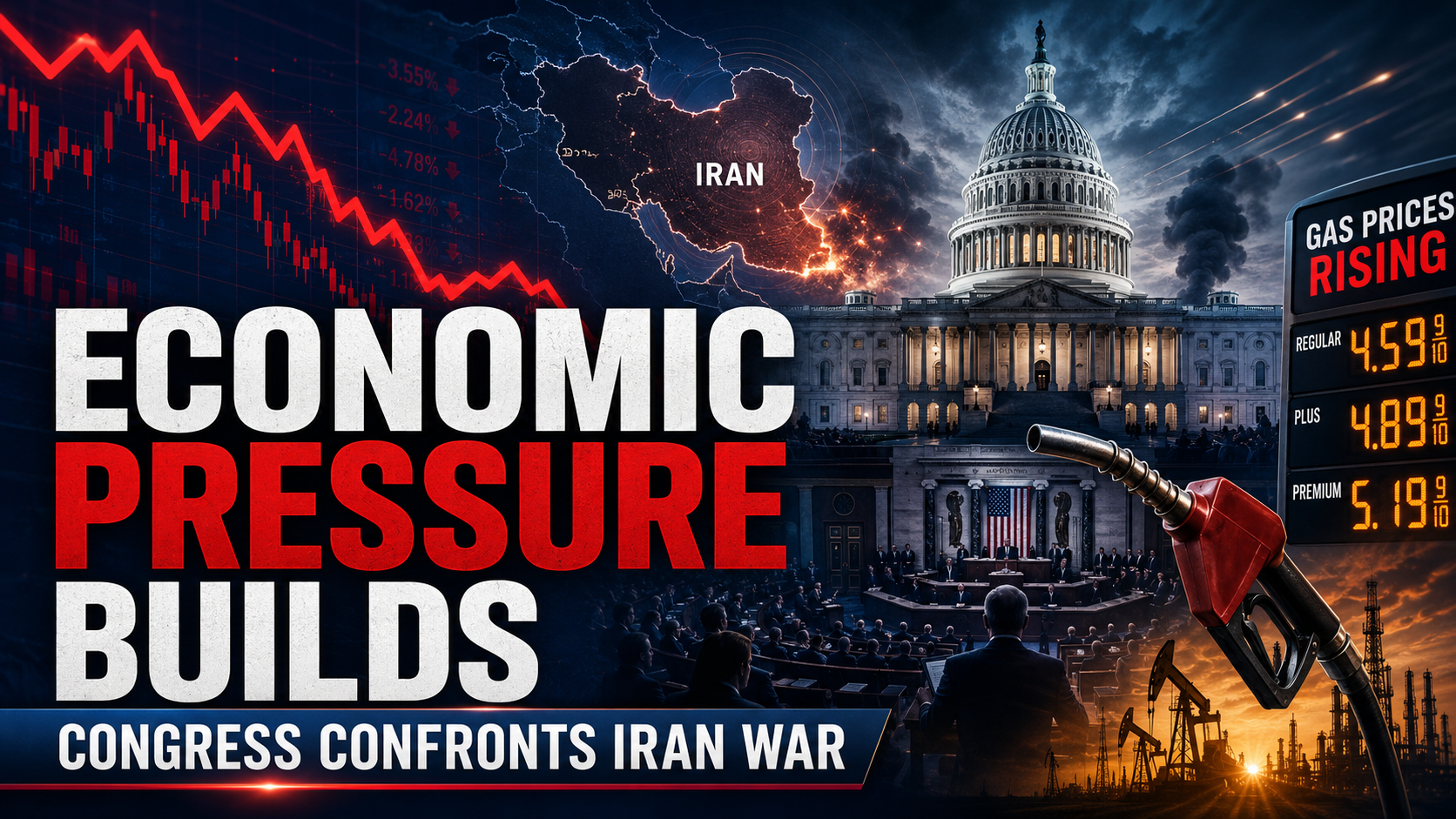
U.S. Morning News: Economic Pressure Builds as Congress Confronts the Iran War
WASHINGTON, D.C. | Friday, July 31, 2026
The United States begins Friday with two major pressures moving toward the same intersection: an economy losing momentum and a war with Iran that is becoming more expensive, politically unpopular and increasingly difficult for Congress to control.
Fresh government data released Thursday showed that economic growth slowed during the second quarter while inflation remained well above the Federal Reserve’s goal. At the same time, the Senate fell one vote short of advancing another attempt to limit President Donald Trump’s authority to continue military operations against Iran without specific congressional authorization.
Neither development exists in isolation.
The war is affecting oil transportation, fuel prices, federal spending and consumer confidence. Those economic consequences are now shaping the congressional debate over whether the United States should continue fighting, reduce its military involvement or force the administration to provide a clearer strategy.
Economic Growth Slows
The U.S. economy grew at an annualized rate of 1.5 percent during the second quarter, according to the Bureau of Economic Analysis’ advance estimate released July 30. That was down from 2.1 percent growth during the first quarter.
Consumer spending, private investment and exports contributed to the expansion, but weaker government spending and other economic pressures limited overall growth. Because this is an advance estimate, the number could be revised when the government releases additional information in August.
The report does not indicate that the country is in a recession. It does, however, show an economy moving with less force at a moment when households and businesses are still managing elevated prices, expensive borrowing and geopolitical uncertainty.
Separate government figures showed personal income increasing only 0.2 percent in June, while consumer spending rose 0.3 percent. The headline Personal Consumption Expenditures price index was 3.7 percent higher than one year earlier, while the core index, which excludes food and energy, increased 3.3 percent.
That combination presents a difficult picture: inflation has eased from its recent peak, but it remains high enough to keep pressure on household budgets and Federal Reserve policymakers.
The Federal Reserve Holds Its Ground
On Wednesday, July 29, the Federal Reserve voted to maintain its benchmark interest-rate range at 3.5 percent to 3.75 percent.
The decision passed by a divided 9-3 vote, with three policymakers preferring an interest-rate increase. That unusually visible split reflected growing concern within the central bank that inflation could remain persistent, particularly if energy prices continue rising.
Holding rates steady protects consumers and businesses from an immediate increase in borrowing costs. However, it also means Americans are unlikely to receive rapid relief on credit cards, auto loans, business financing or other rate-sensitive expenses.
The Fed is walking through a narrow hallway. Raising rates could weaken an already slowing economy. Leaving rates unchanged could allow inflation to remain embedded, especially if the Iran war produces another energy shock.
Oil Prices Carry a War Premium
Oil markets were relatively steady early Friday, but the monthly picture tells a much louder story.
Brent crude traded near $89.50 per barrel, while U.S. West Texas Intermediate crude was around $83.63. Reuters reported that Brent was positioned for a monthly increase of approximately 22 percent, with WTI heading toward a gain of about 20 percent.
Investors are closely monitoring shipping through the Strait of Hormuz and other critical waterways instead of responding only to military headlines. Traffic through key routes has been reduced by the conflict, attacks on shipping and concerns about further regional escalation.
The Energy Information Administration previously forecast that U.S. regular gasoline would average approximately $3.80 per gallon during the third quarter, down from more than $4.20 during the second quarter. That forecast was issued before some of the latest military escalation, meaning the outlook could change if oil supplies or shipping routes experience additional disruption.
Higher crude prices do not remain confined to gas stations. They can raise transportation, agricultural, manufacturing and delivery costs, eventually reaching consumers through groceries, airline tickets, utilities and retail products.
Major oil producers, meanwhile, have reported sharp profit increases as elevated energy prices and refining margins strengthened earnings. That contrast, corporate gains alongside household pressure, is already encouraging proposals in Congress for taxes or other restrictions on extraordinary wartime profits.
Senate Falls One Vote Short
The most immediate political development came Thursday, when the Senate rejected a motion to remove an Iran war-powers resolution from committee and bring it forward for consideration.
The motion involving S.J. Resolution 181 failed 49-50, with one senator not voting. The resolution would direct the removal of U.S. forces from hostilities against Iran that had not been specifically authorized by Congress.
Republican Sens. Susan Collins of Maine, Lisa Murkowski of Alaska and Rand Paul of Kentucky joined most Democrats in supporting the motion. Democratic Sen. John Fetterman of Pennsylvania joined Republicans in opposition.
The result matters, but it should be described precisely. Thursday’s vote was a procedural vote on discharging the resolution from committee, not a final vote authorizing or ending the war.
The House has passed related war-powers measures, including a July vote supported by four Republicans and House Democrats. However, no current measure has completed the necessary process in both chambers to create an enforceable congressional restriction on the administration.
Congress is confronting the conflict, but it has not yet developed the unified majority needed to redirect it.
The Financial Cost Is Becoming Harder to Separate From the War Debate
Defense Secretary Pete Hegseth told lawmakers on July 21 that the estimated cost associated with the Iran conflict had reached $37.5 billion. Reuters reported that the figure included certain expenses already incurred and some anticipated costs through September 30.
The White House also submitted an $87.6 billion supplemental funding request to Congress in June. Approximately $67 billion of that request was intended to replenish Pentagon resources following military operations against Iran, while the remainder covered agriculture, public health and other federal priorities.
The Pentagon has warned that failing to provide additional money could affect military training, maintenance, personnel expenses and the replacement of expensive air-defense interceptors.
Those requests arrive while the economy is growing more slowly and taxpayers are already dealing with elevated prices. The question before Congress is therefore becoming larger than whether lawmakers support or oppose individual strikes.
Congress must decide what mission it is funding, how long that mission could last, what benchmarks would define success and what domestic priorities may be delayed or reduced as military expenses increase.
Public Support Is Weakening
A new Associated Press-NORC poll found that approximately two-thirds of U.S. adults believe the Iran war has not been worth fighting.
Only 28 percent approved of President Trump’s handling of the conflict, down from 34 percent in the previous month. The survey also found that 72 percent of Americans considered keeping gasoline prices low extremely or very important, placing economic concerns near the center of public attitudes toward the war.
Americans can simultaneously believe Iran presents a national-security threat and question whether the current military strategy is producing acceptable results. The polling suggests many voters are now measuring the war through both security and affordability.
With the November midterm elections approaching, that connection could become politically decisive.
A Conflict That Keeps Reopening
The latest congressional vote followed renewed exchanges between the United States and Iran after previous pauses in the fighting.
Recent developments have included Iranian missile and drone attacks directed toward American forces and regional locations, followed by additional U.S. military strikes. The conflict has also drawn in neighboring governments and Iran-aligned groups, increasing the possibility that one attack, miscalculation or shipping incident could widen the war.
Some operational claims remain difficult to confirm independently, and casualty information has become a point of dispute between lawmakers and the Pentagon. The Department of Defense recently created a separate casualty category for troops affected by renewed fighting after declaring the earlier phase of Operation Epic Fury complete.
That administrative distinction illustrates one of Congress’ central frustrations: lawmakers are being asked to vote on money and military authority while still debating whether the original operation ended, restarted or simply changed names.
What This Means for American Households
For most Americans, the conflict will not first appear as a foreign-policy document or congressional resolution. It will arrive through ordinary expenses.
Drivers may see it at the gas pump. Small businesses may experience it through shipping and supply costs. Families could feel it through groceries, utilities and travel. Borrowers may face higher interest rates for longer if the Federal Reserve believes the energy shock is feeding broader inflation.
None of those outcomes is guaranteed. Oil markets can fall quickly if diplomacy succeeds, shipping normalizes or global producers increase supply.
The danger is that the economy currently has less room to absorb a prolonged shock. Growth has slowed, inflation remains above target and federal military expenses continue climbing. What might have been a manageable disruption in a stronger economy could become far more painful when several pressures arrive together.
What to Watch Next
The next several days will show whether the latest military escalation continues or gives way to another diplomatic pause.
Readers should also watch:
Oil and gasoline prices: Markets will focus on shipping movements through the Strait of Hormuz and Bab el-Mandeb.
Congressional funding negotiations: Lawmakers must determine how much additional defense funding to approve and whether to attach oversight requirements.
Federal Reserve messaging: Policymakers will examine whether energy costs are spreading into transportation, services and consumer expectations.
Updated economic data: Employment, manufacturing and consumer-spending reports will reveal whether the second-quarter slowdown is continuing.
War-powers legislation: A one-vote Senate margin means another resolution could produce a different result if attendance or individual positions change.
Refocused Perspective
The debate in Washington is no longer only about who possesses the legal authority to order military strikes. It is about whether national strategy, congressional responsibility and household reality are still moving in the same direction.
Military power can begin a conflict. It cannot, by itself, define a sustainable ending.
Congress must demand clear objectives, transparent costs and measurable conditions for ending military operations. The administration must explain not only what the United States is fighting against, but what outcome it is realistically fighting toward.
For the public, the lesson is equally important: economic policy and foreign policy do not live in separate rooms. Eventually, the bill crosses the hallway.
Sources and Full Links
U.S. Bureau of Economic Analysis: GDP, Second Quarter 2026
https://www.bea.gov/news/2026/gdp-advance-estimate-2nd-quarter-2026
U.S. Bureau of Economic Analysis: Personal Income and Outlays, June 2026
https://www.bea.gov/news/2026/personal-income-and-outlays-june-2026
Federal Reserve: July 29 FOMC Statement
https://www.federalreserve.gov/newsevents/pressreleases/monetary20260729a.htm
U.S. Senate: July 30 Roll Call Vote on S.J. Resolution 181
https://www.senate.gov/legislative/LIS/roll_call_votes/vote1192/vote_119_2_00216.htm
Roll Call: Iran War Powers Resolution Blocked in Senate
https://rollcall.com/2026/07/30/iran-war-powers-resolution-blocked-in-senate-as-conflict-heats-up/
Reuters: Oil Prices and Shipping Flows, July 31
https://www.reuters.com/business/energy/oil-falls-more-than-1-greater-flows-despite-us-iran-war-2026-07-31/
Reuters: House and Senate Iran War-Powers Votes
https://www.reuters.com/legal/government/us-house-votes-curb-trumps-iran-war-powers-senate-backs-president-2026-07-23/
Reuters: Pentagon’s $37.5 Billion War-Cost Estimate
https://www.reuters.com/world/middle-east/us-war-iran-has-cost-375-billion-so-far-pentagon-says-2026-07-21/
Associated Press: AP-NORC Poll on the Iran War
https://apnews.com/article/55e9c80afec521d87f131393a59674c0
Associated Press: White House Supplemental Funding Request
https://apnews.com/article/c0cbd21df91c48fa821fc21e021d8831
Associated Press: Oil-Company Profits During the Conflict
https://apnews.com/article/9375fbf8f6f40426f7428e07d54000c7
Associated Press: Pentagon Casualty Classification Questions
https://apnews.com/article/612099f7e3eda9c28625e8bfe7c5c6dd
U.S. Energy Information Administration: Short-Term Energy Outlook
https://www.eia.gov/outlooks/steo/
CBS News: Live Updates on the U.S.-Iran Conflict
https://www.cbsnews.com/live-updates/us-iran-war-trump-saudi-arabia-strait-of-hormuz/