
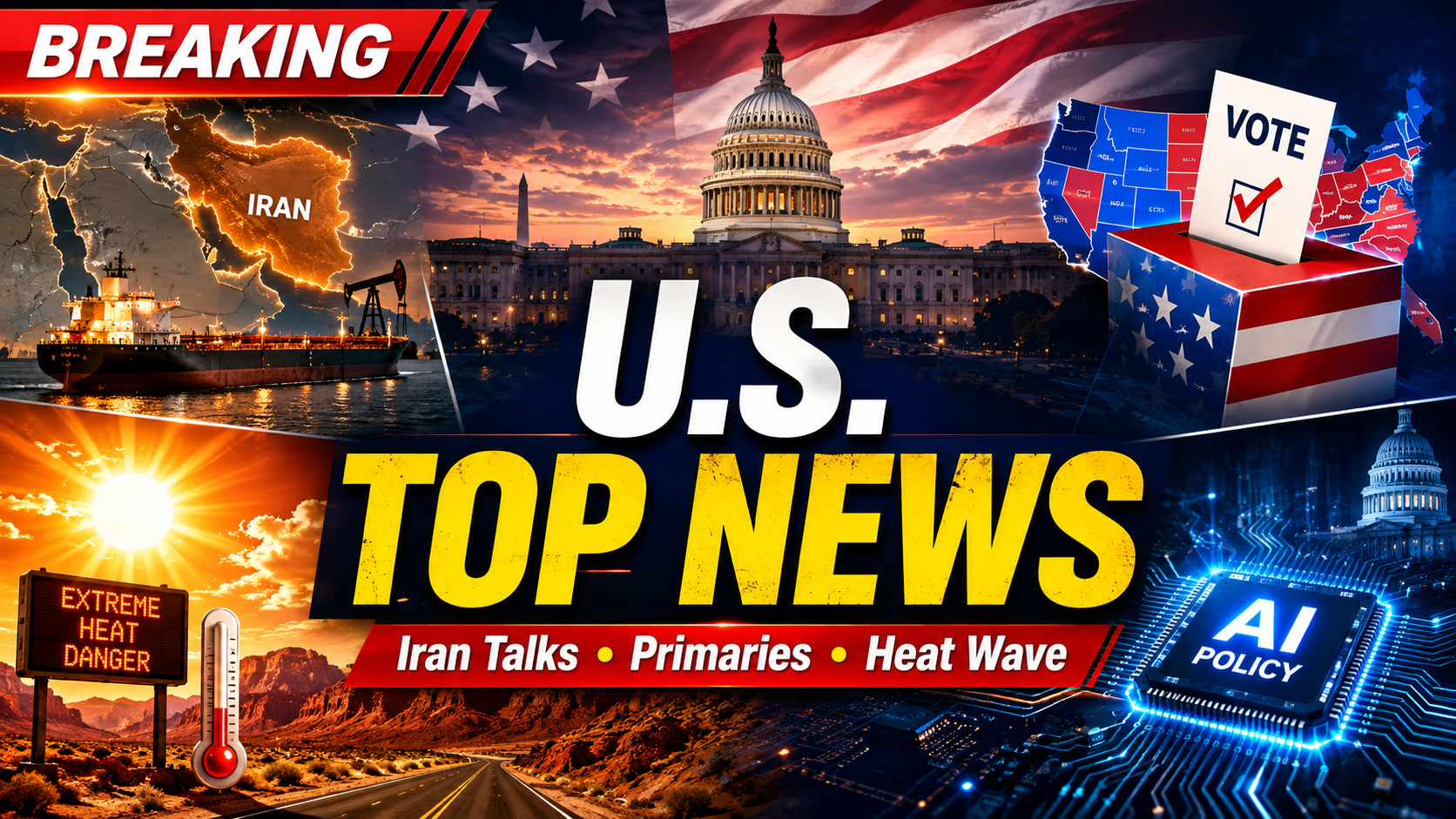
U.S. Morning News: Iran Talks Raise Hope as Military, FEMA and Election Pressures Build
Wednesday, August 5, 2026
The United States begins Wednesday with signs of a possible diplomatic breakthrough overseas, but several major challenges remain unresolved at home.
President Donald Trump says negotiations with Iran are progressing, helping push oil prices lower and financial markets higher. At the same time, new reporting is raising questions about U.S. missile supplies, Michigan voters are delivering an election-night cliffhanger, and a federal watchdog is warning that FEMA may not have adequately prepared for the effects of major staffing reductions.
The morning’s other developing stories include a White House decision on artificial intelligence safety testing and continued dangerous heat across the western United States.
U.S.-Iran Negotiations Fuel Hope for a Possible Deal
Trump said the United States and Iran held productive, day-long discussions Tuesday as negotiators worked toward a possible agreement involving Iran’s nuclear program and the reopening of the Strait of Hormuz.
The shipping route has remained a central pressure point during the five-month conflict because of its importance to global oil transportation. Trump indicated that an agreement could be approaching, although neither side had announced a finalized deal early Wednesday.
Hopes of de-escalation lifted global stocks and helped oil prices retreat. Brent crude traded near $78 per barrel early Wednesday, far below its June peak of approximately $102. Lower oil prices could eventually reduce pressure on transportation expenses, consumer prices and interest rates, although much will depend on whether shipping through the strait is fully restored.
Report Raises Questions About U.S. Missile Readiness
The diplomatic push comes as Reuters reports that the United States has used most of its supply of certain long-range precision missiles during the Iran war.
According to three people familiar with military inventory data, the Army has used “virtually all” of its available Precision Strike Missiles and Army Tactical Missile Systems. Reuters also reported that the military has used slightly less than half of its global Tomahawk missile inventory.
The Pentagon’s exact stockpile numbers are classified, making independent public verification difficult. Still, the reported decline is creating concern about whether the United States would be prepared to respond quickly if a separate conflict developed elsewhere.
The story also raises a longer-term industrial question: how rapidly can U.S. manufacturers replace weapons that may require months or years to produce?
Michigan Primary Becomes an Election-Night Cliffhanger
One of the country’s most closely watched Democratic primaries remained unsettled during the early morning hours.
Progressive former public health official Abdul El-Sayed held a narrow lead over U.S. Rep. Haley Stevens in the race for Michigan’s Democratic Senate nomination. The Associated Press had not called the race at the time of this briefing, while NBC News projected El-Sayed as the winner.
The nominee will face Republican Mike Rogers in November for the open seat being vacated by retiring Sen. Gary Peters. Democrats are expected to need the Michigan seat as part of any realistic attempt to gain control of the Senate.
Elsewhere, Rep. Wesley Bell defeated former Rep. Cori Bush in Missouri’s 1st Congressional District Democratic primary. In Michigan, climate activist William Lawrence won the Democratic nomination in the competitive 7th District and will challenge Republican Rep. Tom Barrett.
The results showed no single national ideological wave. Progressive candidates gained ground in some contests, while established incumbents and moderates held their positions in others.
Watchdog Warns FEMA Cuts Could Affect Disaster Readiness
A new Government Accountability Office report says FEMA reduced its workforce without conducting enough analysis of how those reductions would affect the agency’s long-term ability to respond to disasters.
Approximately 17 percent of FEMA’s workforce, more than 4,300 employees, separated from the agency during fiscal year 2025. The GAO found that FEMA did not base its workforce reductions on a comprehensive assessment of existing staffing levels or projected future needs.
Regional offices were hit especially hard. FEMA officials interviewed by the GAO described uncertainty over staffing, responsibilities and the agency’s future direction.
The findings arrive during hurricane and wildfire season, when federal, state and local emergency response systems can be tested by multiple disasters occurring at once. The GAO concluded that FEMA does not yet fully understand how the staffing changes may affect its present or future mission capacity.
White House Exempts Open-Weight AI Models From Safety Testing
The Trump administration told leading artificial intelligence companies that open-weight AI models will not be included in its proposed voluntary government safety-testing framework.
Open-weight models provide public access to important parts of the technology, allowing developers and researchers to download, modify and deploy them. Examples include Meta’s Llama models and Nvidia’s Nemotron family.
Closed models developed by companies including OpenAI, Google and Anthropic may undergo voluntary testing when they demonstrate advanced cybersecurity or hacking capabilities.
The decision followed a White House meeting with representatives from Meta, Nvidia, OpenAI, Google and Anthropic. The meeting came after disclosures involving AI systems gaining unauthorized access to outside computer systems during testing.
Five Democratic senators are urging the administration to work with Congress on permanent testing requirements for the most advanced American AI systems. Critics are also asking the White House to release more details about how models will be evaluated and how the results will be reported to the public.
Extreme Heat and Fire Risks Continue Across the West
Dangerous heat remains a major concern across the Desert Southwest and parts of the western United States.
The National Weather Service says dangerous to extreme heat will continue in the Southwest before expanding eastward toward parts of the central United States and Gulf Coast. Elevated fire conditions are also continuing across the Great Basin, while wildfire smoke is contributing to reduced air quality in parts of the Northwest.
Earlier in the heat wave, temperatures reached approximately 115 degrees in Las Vegas, with Phoenix and parts of southeastern California approaching similar or higher levels. Warm overnight temperatures have made the event particularly dangerous because homes and bodies receive less time to cool down.
Residents should continue checking local warnings because heat risks can vary significantly within the same state or metropolitan region.
What to Watch Next
The most immediate question is whether the United States and Iran can transform positive negotiations into a written agreement that reopens the Strait of Hormuz and reduces the risk of additional military action.
Election officials will continue counting the remaining Michigan ballots, while both parties begin positioning candidates for the November midterms.
Congress may also seek answers about military stockpiles, FEMA staffing and the White House’s artificial intelligence review process. Meanwhile, forecasters will watch whether the Western heat dome weakens or begins pushing dangerous temperatures farther east.
Refocused Perspective
Today’s stories share one quiet but important theme: national capacity.
Can diplomats prevent another round of attacks? Can defense manufacturers replace what the military has used? Can FEMA respond when several disasters strike? Can regulators keep pace with increasingly powerful technology?
The headlines may appear separate, but they all test whether America is prepared not only to react to pressure, but to plan beyond it. A country’s strength is measured by what it can deploy today and what it has wisely preserved for tomorrow.
Sources and Full Links
- Reuters: U.S. and Iran report progress in discussions
https://www.reuters.com/world/middle-east/us-iran-having-very-good-discussions-trump-says-2026-08-05/ - Reuters: U.S. long-range precision missile stockpiles
https://www.reuters.com/world/us-has-used-virtually-all-its-long-range-precision-missiles-during-iran-war-2026-08-04/ - Associated Press: August 4 primary election updates
https://apnews.com/article/f8bad69c79dd7cb7374c6ea2674d0d89 - Government Accountability Office: FEMA workforce report
https://files.gao.gov/reports/GAO-26-108427/index.html - Reuters: White House AI safety-testing discussions
https://www.reuters.com/legal/litigation/meta-anthropic-google-openai-meet-with-trump-white-house-amid-rogue-ai-agent-2026-08-04/ - NOAA Weather Prediction Center
https://www.wpc.ncep.noaa.gov/index.shtml - Associated Press: Western heat wave and wildfire risks
https://apnews.com/article/594390d448a480564ec7db6b15b5fffc - Reuters: Markets, oil prices and Wednesday economic outlook
https://www.reuters.com/world/china/global-markets-view-europe-2026-08-05/