
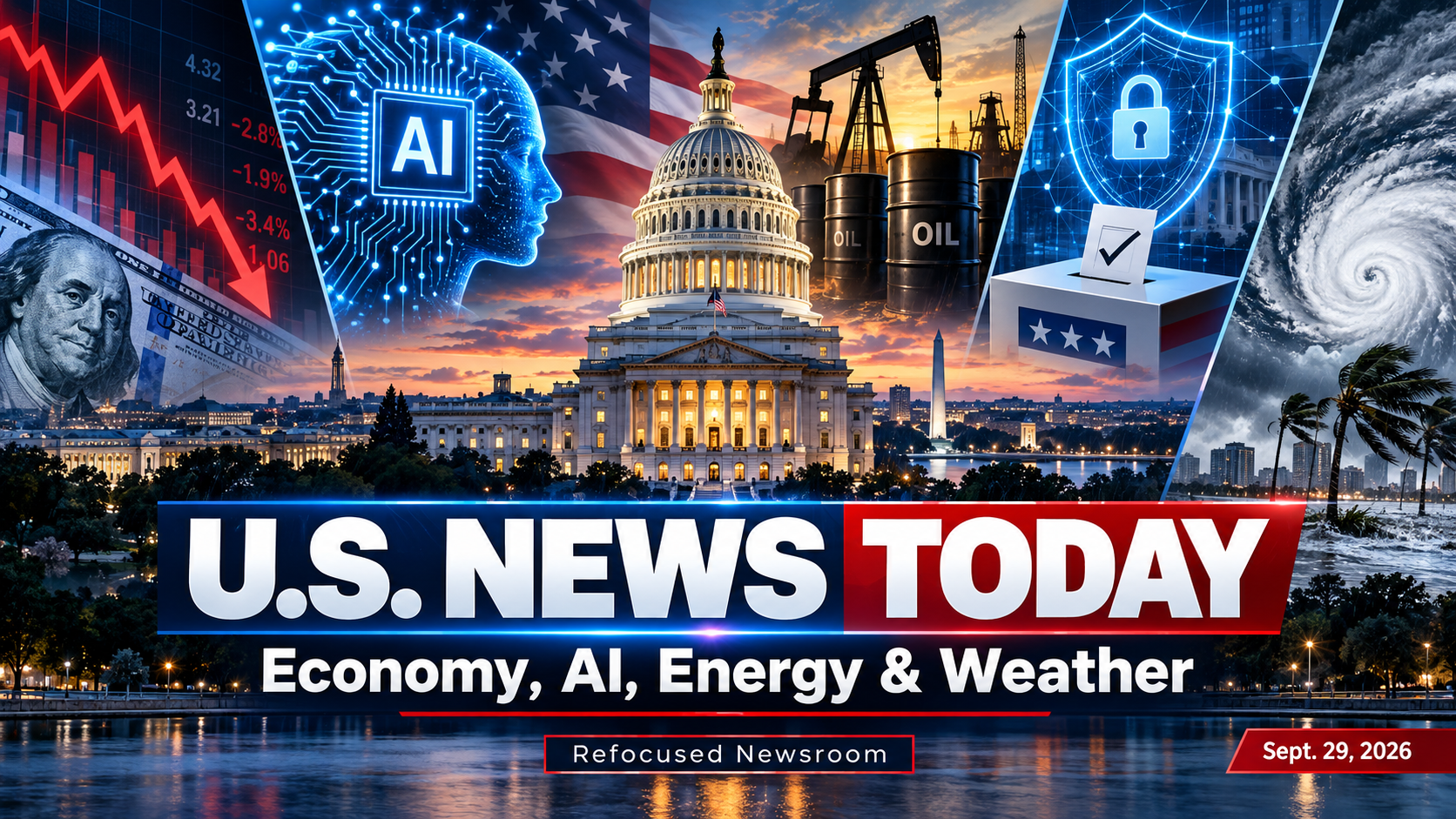
U.S. News Briefing: Economic Anxiety Deepens as Washington Confronts AI, Energy, Election Security and Global Risks
September 29, 2026 | U.S. News
WASHINGTON — Americans are navigating a complicated national landscape Tuesday as new economic data point to growing consumer anxiety, the federal government moves to address high energy prices, Washington debates the next chapter of artificial intelligence, election cybersecurity takes center stage ahead of the November midterms, and a powerful Pacific hurricane threatens to send heavy rain into the Southwest.
Overseas, another chapter in American military history is also nearing its end, with U.S. forces preparing to leave their remaining bases in Iraq after more than two decades.
Together, the developments reveal a country balancing immediate financial pressures at home with rapidly evolving questions about technology, national security and America's role abroad.
Consumer Confidence Falls to Lowest Level Since 2014
One of Tuesday's clearest economic warning signs came from American households.
The Conference Board's Consumer Confidence Index fell 6.7 points to 81.9 in September, down from 88.6 in August. The reading is the lowest since April 2014. The group's Expectations Index, which measures consumers' short-term outlook for income, business conditions and employment, declined for a third consecutive month to 63.6.
The numbers suggest that many households are increasingly uneasy about the economy even as employment remains comparatively resilient.
Higher energy costs, inflation, interest rates and uncertainty surrounding the labor market are weighing on sentiment. Reuters reported that concerns about future business and employment conditions were particularly significant in the September survey.
That matters beyond public mood. Consumer spending is a major engine of the U.S. economy, and confidence can influence decisions about everything from cars and homes to holiday purchases.
Wall Street was also under pressure Tuesday as higher Treasury yields weighed on stocks, adding another layer of financial uncertainty for investors and households.
U.S. Offers Another 40 Million Barrels From Strategic Oil Reserve
Energy prices remain closely tied to the economic picture.
The federal government announced Tuesday that it is offering energy companies the opportunity to borrow up to 40 million barrels of crude oil from the Strategic Petroleum Reserve, or SPR.
The move represents the final U.S. installment of a broader international effort coordinated through the International Energy Agency following energy-market disruptions connected to the conflict involving Iran.
The United States previously committed to making 172 million barrels available as part of a roughly 400-million-barrel international response involving about 30 countries. The oil is structured as an exchange, meaning companies receiving crude must return barrels to the reserve later, typically with additional oil included in repayment.
The immediate objective is to increase available supply during a period of elevated fuel prices and market instability.
For households and businesses, the key question will be whether additional supply helps relieve pressure at gasoline pumps, on diesel-dependent transportation networks and throughout supply chains.
Washington Turns Its Attention to the Future of Artificial Intelligence
Artificial intelligence is also becoming an increasingly central issue in Washington.
President Donald Trump met Tuesday with prominent technology executives as his administration emphasized rapid American AI development and competition with China.
Trump said the United States should avoid policies that unnecessarily restrict AI innovation, while several leading technology executives have separately called for strong safeguards as increasingly capable systems are developed.
The discussion highlights a fundamental policy question now confronting Washington: how quickly the country should pursue increasingly powerful AI while managing potential risks involving cybersecurity, misinformation, employment, national security and advanced autonomous systems.
The administration has previously issued policies aimed at accelerating AI adoption while strengthening cybersecurity protections around advanced systems.
The debate is unlikely to disappear. AI is rapidly shifting from a technology-sector issue into one touching government services, education, defense, media, employment and everyday consumer products.
Election Cybersecurity Moves Into Focus Before November Midterms
With the November 3 midterm elections approaching, federal cybersecurity preparations are receiving increased attention.
Defense Secretary Pete Hegseth said national-security and military cybersecurity resources, including capabilities associated with the National Security Agency, will be used to help protect U.S. election infrastructure against foreign cyber threats.
Military cyber specialists have previously supported election-security efforts, meaning federal defense involvement in protecting election infrastructure is not entirely new.
The 2026 effort, however, arrives amid ongoing debates over how responsibilities should be divided among federal civilian agencies, defense and intelligence organizations, and state and local election officials.
Foreign interference remains one of the central concerns. Cybersecurity agencies may monitor malicious digital activity, infrastructure vulnerabilities and influence operations, while the actual administration of elections remains primarily the responsibility of state and local authorities.
As Election Day approaches, separating verified security information from partisan claims and unsupported allegations will remain particularly important for voters.
Hurricane Polo Could Bring Flooding Threat to the Southwest
Weather is emerging as another story Americans should watch closely.
Hurricane Polo made landfall in Mexico's Baja California Sur, bringing damaging winds and dangerous flooding before continuing northeastward. The storm is expected to push significant tropical moisture toward portions of the southwestern United States later this week.
The National Hurricane Center had been tracking Polo along with additional tropical systems across the eastern and central Pacific.
Even when a hurricane's center does not directly cross the United States, its moisture can produce serious impacts hundreds of miles away.
Parts of the Southwest could face heavy rainfall, flash flooding and dangerous conditions in normally dry washes and low-lying areas.
Residents should follow local National Weather Service forecasts and emergency-management instructions as Polo's remnants move north.
U.S. Military Presence in Iraq Nears Historic Transition
Beyond America's borders, one of the longest military chapters of the post-9/11 era is moving toward a significant transition.
U.S. forces are expected to leave their remaining bases in Iraq by Wednesday, according to Reuters, marking a major reduction in the American military presence there after more than two decades.
Approximately 4,500 Americans were killed during the Iraq War and its aftermath, and the conflict reshaped U.S. foreign policy, American politics and the broader Middle East.
The departure does not mean Washington's involvement with Iraq or the region disappears. Diplomatic, economic, intelligence and security relationships remain, while questions surrounding Iranian influence, terrorism and regional stability continue.
But the withdrawal carries substantial historical weight for a generation of American service members and families whose lives were directly affected by the conflict.
The Bigger Picture
Tuesday's news does not revolve around a single defining story. Instead, several powerful forces are moving at once.
American households are signaling greater concern about their finances. Washington is tapping strategic energy resources as it tries to contain the economic effects of overseas conflict. Artificial intelligence is moving deeper into national policy. Election systems are preparing for heightened cybersecurity threats. Severe weather could threaten communities in the Southwest. And the United States is closing another chapter of its long military presence in Iraq.
Different stories, but a common thread runs through them: uncertainty is increasingly shaping the decisions being made by households, businesses and government leaders alike.
For Americans, the weeks ahead will bring important new information on inflation, employment, interest rates, energy prices, weather threats and the approaching midterm elections.
The numbers, policies and conditions will continue to change. Understanding what has actually happened, what remains uncertain and what comes next will matter more than the noise surrounding it.
Sources and Full Links
Reuters — U.S. consumer confidence near 12½-year low amid labor-market fears
https://www.reuters.com/business/us-consumer-confidence-dives-more-than-12-year-low-september-2026-09-29/
The Conference Board / Consumer Confidence Release
https://www.prnewswire.com/news-releases/us-consumer-confidence-fell-in-september-302892867.html
Reuters — U.S. offers up to 40 million barrels from Strategic Petroleum Reserve
https://www.reuters.com/business/energy/us-release-40-million-barrels-crude-strategic-petroleum-reserve-energy-2026-09-29/
Associated Press — Trump, AI executives and the debate over AI safeguards
https://apnews.com/article/595796511f110fc006cca0d01329733e
Associated Press — Federal military cyber forces and 2026 election security
https://apnews.com/article/2bfc1417d397db5fda4ad672c0b35ee2
CBS News — Hurricane Polo's path and possible U.S. impacts
https://www.cbsnews.com/news/hurricane-polo-path-tracking-forecast/
National Hurricane Center — Eastern Pacific Tropical Weather Outlook
https://www.nhc.noaa.gov/text/refresh/MIATWOEP+shtml/101115_MIATWOEP.shtml
Reuters — U.S. forces prepare to exit remaining bases in Iraq
https://www.reuters.com/world/middle-east/us-forces-exit-iraq-after-two-decades-leaving-opening-iran-2026-09-29/