
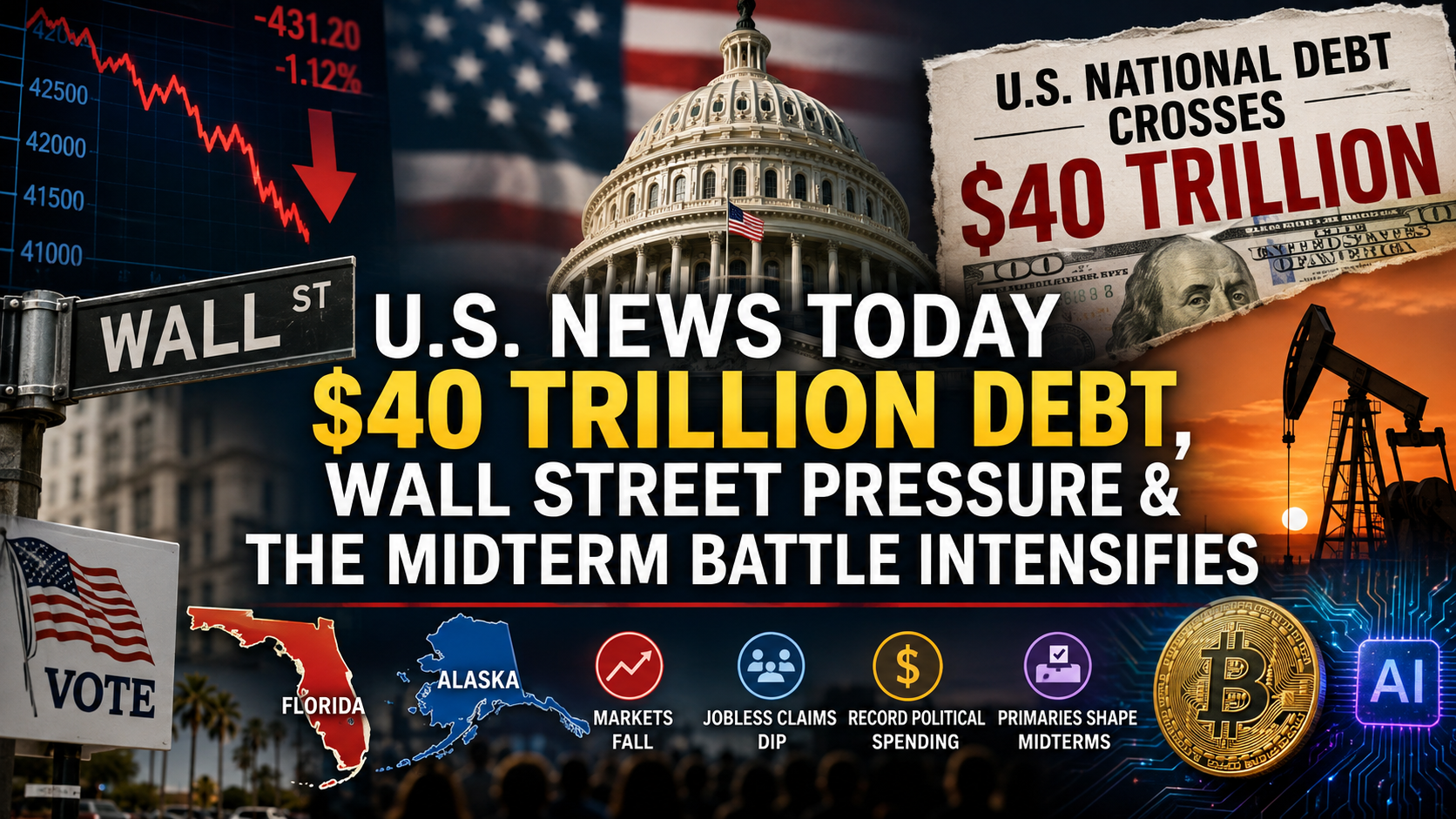
U.S. News Today: $40 Trillion Debt, Wall Street Pressure and the Midterm Battle Intensifies
August 20, 2026
The United States begins Thursday with several major stories converging around the economy, Washington and the approaching midterm elections. The national debt has crossed a historic threshold, financial markets are wrestling with higher oil prices and bond yields, and new industries are pouring extraordinary amounts of money into congressional politics.
Here are some of the biggest U.S. stories to watch today.
U.S. National Debt Crosses $40 Trillion
The U.S. national debt has surpassed $40 trillion for the first time, according to Treasury Department data reported by Reuters.
Of that total, approximately $32.3 trillion is debt held by the public, while roughly $7.8 trillion represents intragovernmental holdings.
The milestone is particularly important because the cost of carrying that debt has risen along with interest rates. Reuters reports that federal interest costs have become the government's second-largest expenditure, surpassing Medicare.
The debt has more than doubled since 2017, spanning both Republican and Democratic administrations. Pandemic spending contributed significantly to the increase, but persistent federal deficits, entitlement spending, tax policy and growing interest expenses continue to add pressure.
For Americans, the issue isn't simply a giant number on Washington's balance sheet. Higher government borrowing costs can contribute to pressure on interest rates throughout the economy, affecting mortgages, business financing and other forms of credit.
Oil and Bond Yields Put Pressure on Wall Street
Financial markets are also navigating renewed uncertainty.
Oil prices jumped Thursday as geopolitical tensions surrounding Iran continued to affect energy markets. The Associated Press reported Brent crude rising about 2.5% to $93.90 per barrel, while U.S. benchmark crude climbed roughly 2.8% to $86.72.
Higher energy prices can complicate the inflation picture because transportation and fuel costs eventually ripple through businesses and household budgets.
Stocks moved lower as investors weighed those concerns. The Dow Jones Industrial Average fell more than 400 points during Thursday's trading, while the S&P 500 and Nasdaq also declined.
Walmart shares fell sharply after the retailer issued a weaker-than-expected profit outlook, despite reporting stronger-than-expected quarterly revenue and earnings.
Jobless Claims Dip
There was a more encouraging signal from the labor market Thursday.
The number of Americans filing new applications for unemployment benefits declined during the latest week, according to Labor Department data reported by Reuters.
The figures suggest that employers have not moved toward widespread layoffs even as uncertainty remains around economic growth, inflation and interest rates.
The labor market remains one of the most closely watched pieces of the economic puzzle. A sharp deterioration in employment could increase pressure for lower interest rates, while continued resilience gives policymakers more room to focus on controlling inflation.
Crypto, AI and Betting Companies Become Political Power Players
A new group of industries is becoming increasingly influential in Washington.
Reuters reports that cryptocurrency, artificial intelligence and online betting interests have collectively poured more than $294 million into congressional races from January 2025 through the first quarter of 2026.
Overall corporate political spending has already reached approximately $517 million during the current election cycle, according to the report.
The development represents an important shift in political influence. Industries including banking, pharmaceuticals, energy and organized labor have traditionally been among Washington's major power centers. Now technology sectors built around AI and cryptocurrency are increasingly fighting to shape the laws that will govern their industries.
With AI regulation, cryptocurrency legislation and online gambling policy all developing rapidly, the outcome of the November elections could have enormous consequences for these companies.
Florida and Alaska Primaries Offer Clues About November
The battle for control of Congress is also becoming clearer following primary elections in Florida and Alaska.
In Florida, state Rep. Angie Nixon, a democratic socialist, scored an upset victory in the Democratic U.S. Senate primary. The result demonstrated the continued strength of progressive candidates inside portions of the Democratic electorate, although Republicans remain strongly positioned in the state.
Alaska produced a different political signal. Former Democratic Rep. Mary Peltola performed strongly in the state's nonpartisan Senate primary against Republican Sen. Dan Sullivan, potentially making Alaska a competitive Senate battleground heading toward November.
The contrasting results illustrate the complicated environment facing both parties: candidates must first motivate their political bases while still building coalitions capable of winning statewide elections.
The Bigger Picture
The stories dominating Thursday morning share a common thread: economic pressure is colliding with political pressure.
A $40 trillion national debt raises long-term questions about federal spending and borrowing. Higher oil prices threaten to keep inflation concerns alive. Meanwhile, rapidly growing industries such as artificial intelligence and cryptocurrency are investing heavily in shaping the next Congress.
And November is getting closer.
For Americans trying to cut through the daily flood of headlines, the next several months will likely revolve around a few basic questions: Can prices stabilize? Can the labor market remain strong? Can Washington address its growing debt burden? And which party will voters trust to handle those challenges after the midterm elections?
Those questions will help define the remainder of 2026.
Sources
Reuters — U.S. debt crosses $40 trillion threshold after doubling under Trump and Biden
Full Reuters article
Associated Press — Pressure builds anew in the bond market as oil prices jump; U.S. stocks fall
Full AP article
Reuters — U.S. weekly jobless claims dip in latest week
Full Reuters article
Reuters — Crypto, AI and betting firms fuel record spending on the 2026 midterms
Full Reuters article
Reuters — Florida and Alaska primaries offer clues in battle for Congress
Full Reuters article
Reuters — Five takeaways from Florida and Alaska primaries
Full Reuters analysis
Reuters — Latest U.S. News
Reuters U.S. News
Associated Press — Latest U.S. and national news
AP News