
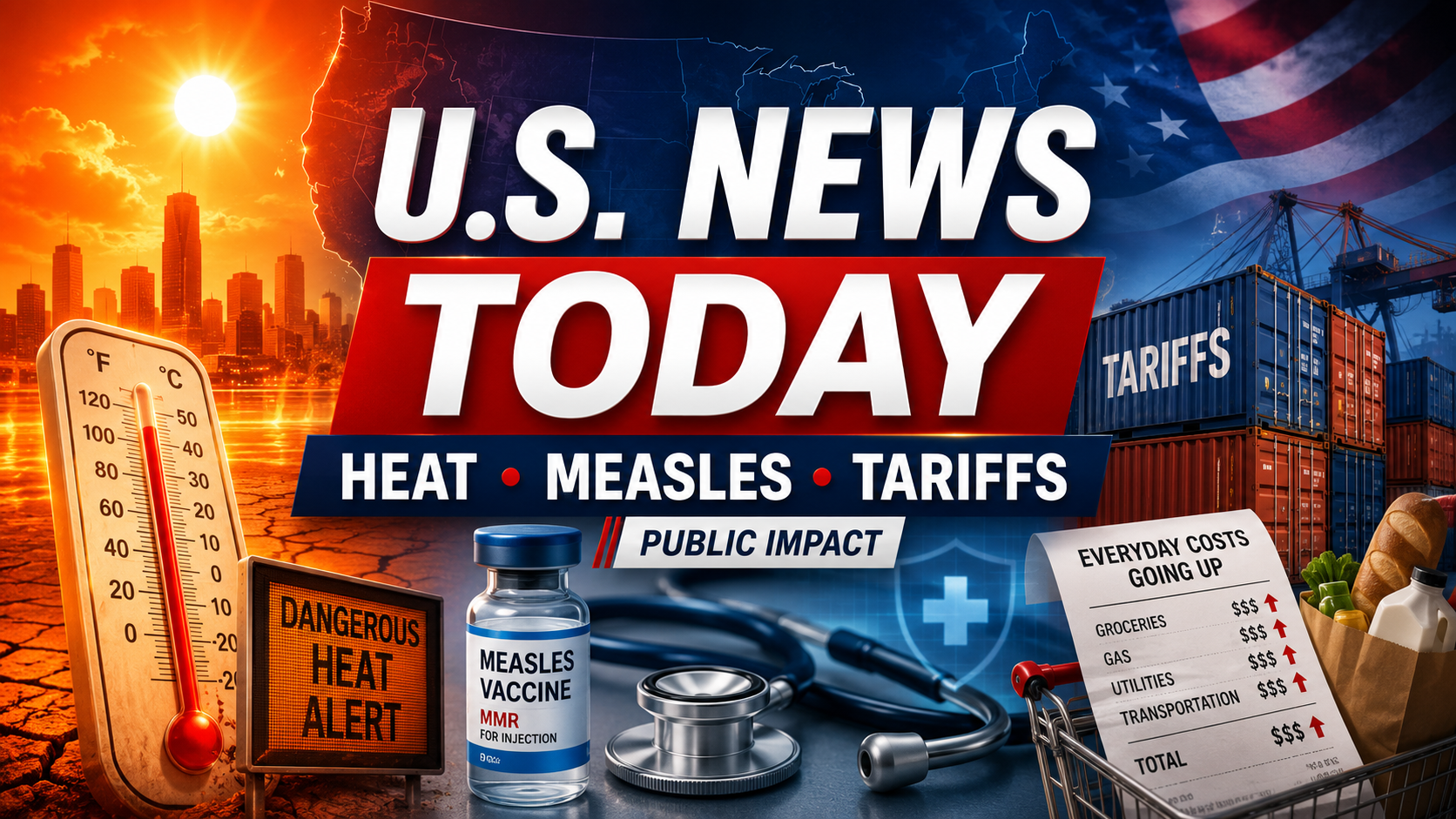
U.S. News Today: Dangerous Heat Expands, Measles Cases Surge and New Tariffs Raise Cost Concerns
A dangerous heat dome is expanding across the central United States, exposing roughly 80 million people to heat advisories or warnings as temperatures and humidity rise.
The heat emergency is the most immediate public-safety story of Sunday, July 26, 2026, but it is unfolding alongside two other developments with broad consequences for American households: the nation has recorded its highest annual measles case total in 35 years, and new tariffs on imports from more than 60 economies are raising fresh questions about consumer prices and legal authority.
Overseas, a pause in U.S. airstrikes against Iran has created a fragile opening for diplomacy, but the conflict continues to affect oil markets, military personnel and international shipping.
Dangerous Heat Expands Across the Central United States
A large heat dome settled across much of the central United States over the weekend, bringing dangerously high temperatures from the Southwest and Gulf Coast into the Great Plains and Midwest.
The Associated Press reported on July 26 that roughly 80 million people were facing heat advisories as the pattern intensified. Temperatures in some areas were expected to run 10 to 15 degrees above normal, with western Nebraska forecast to approach 108 degrees and parts of Texas and the Gulf Coast expected to experience worsening conditions by midweek.
The weather event began building before the article was published Sunday. High temperatures were already affecting communities Saturday, July 25, and forecasters expect the heat to remain largely stationary through much of the coming week.
National Weather Service offices issued regional warnings that show how widely conditions vary. In Arkansas, heat-index readings between 110 and 115 degrees were forecast in areas under extreme heat warnings. Oklahoma forecasters warned of afternoon highs between 100 and 107 degrees Sunday, with dangerous heat potentially continuing through Friday.
Why It Matters
Heat is among the deadliest weather hazards in the United States, especially when high daytime temperatures are followed by unusually warm nights.
Older adults, infants, outdoor workers, people with chronic medical conditions and residents without reliable air conditioning face elevated risk. Humidity can prevent the body from cooling itself efficiently, even when the actual air temperature does not reach a record.
Communities are opening cooling areas and adding water stations at large outdoor events. Residents should limit strenuous activity during the afternoon, drink water before feeling thirsty and check on neighbors who may be isolated.
Anyone experiencing confusion, fainting, very hot skin or an inability to cool down may be suffering from heat stroke and needs emergency medical assistance.
U.S. Measles Cases Reach Highest Annual Total Since 1991
The Centers for Disease Control and Prevention updated its national measles data on Friday, July 24, reporting confirmed cases received from state and local health departments through noon Thursday.
The United States has recorded 2,318 confirmed measles infections in 2026, surpassing the 2,289 cases reported during all of 2025. It is the highest annual total since 1991.
Large outbreaks in South Carolina, Utah and Arizona have driven much of the increase, along with smaller outbreaks elsewhere. The Associated Press reported July 25 that South Carolina had recorded 997 known cases and Utah more than 700.
The case count reflects when health departments confirmed and reported infections, not simply when the CDC webpage was updated. Some illnesses began days or weeks earlier, and state totals may be more current because jurisdictions report publicly on different schedules.
Public-health researchers also believe the official count may understate the true number of infections because some people are never tested or reported. That estimate remains an analysis rather than a confirmed case count.
Why It Matters
Measles is highly contagious and can spread through the air when an infected person coughs or breathes. The virus can cause pneumonia, brain inflammation and death.
The United States declared measles eliminated in 2000, meaning the disease was no longer spreading continuously within the country. Imported cases and declining vaccination coverage have allowed outbreaks to return.
National kindergarten coverage for the measles, mumps and rubella vaccine has fallen below the 95% level generally associated with strong community protection.
Families should verify vaccination records before the school year begins. People who believe they were exposed should contact a medical provider before entering a clinic or emergency room so staff can limit further exposure.
New Tariffs Could Affect Prices Across the Economy
The Trump administration announced on Thursday, July 23, that it would impose tariffs of 10% or 12.5% on imports from 60 economies.
The duties were publicly reported beginning Thursday night and Friday, while an Associated Press analysis explaining the administration’s legal reasoning was published Sunday, July 26.
The administration says the tariffs are intended to penalize countries that have failed to adequately prohibit or enforce restrictions on goods made with forced labor.
According to the White House, imports from countries deemed to have some forced-labor protections or related trade commitments generally face a 10% tariff. Other covered economies face a 12.5% rate. Exemptions apply to certain products, and the administration has proposed a special mechanism allowing limited quantities of textile and apparel imports to enter without the additional duty.
The affected trading partners account for approximately 99% of U.S. imports, though the exemptions mean the duties will not apply evenly across every product category.
Disagreement Over the Policy
The administration argues that Section 301 of the Trade Act of 1974 gives it authority to respond to unfair foreign trade practices.
Critics argue the forced-labor justification is too broad and may be an attempt to replace earlier global tariffs that the Supreme Court invalidated. Several foreign governments, including U.S. allies with existing forced-labor laws, have disputed the administration’s characterization of their enforcement systems.
The legal and diplomatic disputes remain active. It would be premature to state that the tariffs will definitely survive court challenges or produce a specific increase in consumer prices.
Why It Matters
Tariffs are collected from importers, which may absorb the expense, negotiate lower supplier prices or pass some of the cost to retailers and consumers.
That means the impact could eventually appear in prices for clothing, footwear, electronics, household goods and business supplies. Oil, natural gas and fertilizer are among the important categories receiving exemptions.
Even modest price increases could matter at a time when many households remain concerned about groceries, housing, fuel and borrowing costs.
Pause in U.S. Airstrikes Opens a Fragile Diplomatic Window With Iran
The United States has paused its latest military airstrikes against Iran after nearly two weeks of escalating attacks, while mediators attempt to restart talks.
The diplomatic opening was reported Sunday, July 26. The pause follows a U.S. campaign that began earlier in July and expanded from coastal military targets to bridges, communication systems and other infrastructure inside Iran.
The conflict has centered partly on control and security in the Strait of Hormuz, a critical passage for global oil and gas shipments. Iran has attacked commercial vessels, while U.S. forces have struck Iranian military and infrastructure targets and enforced restrictions around Iranian ports.
Oman and other intermediaries have been involved in discussions intended to restore safer shipping access and reduce the risk of a larger regional war.
The pause is confirmed. A durable ceasefire is not.
Both governments continue to maintain firm public positions, and military action could resume if talks collapse or another attack occurs.
Why It Matters
The consequences extend far beyond the region.
Disruptions in the Strait of Hormuz can raise oil and fuel prices, increasing transportation, airline and manufacturing costs in the United States. The conflict also places American service members at risk and raises constitutional questions about how long military operations can continue without additional congressional authorization.
For families, the most visible effect may arrive at the gas pump. For military families, the stakes are much more personal.
What to Watch Next
Heat warnings through the coming week
The greatest heat risk is expected to shift and intensify across Texas and parts of the Gulf Coast by Wednesday. Residents should follow local National Weather Service offices because advisories and cooling-center information differ by county and city.
Updated measles numbers
The CDC updates its national measles figures weekly. State and local health departments may publish newer totals between federal updates.
Health officials will also continue examining whether prolonged transmission threatens the country’s measles-elimination status.
Legal challenges to the tariffs
Business organizations, advocacy groups and foreign governments may challenge the tariffs through U.S. courts or international trade mechanisms.
Consumers should watch for announcements from major retailers and manufacturers about potential price changes, but broad predictions should be treated cautiously until companies disclose how they will respond.
U.S.-Iran negotiations
The key question is whether the pause in strikes becomes a negotiated ceasefire or merely a temporary break.
Shipping activity in the Strait of Hormuz, oil prices, attacks on U.S. forces and official statements from Washington and Tehran will provide the clearest signs.
Refocused Perspective
The biggest stories are not always the loudest. They are the ones that quietly enter daily life.
Extreme heat changes how people work and whether vulnerable neighbors remain safe. Falling vaccination rates can turn a preventable illness into a national emergency. Tariffs written in Washington can eventually appear on a family’s receipt. Decisions made thousands of miles away can change the price of gasoline and place service members in danger.
Being informed should lead to preparation, not panic.
Check on someone during the heat. Confirm vaccination records. Pay attention to what policies actually do, not only how politicians describe them. Responsible citizenship begins when information becomes useful action.
Sources and Full Links
Associated Press
“Heat Dome Expands Across the Central United States, Creating Dangerous Conditions for Millions”
Published July 26, 2026
https://apnews.com/article/65d34e4c520472c7bb1f46cd133b7952
National Weather Service Little Rock
“Heat Advisories and Extreme Heat Warnings”
Updated July 26, 2026
https://www.weather.gov/lzk/
National Weather Service Norman
“Sunday Heat and Extended Heat Outlook”
Updated July 26, 2026
https://www.weather.gov/oun/
Centers for Disease Control and Prevention
“Measles Cases and Outbreaks”
Updated July 24, 2026
https://www.cdc.gov/measles/data-research/index.html
Associated Press
“There Are Already More U.S. Measles Cases This Year Than in All of 2025”
Published July 25, 2026
https://apnews.com/article/371823df32b92169c3d220295f00f054
Reuters
“Trump Imposes New Global Tariffs, Drawing Protests From Trading Partners”
Published July 24, 2026
https://www.reuters.com/world/us/trump-imposes-forced-labor-duties-60-trading-partners-as-10-us-tariffs-expire-2026-07-24/
The White House
“Actions by the United States in the Investigations Under Section 301 of the Trade Act of 1974”
Published July 23, 2026
https://www.whitehouse.gov/presidential-actions/2026/07/actions-by-the-united-states-in-the-investigations-under-section-301-of-the-trade-act-of-1974-of-the-acts-policies-and-practices-of-60-economies-related-to-the-failure-of-each-economy-to-impose-and/
Associated Press
“A Forced-Labor Crackdown or an End-Run Around Congress? Dissecting Trump’s New Tariffs”
Published July 26, 2026
https://apnews.com/article/8ea8114c6893a6062cf1addc3518660b
Associated Press
“What to Know About Trump’s Latest Tariffs”
Published July 25, 2026
https://apnews.com/article/160b5c76b005a5d703cdcc4644f7cdc9
Associated Press
“Airstrikes Have Paused and Talks Are Pressing Forward. But Can the U.S. and Iran Take the Off-Ramp?”
Published July 26, 2026
https://apnews.com/article/d491158a4c9a1d3429a87a6ed58f2f72
Associated Press
“Bridges and Infrastructure Hit as U.S. Struck Deeper Inside Iran”
Published July 25, 2026
https://apnews.com/article/d7744d3063116944d49a616c007d669c