
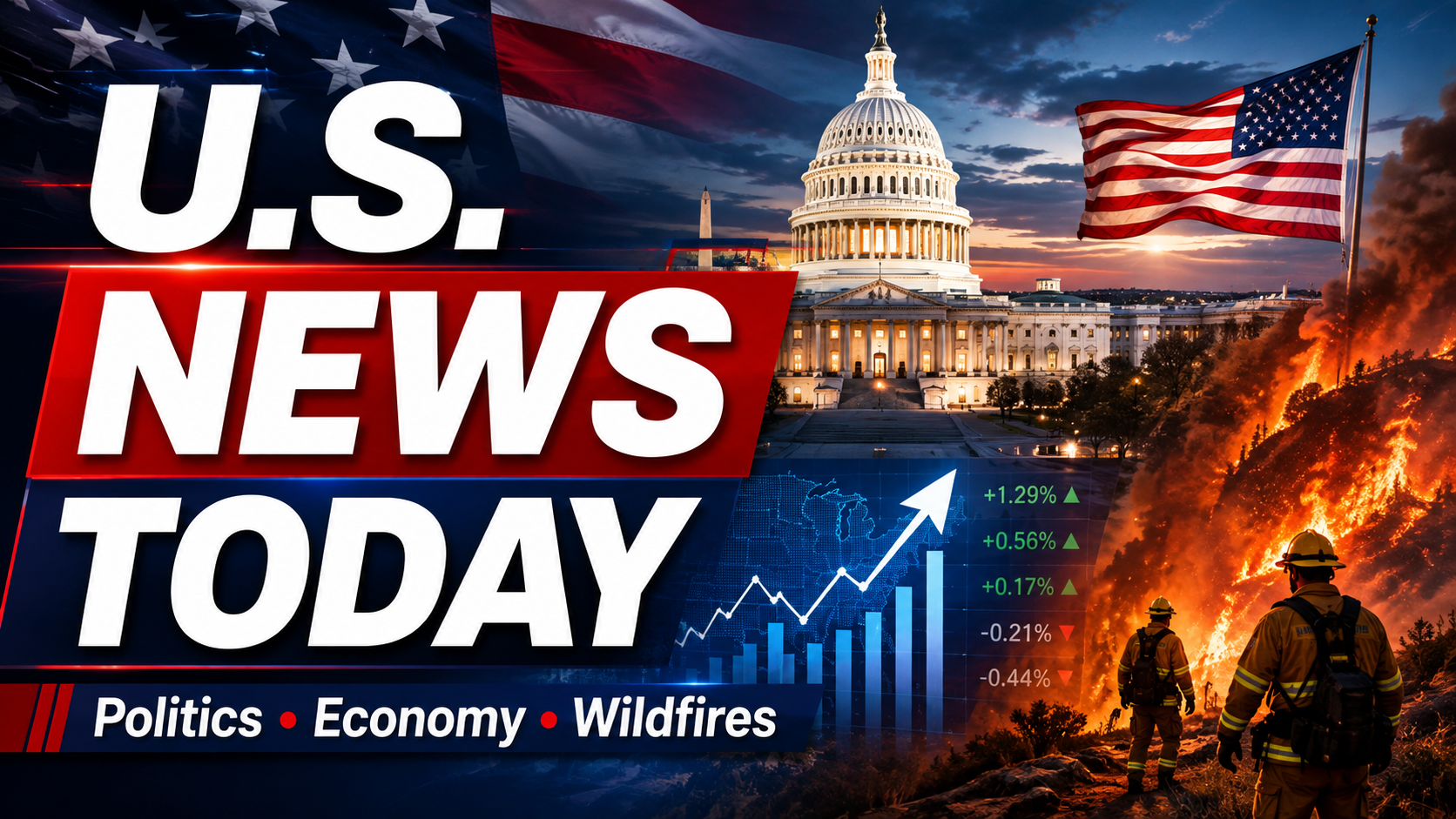
U.S. News Today: Election Rules, Trade Tensions, Wildfires and the Economy Lead the Headlines
August 25, 2026
The United States is moving through a busy Tuesday news cycle, with major developments touching elections, trade, immigration, the economy, wildfires and health care.
From a consequential Supreme Court decision involving mail-in voting to a rapidly escalating trade dispute with Canada, several of today’s stories could have effects well beyond a single news cycle. Meanwhile, Americans are showing growing concern about the economy, firefighters continue battling major wildfires in the West and Texas, and a new Alzheimer’s blood test could expand access to diagnostic testing.
Here are the major U.S. stories to watch on Tuesday, August 25.
Supreme Court Allows Trump Administration to Move Ahead With Mail-Voting Order
One of the biggest political developments involves the rules surrounding mail-in voting ahead of the November 2026 midterm elections.
The U.S. Supreme Court has allowed President Donald Trump’s administration to proceed, for now, with significant portions of an executive order seeking tighter federal controls over mail voting.
The 6-3 decision lifted one lower-court injunction involving a challenge brought by 23 mostly Democratic-led states and Washington, D.C. The decision does not settle the ultimate constitutional question surrounding the executive order, and additional litigation remains underway.
The U.S. Postal Service has also issued new procedures outlining how it would comply with the administration's order. The changes could affect how states distribute and process mail ballots, although implementation remains uncertain because voting has already begun approaching in some jurisdictions.
Supporters of the administration’s approach argue that stronger verification procedures could improve election security and confidence. Democratic officials and voting-rights organizations argue that the executive branch is reaching into election responsibilities traditionally handled by states and Congress.
With the midterms just over two months away, expect the legal battle to remain one of the most closely watched election stories in the country.
U.S.-Canada Trade Fight Escalates
The economic relationship between the United States and Canada is facing another major test.
Canada announced retaliatory tariffs Tuesday covering approximately C$27.6 billion, or nearly $20 billion, in U.S. goods, following new U.S. tariffs on Canadian products. The Canadian measures are scheduled to take effect September 8 and cover hundreds of product categories, including steel, aluminum, clothing, appliances, electronics and some food products.
Canada also announced billions of dollars in financial assistance for businesses and workers potentially affected by the dispute.
President Trump has separately threatened 50% tariffs on Canadian-made automobiles, trucks and automotive parts as tensions between the neighboring countries intensify.
The stakes are significant because the U.S. and Canadian economies are deeply interconnected. Automobiles and their components can cross the border multiple times during manufacturing, meaning higher tariffs could ultimately affect producers, retailers and consumers on both sides.
White House Considering Additional China Tariffs
China is also back at the center of American trade policy.
The Trump administration is considering an additional 7.5% tariff on Chinese goods, according to people familiar with deliberations cited by The Associated Press. The proposed action would target what U.S. officials describe as China's excess industrial capacity and exports of underpriced products.
Importantly, the additional tariff has not yet been finalized, and administration plans could change.
The White House appears to be attempting to apply additional economic pressure without derailing the existing U.S.-China trade truce or a planned meeting between Trump and Chinese President Xi Jinping.
Industries including automobiles, steel, solar equipment and manufacturing are at the center of the broader debate over Chinese production.
American officials argue that heavily supported Chinese industries can overwhelm international markets and make it difficult for U.S. producers to compete. Beijing disputes claims that its manufacturing capacity represents unfair economic behavior.
Immigration Policy Tightens on Multiple Fronts
Immigration policy is also producing major headlines.
The administration announced plans to revoke certain B1 and B2 business and tourism visas held by foreign nationals who later applied for asylum in the United States.
The State Department did not provide an official total, but reporting cited by Reuters indicates as many as 200,000 visas could potentially be affected. Revocation would not automatically mean immediate deportation for every affected person, particularly those with pending asylum cases.
At the same time, the Department of Homeland Security has proposed a dramatically higher fee for certain new H-1B employment visa petitions.
Under the proposed rule, employers filing cap-subject H-1B petitions would pay an additional $103,265 fee. DHS projects that the fee could generate approximately $8.8 billion annually if applied to the typical 85,000 annual cap-subject petitions.
This is a proposal rather than a final rule, an important distinction as businesses, universities, immigration advocates and technology companies evaluate its potential impact.
The administration argues that higher costs could encourage employers to hire and train more American workers while generating revenue for the immigration system. Opponents are likely to argue that such fees could make it significantly harder for American companies to recruit specialized international talent.
Consumer Confidence Drops
Economic anxiety among American consumers remains an important story.
The Conference Board reported Tuesday that its consumer confidence index declined to 89.4 in August, down from a revised 90.2 in July and its lowest reading in seven months.
Consumers became more pessimistic about future business conditions and employment prospects, even as their assessment of current conditions improved. Expectations for inflation over the coming year also increased slightly.
The report adds another piece to a complicated economic picture.
The labor market has remained relatively stable, but consumers continue to deal with concerns surrounding prices, interest rates, tariffs and uncertainty about future economic growth.
Financial markets were somewhat more upbeat Tuesday. Major Wall Street indexes moved higher as technology stocks rebounded ahead of Nvidia's highly anticipated earnings report. Investors are also preparing for upcoming inflation data and comments from Federal Reserve Chairman Kevin Warsh.
Major Wildfires Continue in Nevada and Texas
Wildfire emergencies remain another major national concern.
Near Reno, Nevada, firefighters have made progress battling the Hawk Fire, which has burned more than 15,000 acres and destroyed at least 32 homes.
Containment had reached roughly 27%, according to the latest reporting, after evacuation warnings and orders affected tens of thousands of residents. Hundreds of firefighters from across the United States and international crews have joined the response.
Nevada Governor Joe Lombardo declared a state of emergency for Washoe County as the fire threatened communities surrounding Reno.
Texas is facing its own fire emergency.
The Ross Fire in Palo Pinto County, west of Fort Worth, rapidly expanded across tens of thousands of acres of ranchland. Evacuations were ordered in some rural communities, several structures were reported destroyed and schools were affected as firefighters battled dry and dangerous conditions.
The two fires underscore the continuing wildfire threat across large portions of the western and southern United States.
New Alzheimer’s Blood Test Cleared
Away from politics and economic headlines, an important development in medical testing is also drawing national attention.
The FDA has cleared Roche and Eli Lilly's Elecsys pTau217 blood test, designed to help identify amyloid pathology associated with Alzheimer’s disease in people age 55 and older experiencing signs or symptoms of cognitive decline.
The test could provide doctors with a less invasive option than some existing diagnostic methods such as PET scans or cerebrospinal-fluid testing.
It is important to understand what the test does not do: it is not intended to function as a stand-alone Alzheimer’s diagnosis. Results are meant to be interpreted together with other clinical information.
Major laboratory networks including Labcorp and Quest Diagnostics are expected to make the test available, potentially broadening access to Alzheimer’s assessment across the country.
The Bigger Picture
Several themes connect Tuesday's headlines.
The first is uncertainty.
Election rules are being litigated just weeks before voting intensifies. Businesses are trying to calculate the effects of changing tariffs and immigration regulations. Consumers remain uneasy about the economy even while markets continue to show resilience.
The second is the increasing influence of federal policy on everyday life.
Decisions involving trade, visas, voting procedures and interest rates can sound distant from daily routines, but their effects eventually reach workplaces, grocery stores, manufacturing plants, universities and household budgets.
Finally, today's wildfire emergencies are a reminder that while Washington debates policy, communities around the country are dealing with immediate challenges requiring emergency response, coordination and recovery.
With the 2026 midterms approaching and major economic decisions still ahead, the final months of the year are shaping up to be consequential ones for the United States.
Sources and Full Links
Associated Press — Supreme Court and mail voting
https://apnews.com/article/b4b9ef095b4d6bceab18adbb34814640
CBS News — Supreme Court allows key portions of mail-voting order
https://www.cbsnews.com/news/supreme-court-trump-mail-voting-order-usps-dhs/
Reuters — Canada announces retaliatory tariffs on U.S. goods
https://www.reuters.com/business/canada-announces-20-bln-retaliatory-tariffs-us-goods-unveils-support-measures-2026-08-25/
Associated Press — Trump considering new China tariff
https://apnews.com/article/3228ac85fefbddee31cbb9481ec42a2a
Reuters — Administration plans visa revocations involving asylum applicants
https://www.reuters.com/world/us-plans-revoke-up-200000-tourism-business-visas-ap-reports-2026-08-24/
Federal Register — Proposed H-1B fee rule
https://public-inspection.federalregister.gov/2026-17324.pdf
Reuters — U.S. consumer confidence falls in August
https://www.reuters.com/business/us-consumer-confidence-falls-august-conference-board-says-2026-08-25/
Reuters — Wall Street rebounds ahead of Nvidia results and inflation data
https://www.reuters.com/business/us-stock-futures-rise-tech-rebound-before-nvidia-inflation-tests-2026-08-25/
Reuters — Firefighters gain ground on Hawk Fire near Reno
https://www.reuters.com/business/environment/fire-crews-gain-ground-destructive-blaze-raging-near-reno-nevada-2026-08-25/
Nevada Governor’s Office — Hawk Fire emergency declaration
https://www.gov.nv.gov/press-releases/governor-joe-lombardo-declares-state-of-emergency-for-hawk-fire-in-washoe-county/
Associated Press — Texas wildfire evacuations
https://apnews.com/article/fbc5e54ca348ac71e7384caafcb87fdc
Reuters — FDA clearance of Roche/Eli Lilly Alzheimer’s blood test
https://www.reuters.com/legal/litigation/roche-eli-lillys-alzheimers-blood-test-gets-fda-clearance-2026-08-24/
FDA database — Alzheimer’s blood-test classification and clearance information
https://www.accessdata.fda.gov/scripts/cdrh/cfdocs/cfTPLC/tplc.cfm?id=SET