
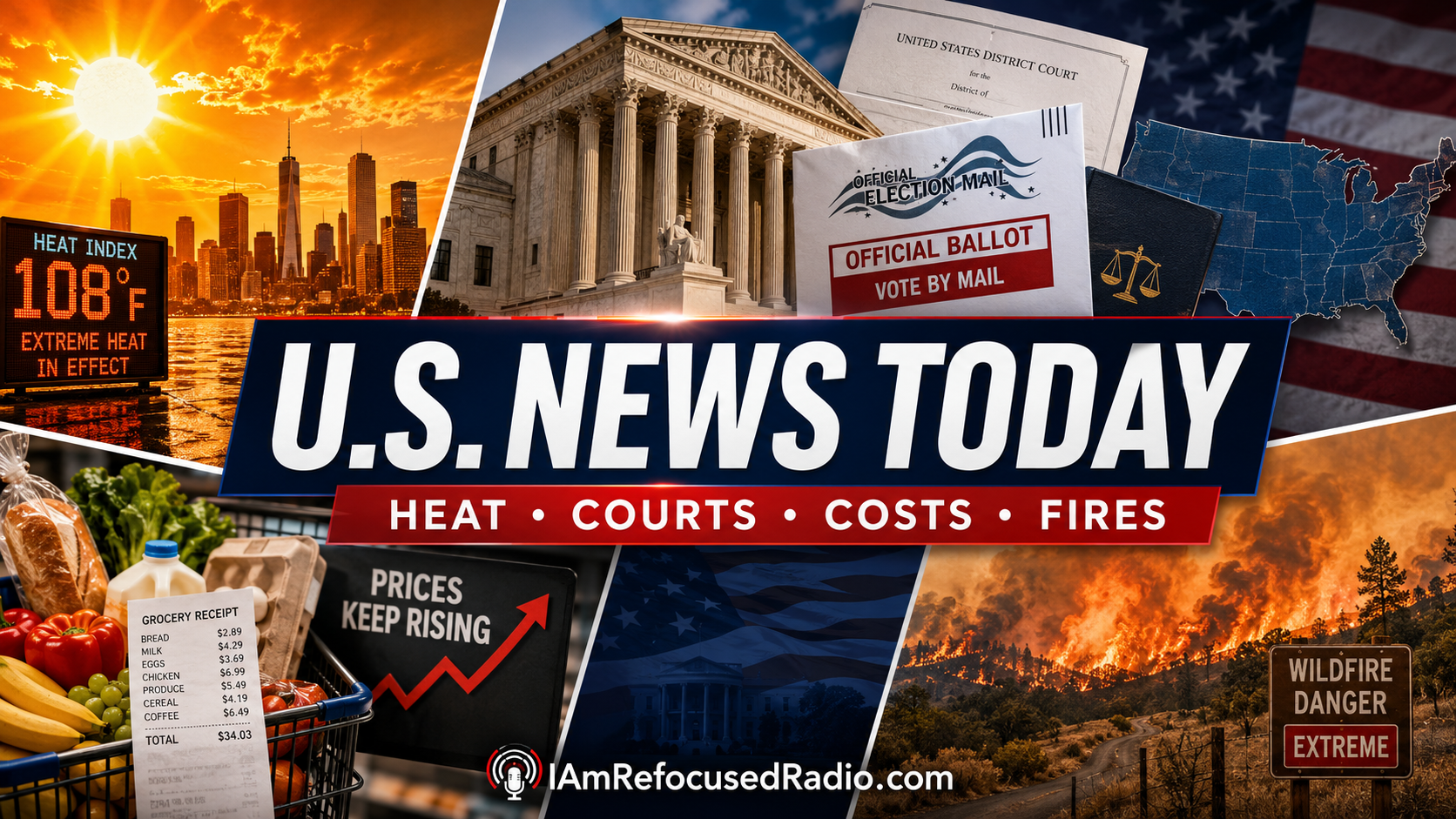
U.S. News Today: Extreme Heat, Voting Order Blocked and Tariff Fight Deepens
Published July 25, 2026 | IAmRefocusedRadio.com
Dangerous heat spread across the central United States on Saturday as a federal appeals court preserved restrictions on a Trump administration mail-voting order, small businesses opened a new legal front against sweeping tariffs, and families continued reshaping grocery budgets after years of steep food-price increases.
Western wildfire conditions also remained serious, with a large Oregon fire burning near the city of Sisters and federal officials confirming that a fourth firefighter died from injuries suffered during a June burnover in Colorado.
Together, today’s major stories touch four issues that reach directly into American life: public safety, election administration, trade policy and affordability.
Dangerous Heat Expands Across the Central United States
Date check: The Associated Press published its report on Saturday, July 25. The extreme temperatures and warnings described in the report were occurring Saturday and were forecast to continue into the coming week.
Approximately 80 million people were facing heat advisories as a persistent dome of high pressure trapped heat across a large portion of the country. The affected area stretched from the Southwest and Gulf Coast through the Great Plains and Midwest, with temperatures exceeding 100 degrees in multiple locations.
The National Weather Service warned of heat-index values reaching approximately 105 to 118 degrees in parts of Nebraska and neighboring areas through Monday. Overnight temperatures were also expected to remain unusually high, limiting the body’s ability to recover from daytime heat.
The heat matters beyond uncomfortable afternoons. Prolonged exposure increases the risk of heat exhaustion and heat stroke, particularly for older adults, young children, outdoor workers, people without reliable air conditioning and those with existing medical conditions. Power demand can also rise sharply when millions of households run cooling systems simultaneously.
Conditions are still developing. Forecasts can shift by location, so residents should follow their local National Weather Service office rather than relying solely on broad regional predictions.
Appeals Court Keeps Block on Mail-Voting Order in 23 States
Date check: Reuters published the report on July 25, the same day the First U.S. Circuit Court of Appeals issued its decision. The executive order at the center of the case was signed March 31, while the lower-court injunction was entered June 25.
A federal appeals court declined to let the Trump administration implement key portions of its election-related executive order in 23 plaintiff states while the administration continues its appeal.
The Boston-based court ruled 2-1 against the Justice Department’s request to pause the lower-court injunction. The disputed order directed federal agencies to develop citizenship lists and proposed procedures affecting mail and absentee ballots.
The plaintiff states argued that the order interfered with state authority over election administration and required immediate preparation before approaching election deadlines. The Justice Department argued that the challenge was premature because agencies had not finalized all implementing policies. The appeals court found that the states faced practical obligations now and did not need to wait until the policies were fully implemented.
The ruling does not create a nationwide judgment on every provision of the order. It leaves the injunction in place for the states involved while the broader appeal proceeds. The Justice Department could ask the U.S. Supreme Court to intervene.
Why it matters: November’s elections will determine control of Congress, and last-minute changes to ballot procedures could affect election offices, voters, postal operations and public confidence. The legal dispute is therefore about both presidential authority and how close to an election major procedural changes may be imposed.
Small Businesses Challenge New Global Tariffs
Date check: The Associated Press published its story July 25. The administration announced the tariffs Thursday, July 23, and the small-business lawsuits were filed Friday, July 24.
Two groups of small businesses have sued over the Trump administration’s new tariffs of 10% or 12.5% on goods from 60 trading partners.
The administration imposed the duties under Section 301 of the Trade Act of 1974, arguing that the affected countries had not adequately prevented the use or importation of goods connected to forced labor. The new duties cover nearly all U.S. imports, according to the Office of the U.S. Trade Representative.
One lawsuit includes educational toy company Learning Resources and several other businesses. A second was filed by New York spice importer Burlap & Barrel and California watch retailer Collective Horology.
The plaintiffs are not disputing that forced labor is a serious problem. Their legal argument is that the administration did not make sufficient findings against each economy or explain precisely how the countrywide tariffs would correct the targeted practices. The White House had not provided an immediate response to the Associated Press at the time of publication.
The outcome matters to consumers because tariffs are paid by U.S. importers at the border. Businesses must then decide whether to absorb those costs, reduce operations, change suppliers or pass some of the expense to customers.
This story is still developing. The lawsuits have only begun, and no court has ruled on whether these particular Section 301 tariffs are lawful.
Grocery Prices Continue to Reshape Family Budgets
Date check: The Associated Press published its national report July 25. Unlike the day’s court and weather stories, this was not based on one event occurring Saturday. It examined government price data through June 2026 and household experiences documented during July.
The cost of food purchased for home consumption has risen approximately 33% in U.S. cities since the beginning of 2019. During the preceding seven-and-a-half-year period, grocery prices increased about 6.4%, according to government data reviewed by the Associated Press.
Ground beef reached an average of $6.82 per pound in June, roughly 79% higher than at the beginning of 2019. Families interviewed in Texas, Massachusetts, California and Hawaii described comparing prices across stores, using more coupons, switching brands, reducing meat purchases and relying more heavily on food assistance.
The numbers also reveal why a slowdown in inflation does not always feel like financial relief. Slower inflation means prices are increasing less rapidly. It does not necessarily mean food has returned to earlier price levels.
This matters because groceries are not an optional expense. Higher food costs can force households to compromise on nutrition, postpone other bills or reduce spending elsewhere in the economy. The burden is especially heavy for lower-income families, which spend a much larger portion of their earnings on food.
Western Wildfires Remain Dangerous as Fourth Firefighter Dies
Date check: The Associated Press and Department of the Interior published updates July 25. Firefighter Nathan Matthews died July 24 from injuries suffered during a June 27 wildfire burnover. The major Oregon fire described in the reports was actively burning July 25.
Federal officials confirmed that Matthews, 43, of Lincoln, Nebraska, died Friday after being injured while responding to the Knowles Fire in western Colorado. Three other members of the firefighting crew died during the June 27 incident.
Meanwhile, a lightning-caused wildfire near Sisters, Oregon, had burned approximately 40 square miles and was only 5% contained as of Saturday. Roughly 30 people had taken shelter at a local high school, with additional evacuees staying in recreational vehicles outside. Officials said the city itself was not in immediate danger at the time of the report.
Dry vegetation, limited snowfall, hot weather and unpredictable winds have contributed to a difficult fire season across several Western states.
The situation remains fluid. Containment percentages, evacuation areas and community threats may change quickly as winds shift.
What to Watch Next
Forecasters will monitor whether the heat dome remains in place through the week and whether high overnight temperatures produce a growing public-health emergency.
The Justice Department must decide whether to continue its mail-voting appeal through the First Circuit or seek emergency relief from the Supreme Court.
Federal trade courts will begin considering the new tariff lawsuits, while importers assess whether the duties will affect inventory, hiring and consumer prices.
In Oregon, attention will remain on wind conditions, evacuation notices and whether firefighters can stop the blaze near Sisters from expanding.
Future inflation and food-price reports will show whether household grocery pressure is stabilizing or becoming a larger issue before the midterm elections.
Refocused Perspective
The biggest national stories are not always separate storms. Heat affects health and utility bills. Wildfires test public resources. Tariffs can reach store shelves. Election rules influence trust long before ballots are counted.
Responsible news coverage should help people understand where power is being exercised, who carries the risk and what remains unresolved.
The goal is not to manufacture panic. It is to give readers enough verified information to prepare wisely, question responsibly and stay engaged while the facts continue to develop.
Sources and Full Links
1. Associated Press
“Heat dome expands across the central United States, creating dangerous conditions for millions”
Publication date: July 25, 2026
https://apnews.com/article/hot-weather-temperatures-climate-heat-dome-65d34e4c520472c7bb1f46cd133b7952
2. National Weather Service
“WWA Summary for All: Watches, Warnings and Advisories”
Updated July 25, 2026
https://www.weather.gov/wwamap/wwatxtget.php?cwa=usa&wwa=all
3. National Weather Service, Omaha/Valley, Nebraska
“Decision Support Briefing”
Publication date: July 25, 2026
https://www.weather.gov/media/oax/DssPacket.pdf
4. Reuters
“US appeals court rules Trump cannot implement mail-in voting order”
Publication date: July 25, 2026
https://www.reuters.com/world/us-appeals-court-rules-trump-cannot-implement-mail-in-voting-order-2026-07-25/
5. U.S. Court of Appeals for the First Circuit filing
“Emergency Motion for Stay Pending Appeal, State of California et al. v. Donald J. Trump et al.”
Filing date: July 7, 2026
https://fingfx.thomsonreuters.com/gfx/legaldocs/xmpjxrzlepr/07072026mail.pdf
6. Associated Press
“Small businesses file lawsuits against Trump’s new sweeping tariffs”
Publication date: July 25, 2026
https://apnews.com/article/tariffs-trump-forced-labor-fd55d81461c38892a03c322bfcc46e95
7. Reuters
“This wave of Trump tariffs is likely here to stay; more are coming”
Publication date: July 25, 2026
https://www.reuters.com/legal/government/this-wave-trump-tariffs-is-likely-here-stay-more-are-coming-2026-07-25/
8. Associated Press
“Americans rewire their grocery shopping routines while digesting the biggest price jump in 50 years”
Publication date: July 25, 2026
https://apnews.com/article/grocery-shopping-prices-food-affordability-8468c1d6532ca762bbcfa17e3c7707d1
9. Associated Press
“Oregon fire looms near town as fourth firefighter dies weeks after Colorado blaze”
Publication date: July 25, 2026
https://apnews.com/article/wildland-firefighters-death-colorado-utah-41f7f9576a4b65a58709ca7807233a33
10. U.S. Department of the Interior
“Fourth Firefighter Dies Following Knowles Fire Burnover in Colorado”
Publication date: July 25, 2026
https://www.doi.gov/pressreleases/fourth-firefighter-dies-following-knowles-fire-burnover-colorado