
U.S. News Today: Iran Conflict, Canadian Tariffs and Economic Pressure Dominate the National Conversation
July 21, 2026
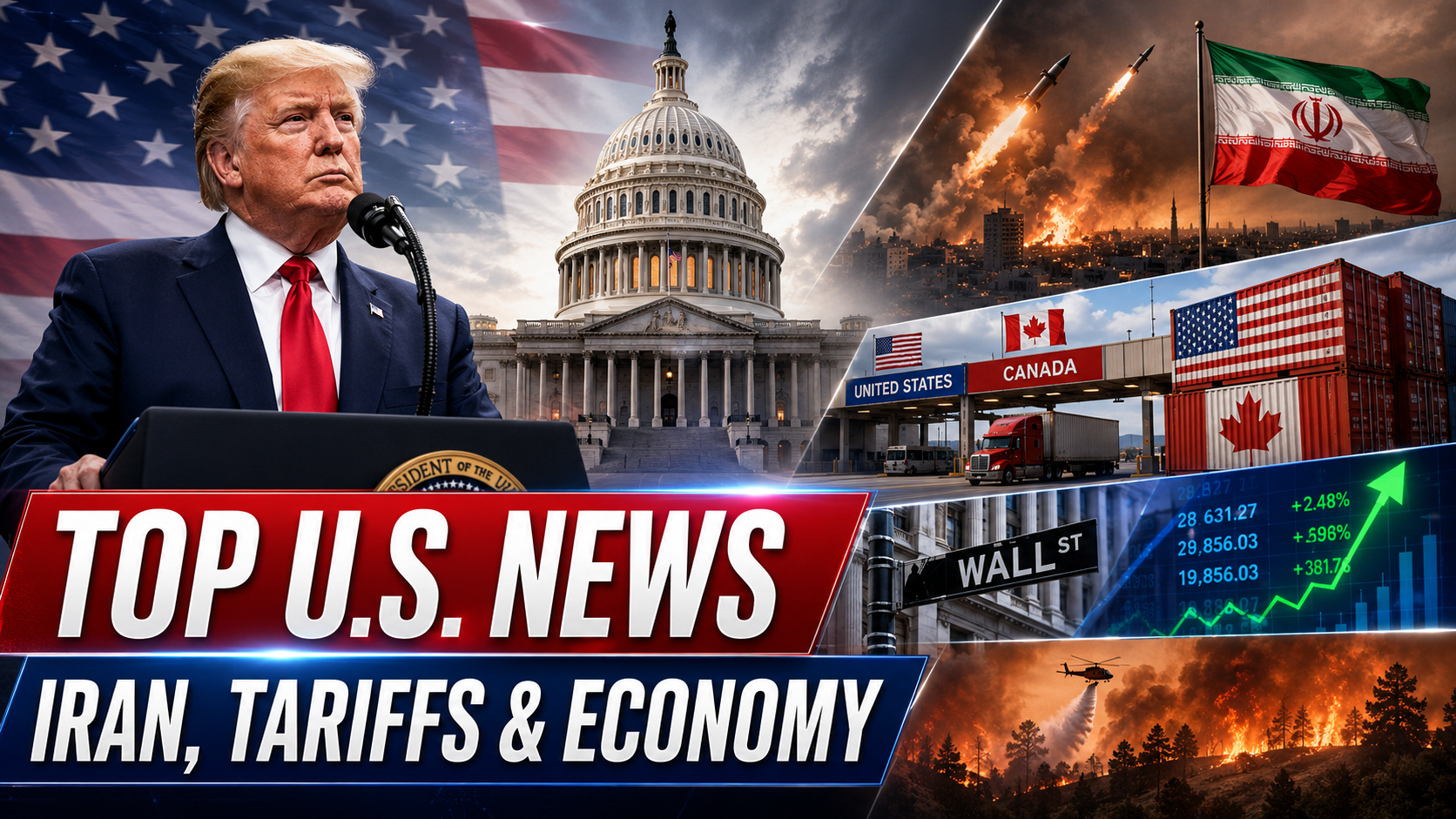
The United States is confronting a turbulent mix of military escalation, trade conflict, political gridlock, economic uncertainty and destructive summer weather.
Renewed fighting with Iran is increasing pressure on American service members, global shipping and household energy costs. Meanwhile, President Donald Trump has opened another front by announcing steep tariffs on Canadian imports. On Capitol Hill, Republican leaders are attempting to push major defense, spending and election legislation through a sharply divided House before lawmakers leave Washington.
Despite the uncertainty, Wall Street climbed Tuesday as investors returned to semiconductor and artificial-intelligence stocks. Across the country, however, millions of Americans continue to face wildfire smoke, dangerous heat and flooding.
U.S.-Iran Conflict Escalates as Diplomacy Stalls
The United States and Iran have returned to daily attacks as both countries compete for control and influence around the Strait of Hormuz, one of the world’s most important oil-shipping corridors.
An interim agreement intended to reduce the fighting has largely collapsed. The renewed hostilities have resulted in additional American military deaths, disrupted global shipping and contributed to higher oil and gasoline prices. President Trump said Tuesday that the United States currently has little interest in negotiations unless Iranian officials are prepared to engage in what he described as a meaningful way.
The conflict is also spreading beyond the Persian Gulf. Iran-backed Houthi forces have announced restrictions against shipping in the Red Sea, with several vessels reportedly changing course after receiving warnings. Disruptions in both the Strait of Hormuz and the Red Sea could place additional pressure on oil supplies, shipping costs and consumer prices worldwide.
The political consequences are growing at home. With the November midterm elections approaching, Republicans face questions about the duration of the conflict, its financial cost and whether escalating airstrikes can deliver a lasting diplomatic or military outcome.
Trump Announces 50% Tariffs on Most Canadian Goods
President Trump announced a 50% tariff on a wide range of Canadian imports, accusing Canada of discriminating against American automobile, alcohol and dairy industries.
The tariffs are scheduled to take effect in approximately 30 days, allowing time for negotiations. Energy products, potash, fish and critical minerals are expected to be excluded, but many products that were previously protected under the United States-Mexico-Canada Agreement would be affected.
Canadian Prime Minister Mark Carney said Canada remains prepared to negotiate, while Ontario Premier Doug Ford suggested the country should retaliate dollar for dollar should the tariffs move forward.
The announcement introduces another layer of uncertainty for businesses whose supply chains cross the U.S.-Canadian border. Tariffs are paid by companies importing goods into the United States, and some of those added costs may ultimately be passed to American consumers through higher prices.
The White House has also explored whether additional trade action could be taken against Canada over wildfire smoke drifting into the United States, although no separate tariff policy has been formally announced.
House Republicans Race to Advance Trump’s Agenda
Republican leaders are working to advance several major pieces of legislation before the House begins its five-week August recess.
The package includes a $1.15 trillion defense policy bill, temporary government funding through the midterm elections and a $95 billion budget resolution that could create a pathway for additional defense, intelligence, agricultural and election-related spending.
House Speaker Mike Johnson faces an unforgiving vote count. Republicans hold a 218-212 majority, meaning leadership can lose no more than two Republican votes if Democrats remain united in opposition.
Internal divisions have emerged among fiscal conservatives concerned about spending, defense-focused Republicans seeking additional military funding and lawmakers debating election requirements contained in the SAVE America Act.
One proposal would require photo identification for voting and proof of citizenship when registering. Republicans have also connected voter-identification language to legislation that would prohibit members of Congress from trading individual stocks.
Even if the House passes the measures, their future in the Senate remains uncertain.
Federal Reserve Expected to Hold Interest Rates Steady
Economists surveyed by Reuters overwhelmingly expect the Federal Reserve to leave its benchmark interest rate unchanged at its July 28-29 meeting.
All 104 economists participating in the survey predicted that rates would remain within the current 3.50% to 3.75% range. Most also expect no change through the end of 2026. However, a growing number believe the probability of another rate increase has risen because inflation remains above the Fed’s 2% target and renewed Middle East fighting has pushed oil prices higher.
For American households, the Fed’s position means borrowing costs for mortgages, credit cards, vehicles and business financing could remain elevated. Consumers hoping for significant interest-rate relief may have to wait longer, particularly if higher fuel and transportation costs reignite inflation.
Semiconductor Stocks Lead Wall Street Rally
Wall Street moved higher Tuesday despite the Iran conflict and the threat of a new U.S.-Canada trade battle.
The Dow Jones Industrial Average gained 0.72%, the S&P 500 rose 0.88% and the Nasdaq Composite increased 1.39%. Semiconductor stocks powered much of the rally, with the Philadelphia Semiconductor Index rising 5.5%.
Investors are looking toward upcoming earnings reports from Alphabet, Intel and Texas Instruments for evidence that corporate investment in artificial intelligence, cloud infrastructure and advanced chips remains strong.
The rebound demonstrates the unusual split shaping financial markets. Investors remain enthusiastic about AI-related growth, even as war, tariffs, oil prices and inflation create significant risks for the wider economy.
Wildfire Smoke, Western Fires and Texas Flooding Continue
Communities across the country are also recovering from an intense combination of weather emergencies.
Wildfire smoke has spread across portions of the Midwest, Northeast and Mid-Atlantic, while firefighters battle dozens of large fires across the western United States. More than 100 million Americans were recently placed under some level of air-quality alert as smoke from fires in Canada and the United States moved across major population centers.
Texas Hill Country has experienced catastrophic flooding after some locations received more than 27 inches of rain. Hundreds of rescues were conducted, roads were damaged and at least two deaths were reported. Nearly one trillion gallons of water fell across three heavily affected Texas counties over approximately three days.
Meteorologists say the region’s steep terrain, shallow soil and narrow river systems can cause water levels to rise with little warning. Although scientists caution against attributing one individual storm entirely to climate change, warmer air can hold more moisture and create conditions capable of producing heavier rainfall.
What Comes Next
The coming days could determine whether several of these crises deepen or begin to stabilize.
Congress must decide whether Republican leaders can unite their narrow majority. Washington and Ottawa have several weeks to negotiate before the Canadian tariffs are scheduled to begin. Investors will examine technology earnings for clues about the strength of the AI economy, while the Federal Reserve prepares for its July policy meeting.
The largest uncertainty remains the U.S.-Iran conflict. Continued attacks could increase military casualties, further restrict global shipping and push energy prices higher. That would connect the foreign-policy crisis directly to inflation, household expenses and the political battle heading toward the midterm elections.
Sources and Full Links
- Associated Press: U.S.-Iran conflict and national political updates
https://apnews.com/article/08d075c3d9cd01653b99149a8dd51adb - Associated Press: Trump announces 50% tariffs on Canadian goods
https://apnews.com/article/trump-canada-50-tariff-autos-alcohol-cheese-ca268ef24992b16695954c4c2e5eae6a - Reuters: House Republicans face major legislative test
https://www.reuters.com/legal/government/us-house-republicans-face-major-test-passing-trump-priorities-august-break-looms-2026-07-21/ - Reuters: Economists expect the Federal Reserve to hold rates steady
https://www.reuters.com/world/fed-hold-rates-this-year-despite-high-inflation-economists-cite-high-chances-2026-07-21/ - Reuters: Wall Street rallies as semiconductor stocks recover
https://www.reuters.com/business/wall-st-futures-gain-iran-ceasefire-hopes-earnings-focus-2026-07-21/ - Reuters: Smoke, fires and flooding threaten communities across the United States
https://www.reuters.com/business/environment/smoke-fire-floods-us-faces-triple-extreme-summer-weather-threats-2026-07-17/ - Associated Press: Texas Hill Country flooding and rescue operations
https://apnews.com/article/texas-floods-climate-e3e46b001ea1bf687d909134e80ed7e3