
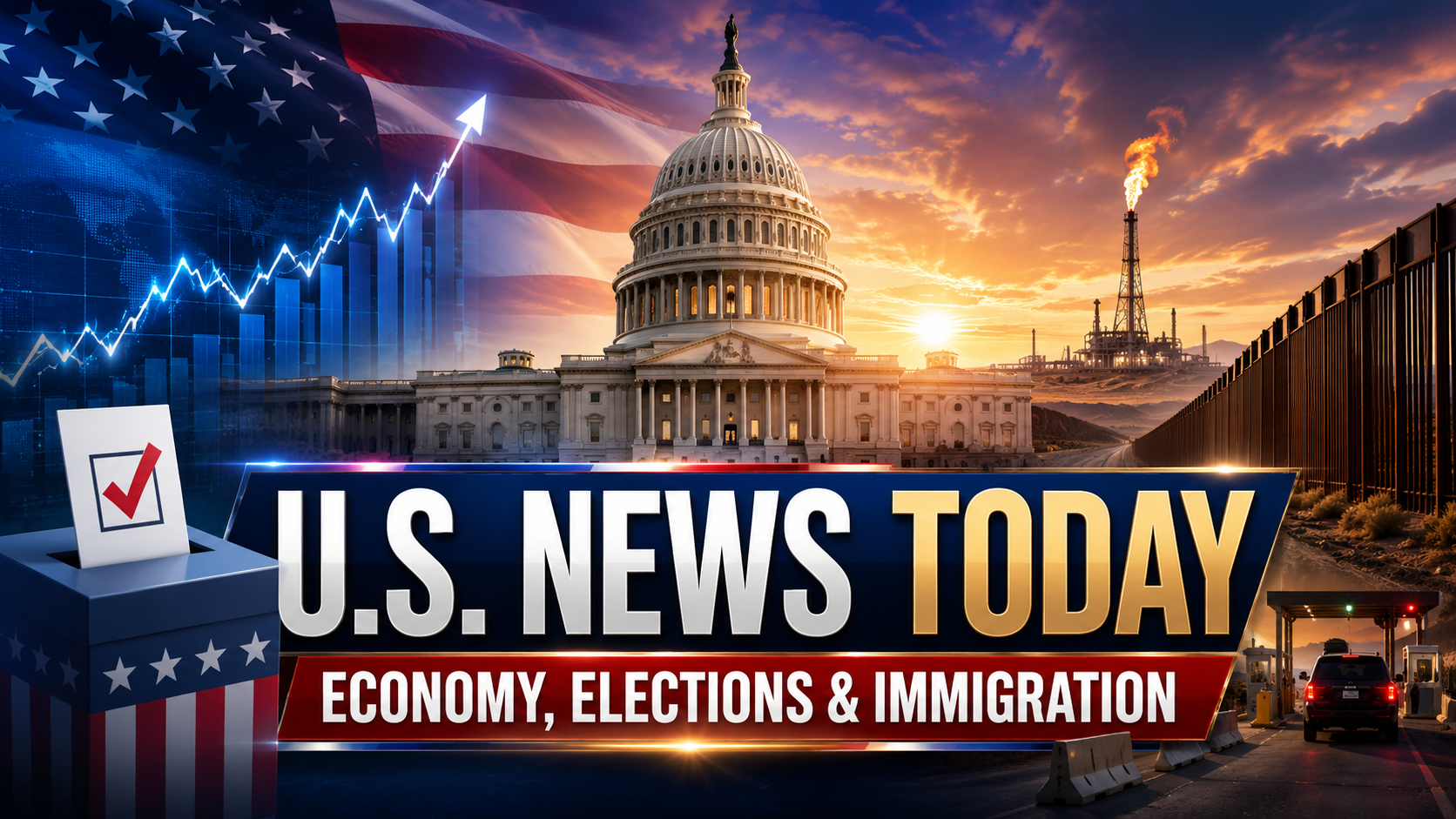
U.S. News Today: Oil, the Economy, Immigration and the Midterms Shape the National Conversation
August 30, 2026
From a major new energy agreement involving Venezuela to intensifying legal battles over elections and immigration, the United States enters the final day of August with several stories carrying major economic and political consequences.
Here’s a look at some of the biggest developments shaping the country today.
U.S.-Venezuela Oil Deal Takes Center Stage
One of the weekend’s biggest stories is a sweeping new energy arrangement between the United States and Venezuela.
The Trump administration says the agreement will give the U.S. access to enormous Venezuelan oil reserves through a new partnership involving 17 oil fields. Venezuela’s interim President Delcy Rodríguez described the agreement as a 25-year plan aimed at rebuilding the country’s struggling petroleum industry.
According to reporting from Reuters and The Associated Press, the arrangement could involve tens of billions of barrels of oil and significant U.S. participation in future production. Supporters see the deal as a potential way to expand global energy supplies and eventually ease pressure on fuel prices.
There are still major questions surrounding financing, infrastructure, legal authority and how quickly additional oil could actually reach the market. Venezuela’s energy infrastructure has suffered from years of underinvestment and instability, meaning any major increase in production could take considerable time.
Iran Conflict Continues to Affect American Consumers
The U.S. conflict with Iran has now stretched into its sixth month, and its consequences are increasingly being felt beyond the battlefield.
Oil disruptions and uncertainty surrounding shipping through the Strait of Hormuz have contributed to higher energy costs. Those increases can work their way through the economy in the form of more expensive gasoline, airline travel, shipping and consumer goods.
An Associated Press analysis published Sunday found that the economic impact has been uneven. Financial markets have recovered from earlier declines, while many consumers continue to face higher transportation and energy expenses.
For Washington, that creates a difficult equation: foreign-policy decisions abroad are colliding with one of voters’ most immediate concerns at home, the cost of living.
Treasury Secretary Heads Into Major G20 Test
U.S. Treasury Secretary Scott Bessent is preparing for a consequential G20 gathering in Asheville, North Carolina, with trade tensions, sanctions, global debt and the Iran conflict hanging over the meeting.
The administration is expected to push other countries to reduce economic ties with Iran while also defending its tariff strategy and advocating for changes in global trade.
The talks arrive during an unusually sensitive period for financial markets. Long-term U.S. government borrowing costs have drawn attention, federal debt has surpassed $40 trillion, and major economies remain concerned about trade restrictions and global financial stability.
Federal Reserve Keeps Inflation in Focus
The Federal Reserve is also giving Americans another reason to watch the economy closely.
Fed Chair Kevin Warsh signaled at the Jackson Hole economic symposium that policymakers remain concerned about inflation and could take further action if price pressures fail to move sustainably toward the central bank’s 2% target.
Markets reacted cautiously to his comments, with investors weighing the possibility that interest rates could remain elevated or potentially move higher.
The next major economic test will be fresh U.S. employment data. Recent government revisions showed that job growth between March 2025 and March 2026 was slightly weaker than previously reported, adding to concerns about a cooling labor market.
For everyday Americans, the combination matters. Persistent inflation can keep borrowing expensive, while slower hiring could make businesses and households more cautious heading into the fall.
Election Battles Intensify Ahead of November Midterms
With the November 2026 midterm elections approaching, voting rules are becoming an increasingly important political and legal battleground.
The Trump administration has pushed for stronger citizenship verification requirements while raising concerns about noncitizen voting. Election officials and voting experts cited by The Associated Press say illegal noncitizen voting is rare and have challenged some of the data being used to support broader claims of widespread problems.
At the same time, courts continue to wrestle with proposed restrictions involving mail-in ballots.
A federal judge recently blocked key portions of a U.S. Postal Service rule connected to President Trump’s executive order on mail voting. The administration has appealed the decision, leaving states and election officials facing continued uncertainty as ballot deadlines approach.
Expect election rules, voter access, immigration and the economy to remain tightly intertwined as campaigning accelerates through September and October.
Immigration Enforcement Remains a Major Flashpoint
Immigration policy remains another dominant national issue.
The Associated Press reports that the administration deported dozens of people to the Central African Republic on Saturday, including an Afghan man whose family members had assisted U.S.-backed forces in Afghanistan.
Attorneys and advocacy organizations have raised concerns about deportations to third countries, particularly in cases involving migrants who argue that returning to their country of origin could place them in danger.
Separately, ICE arrests reached nearly 50,000 in July, according to data analyzed by the Deportation Data Project and reported by AP. More than half of those arrested reportedly had neither criminal convictions nor pending criminal charges.
The administration argues its expanded enforcement program is necessary to strengthen immigration law and border security. Critics continue to challenge the tactics, scale and legal implications of the crackdown.
Border Wall Construction Creates Tribal Sovereignty Dispute
Another border dispute is unfolding in Arizona, where construction has begun on a section of border wall near the Tohono O’odham Nation.
Federal officials say the project will close a security gap along a corridor associated with smuggling. Tribal leaders, however, accuse contractors and federal authorities of improperly entering tribal territory and say construction threatens culturally and spiritually significant land.
The conflict is now about more than immigration. It also raises questions about federal power, Native American sovereignty and control of land along the U.S.-Mexico border.
Meanwhile in Texas, the federal government has agreed to extend a temporary pause on border construction in and around Big Bend National Park until mid-September while legal challenges continue.
A Different Kind of Headline: Music Raises Millions for Women’s Organizations
Not every national story this weekend is rooted in Washington.
Singer Olivia Rodrigo's Daisy Chain Fields festival in Irvine, California, brought together a women-led lineup while raising millions of dollars for organizations focused on women and girls.
The Associated Press reports that the initiative generated $20 million, including a $10 million commitment from Melinda French Gates' Pivotal Ventures.
The event offered an example of entertainment, philanthropy and youth engagement intersecting on a national stage.
What to Watch Next
September is arriving with no shortage of pressure points.
The next U.S. employment report could significantly influence expectations for Federal Reserve policy. The administration will face international scrutiny at the G20. Courts will continue dealing with election and immigration disputes. Energy prices will remain closely connected to events in Iran and Venezuela.
And hovering over nearly everything is the November midterm election.
For Americans, the big question may be less about any single headline and more about how these stories converge. Energy policy affects prices. Foreign conflicts affect household budgets. Immigration policy moves into the courts. Economic anxiety moves into elections.
As summer gives way to fall, Washington is moving into what could be one of the most consequential political and economic stretches of 2026.
Sources & Full Links
Associated Press — What we know about the U.S.-Venezuela oil agreement
Read the full AP report
Reuters — Venezuela says U.S. energy deal will last 25 years
Read the full Reuters report
Associated Press — Economic impact of six months of the Iran war
Read the full AP report
Reuters — U.S. Treasury faces G20 diplomacy test
Read the full Reuters report
Reuters — Fed Chair Warsh discusses inflation and rates
Read the full Reuters report
Reuters — U.S. employment benchmark revision
Read the full Reuters report
Associated Press — Noncitizen voting claims and the 2026 midterms
Read the full AP report
Reuters — Judge blocks mail-in voting restrictions
Read the full Reuters report
Associated Press — Deportations to the Central African Republic
Read the full AP report
Associated Press — ICE arrests reach nearly 50,000 in July
Read the full AP report
Associated Press — Arizona border wall and Tohono O’odham Nation dispute
Read the full AP report
Associated Press — Big Bend border construction pause extended
Read the full AP report
Associated Press — Olivia Rodrigo benefit festival raises $20 million
Read the full AP report