
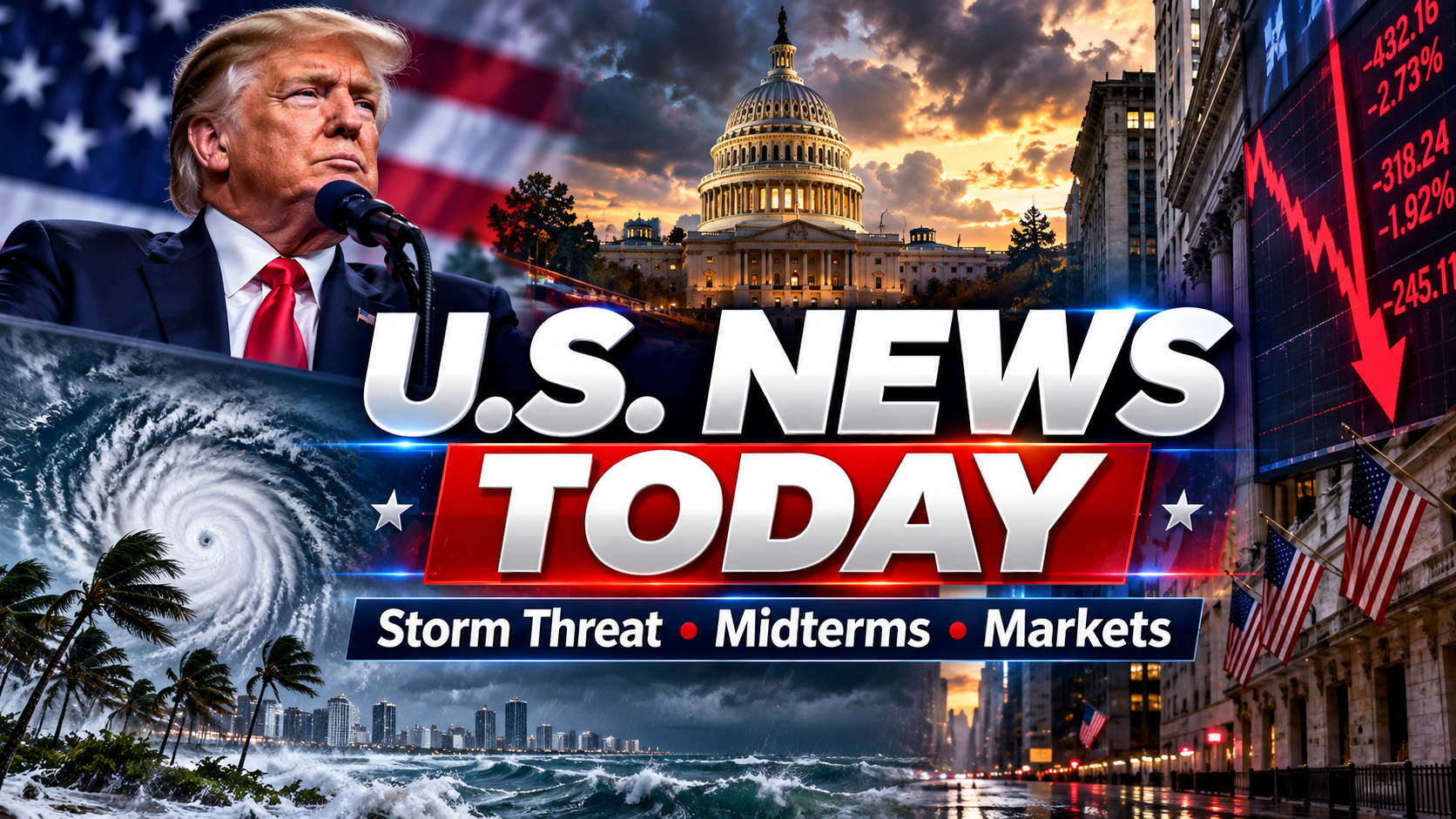
U.S. News Update: Gulf Storm Threatens Coast as Midterm Pressure and Economic Concerns Intensify
October 7, 2026
The United States is facing a fast-moving mix of political, economic and weather-related developments Wednesday as a tropical storm takes aim at the Gulf Coast, President Donald Trump campaigns in an unexpectedly competitive Texas, oil prices climb above $100 a barrel and millions of Americans begin receiving new Medicare rebate payments.
At the same time, concerns are growing over the ability of the nation's campaign finance regulator to enforce federal election law with the November 3 midterm elections less than a month away.
Tropical Storm Isaias Takes Aim at Gulf Coast
Tropical Storm Isaias formed Wednesday over the Gulf of Mexico and is forecast to strengthen into the first Atlantic hurricane of the 2026 season, potentially ending one of the latest starts to a hurricane season in more than a century.
The National Hurricane Center issued a hurricane watch along the northern Gulf Coast from Bay St. Louis, Mississippi, to Indian Pass in the Florida Panhandle. Forecasters expect the system to strengthen Thursday before approaching the U.S. coast, with landfall possible late Friday or early Saturday.
As of Wednesday, Isaias had maximum sustained winds of 45 mph. The storm could bring dangerous winds, storm surge and significant rainfall. Forecasts call for 3 to 6 inches of rain across portions of the Gulf Coast, with isolated totals reaching 10 inches.
Florida Gov. Ron DeSantis declared a state of emergency for 25 counties in the Panhandle and Big Bend region, allowing the state to mobilize emergency personnel and equipment ahead of the storm.
Trump Heads to San Antonio as Texas Becomes a Midterm Battleground
President Donald Trump is making his third trip to Texas in a month, campaigning Wednesday in San Antonio as Republicans fight to protect what has traditionally been one of their strongest political states.
Trump is scheduled to appear at the Freeman Coliseum with Republican Senate candidate Ken Paxton, who is facing Democrat James Talarico.
A Siena College poll released October 3 showed Talarico leading Paxton 51% to 45% among likely voters. Trump won Texas by 14 percentage points in the 2024 presidential election, highlighting how dramatically the political environment has shifted heading toward the November 3 midterms.
The stakes extend beyond Texas. Republicans are trying to preserve their Senate majority while defending competitive House seats across the country.
A Reuters/Ipsos poll completed Monday placed Trump's approval rating at 32% among registered voters, while Democrats led Republicans 44% to 37% in congressional voting preference. Economic concerns, particularly higher prices and the continuing war with Iran, have emerged as major issues for voters.
Trump's rally in San Antonio is part of a broader campaign push through Republican-leaning states including Oklahoma, Alabama, Ohio and Nebraska.
Oil Above $100 Puts Pressure on Wall Street
Economic concerns intensified Wednesday as oil prices climbed again.
Brent crude rose to about $101.87 per barrel, while U.S. West Texas Intermediate traded around $89.66. Markets are balancing multiple risks, including Middle East conflict, tight global energy supplies and the approaching storm in the Gulf of Mexico.
U.S. crude inventories also unexpectedly declined by 3.2 million barrels during the week ending October 2, adding another layer of pressure to energy markets.
Wall Street pulled back from record highs as investors reacted to rising energy costs and Treasury yields.
At 11:26 a.m. Eastern time, the Dow Jones Industrial Average was down 1.06%, while the S&P 500 had fallen 0.57% and the Nasdaq Composite was down 0.67%.
Long-term borrowing costs are another concern. The yield on the 30-year U.S. Treasury briefly reached 5.68%, its highest level since 2002.
Investors are also watching the Federal Reserve closely after policymakers raised interest rates in September. The market broadly expects the Fed to leave rates unchanged at its October meeting, although another increase later in the year remains possible.
$90 Medicare Payments Begin, But Millions Are Excluded
Millions of Medicare beneficiaries are also beginning to receive a new one-time $90 payment from the federal government.
The Trump administration says approximately 20.8 million people enrolled in original Medicare Part B qualify. Most eligible recipients are expected to receive the money automatically through direct deposit around Friday, while others will receive Treasury checks later this month.
But the program covers fewer than one-third of Medicare beneficiaries.
Approximately 35 million Medicare Advantage enrollees are excluded, along with about 12 million lower-income older adults and people with disabilities whose premiums are already assisted through other programs.
The payments are being funded with roughly $2 billion from the Medicare Improvement Fund.
Supporters say the money offers some relief as Americans deal with higher healthcare, food and energy expenses. Critics argue that a one-time payment only weeks before the midterm elections does little to address the underlying cost of healthcare.
No application is required for eligible beneficiaries.
Federal Election Commission Effectively Sidelined Ahead of Midterms
Another major issue is quietly developing in Washington.
The Federal Election Commission currently has only two of its six commissioner positions filled, leaving the agency without the four members required to conduct many of its most important functions.
That means the FEC cannot currently open enforcement investigations, impose fines, approve new rules or issue formal legal guidance to campaigns.
According to CBS News, the commission has been unable to fully perform those duties since May 2025.
The timing is significant because political advertising spending for the 2026 election cycle is projected to reach approximately $11.6 billion, potentially making it the most expensive election cycle in U.S. history.
The FEC's enforcement backlog has reportedly grown from 154 cases to 307 cases in roughly a year.
Republican and Democratic lawmakers alike have sought guidance from the commission on issues ranging from artificial intelligence and election misinformation to campaign spending. Without a quorum, however, the agency has been unable to formally act on many of those requests.
The situation leaves one of the federal government's principal election watchdogs largely unable to enforce campaign finance laws just weeks before voters determine control of Congress.
The Bigger Picture
October is quickly becoming a pressure point for the country.
A potentially dangerous Gulf hurricane threatens communities and energy infrastructure. Oil above $100 is feeding new concerns about household costs and inflation. Financial markets are wrestling with higher interest rates and borrowing costs. And an increasingly competitive midterm election is putting political pressure on races that once appeared predictable.
For Americans, many of these stories eventually meet at the same place: the cost of living.
Gasoline, healthcare, borrowing costs and household expenses are becoming increasingly intertwined with the political debate heading into November. With Election Day less than four weeks away, economic conditions and events beyond Washington could have as much influence on voters as campaign speeches themselves.
Sources
Associated Press: Tropical Storm Isaias forms and threatens the U.S. Gulf Coast
Reuters: Trump makes third Texas trip as Republicans defend longtime stronghold
Reuters: S&P 500 and Nasdaq retreat as yields and oil climb
Reuters: Oil rises as investors weigh supply threats
Associated Press: Trump's $90 Medicare rebate rolls out
CBS News: FEC unable to enforce campaign finance law weeks before Election Day