
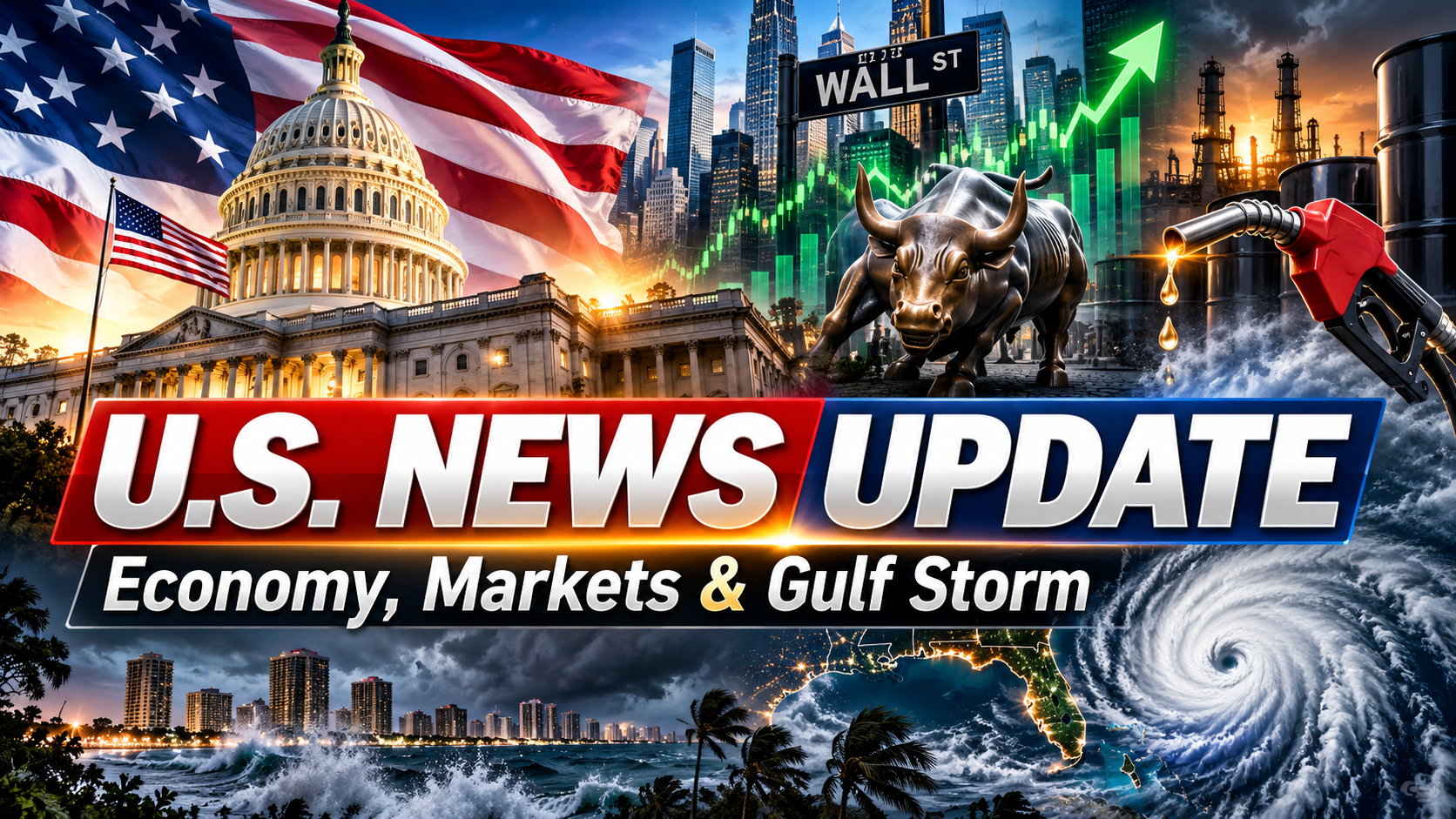
U.S. News Update: Trade Deficit Surges, Wall Street Hits Records, Gulf Storm Develops and Major Maryland Shipyard Announced
October 6, 2026
The United States closed Tuesday with major developments across the economy, financial markets, energy, weather, national defense and the approaching midterm elections.
The latest numbers paint a complicated picture. American consumers and businesses continue to spend, Wall Street is setting records, and billions of dollars are flowing into new domestic manufacturing. At the same time, high energy prices, a widening trade deficit and growing voter concerns over the cost of living remain major pressure points.
U.S. Trade Deficit Jumps to $105.6 Billion
The U.S. goods and services trade deficit widened sharply in August, increasing 13.7% to $105.6 billion, according to new data released Tuesday by the Bureau of Economic Analysis and Census Bureau.
Imports climbed 4.3% to a record $420.8 billion, while exports increased 1.4% to $315.2 billion. Capital-goods imports also reached a record $146.4 billion, reflecting strong demand for semiconductors, machinery and equipment connected in part to the continuing artificial-intelligence infrastructure expansion.
Despite the large monthly increase, the trade deficit for the first eight months of 2026 remained nearly 20% below the comparable period in 2025.
The numbers underline a curious tension in the economy: demand remains strong enough to pull in record imports, but that same import growth can subtract from U.S. gross domestic product calculations.
Wall Street Climbs to New Records
Investors delivered another strong session Tuesday.
The S&P 500 gained 0.6% to 7,818.93, setting a new record. The Dow Jones Industrial Average rose 253 points to 51,521.28, while the Nasdaq climbed 0.4% to 27,599.79, extending its own record run.
Technology and energy-related optimism continued to drive markets, while falling bond yields provided additional support. The Nasdaq is now up nearly 19% in 2026, according to Associated Press market data.
The market strength presents another economic split-screen: investors continue betting on corporate earnings and AI-driven expansion even as households contend with elevated fuel, housing and consumer costs.
Energy Prices Remain a Major Pressure Point
The U.S. Energy Information Administration raised its global oil-price outlook Tuesday as Middle East disruptions continue to affect petroleum markets.
The agency now expects Brent crude to average about $105 per barrel during the fourth quarter, $14 higher than its previous forecast.
U.S. gasoline averaged about $4.35 per gallon in September, while diesel averaged $6.29 per gallon. The EIA expects retail diesel prices to remain above $6 per gallon during October before gradually declining.
There is somewhat better news for many households heading into winter. Homes primarily heated with natural gas or propane are expected to spend less than last winter, while households relying on electricity or heating oil could pay more.
Energy costs are becoming increasingly important economically and politically as Americans prepare to vote in November.
Developing Gulf Storm Could Become Hurricane
Attention is also turning toward the Gulf.
A tropical system strengthening Tuesday was designated Tropical Depression Nine, with forecasters expecting it to intensify as it moves toward the northern Gulf Coast.
The system is expected to move north of Mexico's Yucatán Peninsula before approaching the U.S. Gulf Coast late this week, with Louisiana and Mississippi among the areas being closely watched. Forecasters said the cyclone could become the first Atlantic hurricane of the 2026 season before reaching the coast.
The storm could have consequences beyond wind and rain. Roughly 15% of U.S. crude-oil production and about 5% of natural-gas production comes from offshore Gulf facilities, while the Gulf Coast is home to roughly half of U.S. refining capacity.
Residents along the northern Gulf Coast should continue monitoring National Hurricane Center forecasts because the storm's exact track and intensity could still change.
Maryland Lands $3.7 Billion High-Tech Shipyard
Maryland is getting one of Tuesday's largest domestic manufacturing announcements.
Defense technology company Anduril Industries plans to invest $3.7 billion in a new high-tech shipyard at Sparrows Point near Baltimore.
The facility is expected to create approximately 3,100 jobs and manufacture components for the Navy's Virginia-class nuclear-powered attack submarines.
Anduril has also received a $2.9 billion U.S. Navy contract, bringing the potential combined value of the investment and related contract to as much as $6.6 billion.
The project is expected to become operational by the end of the decade and represents a broader push to strengthen American shipbuilding and defense-manufacturing capacity.
Early Voting Begins as Midterm Battle Intensifies
The political calendar is moving quickly toward Election Day on November 3.
Early voting began Tuesday in Ohio, where several closely watched congressional races could help determine control of Washington.
One of the highest-profile contests features Democratic former Senator Sherrod Brown attempting a return to the Senate against Republican Jon Husted. Two competitive House races are also attracting national attention.
First-day voting figures from Medina County showed Democrats casting more early ballots than Republicans, although a single day of turnout is far too limited to predict the final result.
Interviews with voters showed that inflation, gasoline prices, the economy and the continuing U.S. conflict with Iran are weighing heavily on the electorate.
Supreme Court Faces Growing Emergency Caseload
The Supreme Court is also beginning a consequential new term.
Justice Samuel Alito said the growing number of emergency appeals reaching the court is concerning, but argued that the justices have limited ability to slow the flow of urgent cases.
Emergency petitions have increasingly placed the Supreme Court at the center of disputes involving executive authority, elections and other major federal policies, sometimes before cases have gone through the traditional full appeals process.
The Bigger Picture
Tuesday's news reflects an American economy and political system pulling in several directions at once.
Markets are booming and major industrial investments are moving forward. Yet Americans continue facing high fuel prices and persistent inflation concerns. Strong domestic demand is helping businesses but also pushing imports to record levels. Meanwhile, a potentially significant Gulf storm is developing just as the country enters the final weeks of a closely contested midterm election season.
October is shaping up to be anything but quiet.
Sources
1. U.S. Bureau of Economic Analysis — U.S. International Trade in Goods and Services, August 2026
Full BEA source link
2. U.S. Census Bureau — International Trade Report
Full Census Bureau source link
3. Reuters — U.S. Trade Deficit Widens as Imports Hit Record High
Full Reuters source link
4. Associated Press — U.S. Stock Indexes Reach Records
Full AP source link
5. U.S. Energy Information Administration — October Short-Term Energy Outlook
Full EIA outlook link
6. U.S. Energy Information Administration — Winter Fuel Costs
Full EIA release link
7. National Hurricane Center — Atlantic Tropical Weather Outlook
Full National Hurricane Center source link
8. Reuters — Maryland Defense Shipyard Investment
Full Reuters source link
9. Reuters — Ohio Early Voting and the 2026 Midterms
Full Reuters source link
10. Associated Press — Justice Alito on Supreme Court Emergency Appeals
Full AP coverage link