
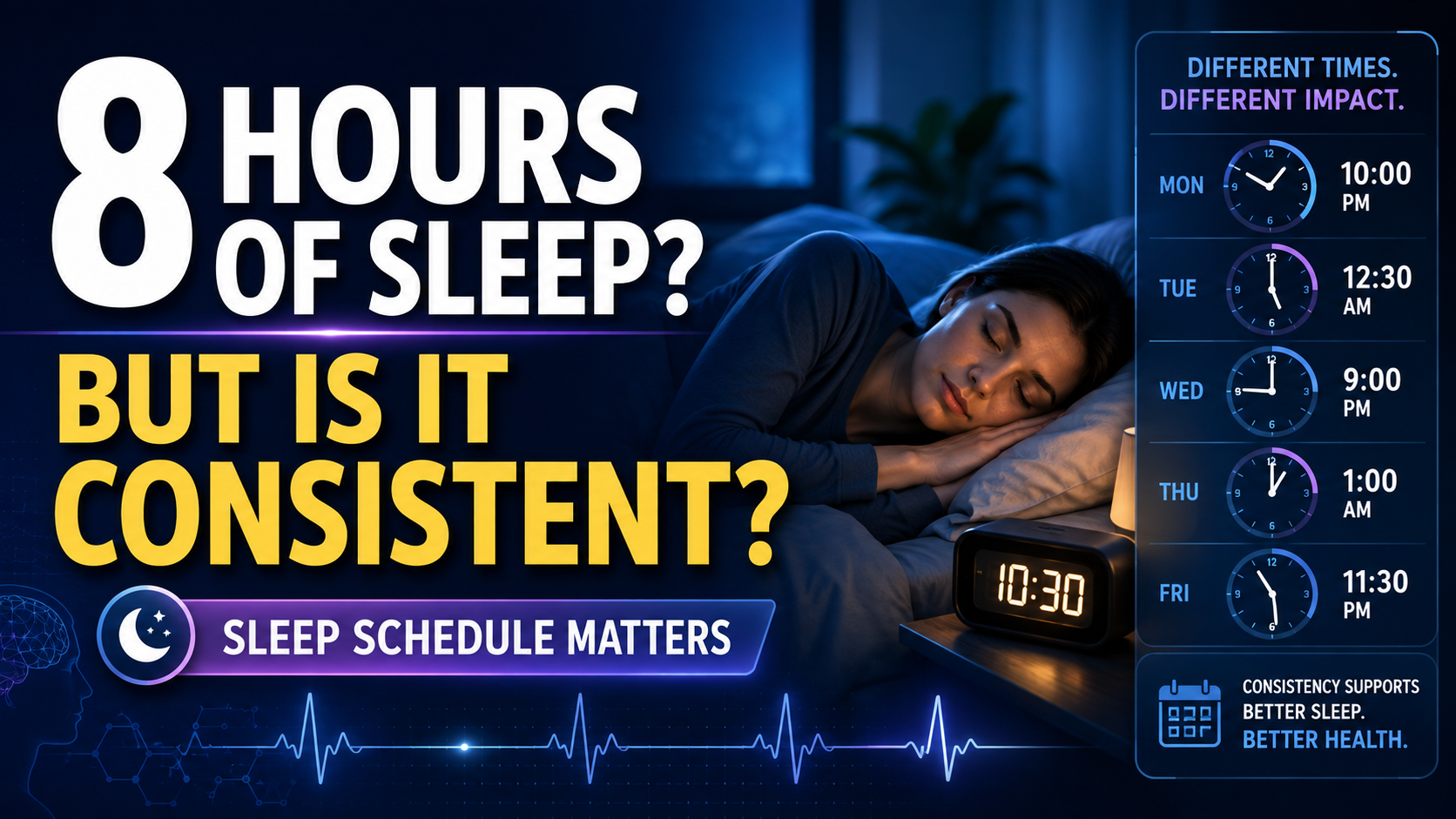
You’re Getting 8 Hours. But Is Your Sleep Schedule Consistent?
Most conversations about sleep begin with one question:
How many hours did you get?
But researchers are increasingly looking at another question:
How consistent is your sleep schedule?
Getting enough sleep is still important. The CDC recommends adults ages 18–60 get at least seven hours of sleep per night. But emerging research suggests that regularly changing when you go to sleep and wake up may also matter for long-term health.
What Researchers Found
A study published in the Journal of Epidemiology & Community Health followed 72,269 adults from the UK Biobank.
Participants wore wrist accelerometers that allowed researchers to measure their sleeping patterns. They were then followed for nearly eight years.
The result was striking.
People classified as having the most irregular sleep patterns had a 26% higher risk of major adverse cardiovascular events compared with people who had regular sleep schedules.
Those events included heart attack, heart failure and stroke.
Even more interesting, simply getting the recommended number of hours of sleep did not completely eliminate the increased cardiovascular risk among the most irregular sleepers.
That doesn't mean irregular sleep directly causes heart disease. This was an observational study, so researchers found an association rather than proving cause and effect.
But it adds to a growing body of evidence.
Another Study Followed More Than 60,000 People
Researchers analyzing another group of 60,977 UK Biobank participants calculated something called the Sleep Regularity Index, or SRI.
Instead of simply measuring total hours asleep, the index measures how consistently someone is asleep or awake at approximately the same times from one day to the next.
Researchers followed participants for an average of more than six years.
Compared with the people who had the least regular sleep patterns, people in the four more regular groups experienced approximately 20% to 48% lower risk of death from any cause, depending on their level of sleep regularity.
The researchers also found that sleep regularity was a stronger predictor of mortality risk than sleep duration in their statistical models.
Again, this does not mean sleeping at exactly 10:03 every night guarantees better health.
It does suggest that sleep health may be more complicated than simply hitting an eight-hour target.
Why Would Consistency Matter?
Our bodies operate using internal biological clocks known as circadian rhythms.
These rhythms help regulate sleep, alertness and other physiological processes throughout the day.
Researchers studying sleep regularity suggest that constantly changing sleep and wake times may contribute to circadian disruption. Irregular timing can also change when people are exposed to light, eat meals or exercise, all signals that interact with the body's internal clock.
Think about the difference between:
Schedule A
Monday: 10:30 p.m.
Tuesday: 10:45 p.m.
Wednesday: 11:00 p.m.
and:
Schedule B
Monday: 10:30 p.m.
Tuesday: 1:30 a.m.
Wednesday: 11:00 p.m.
Thursday: 2:00 a.m.
Both people could technically average a similar amount of sleep.
Their patterns, however, are very different.
That difference is what researchers are beginning to investigate more closely.
What Can You Actually Do?
The good news is that improving sleep regularity doesn't require buying a $400 sleep gadget or turning your bedroom into a laboratory. 😂
The CDC recommends several basic habits that support better sleep:
Keep your bedtime and wake-up time consistent.
Going to sleep and waking up around the same time each day gives your body a more predictable rhythm.
Reduce screens before bed.
The CDC recommends turning off electronic devices at least 30 minutes before bedtime.
Be careful with late caffeine.
Caffeine in the afternoon or evening can interfere with sleep.
Create an environment that makes sleep easier.
A quiet, relaxing and comfortably cool bedroom can help support better sleep.
Pay attention to persistent sleep problems.
If you regularly struggle to fall asleep, stay asleep or remain exhausted despite getting enough sleep, the CDC recommends discussing it with a healthcare provider.
The Bigger Lesson
For years, sleep advice has largely focused on one number:
7 to 9 hours.
That remains important.
But science is increasingly showing that sleep has several dimensions: duration, quality, timing and regularity.
You may get eight hours tonight.
But if those eight hours constantly move around the clock, researchers are beginning to ask whether your body experiences that sleep differently.
The emerging message is simple:
Don't only ask how long you slept. Pay attention to when you sleep too.
Sometimes better health isn't about doing something dramatic.
It may start with giving your body a little more predictability.
Sources
Journal of Epidemiology & Community Health — Sleep regularity and major adverse cardiovascular events: a device-based prospective study in 72,269 UK adults
https://jech.bmj.com/content/79/4/257
PubMed — Sleep regularity and major adverse cardiovascular events
https://pubmed.ncbi.nlm.nih.gov/39603689/
SLEEP / Oxford Academic — Sleep regularity is a stronger predictor of mortality risk than sleep duration
https://academic.oup.com/sleep/article/47/1/zsad253/7280269
PubMed — Sleep regularity is a stronger predictor of mortality risk than sleep duration
https://pubmed.ncbi.nlm.nih.gov/37738616/
Centers for Disease Control and Prevention — About Sleep